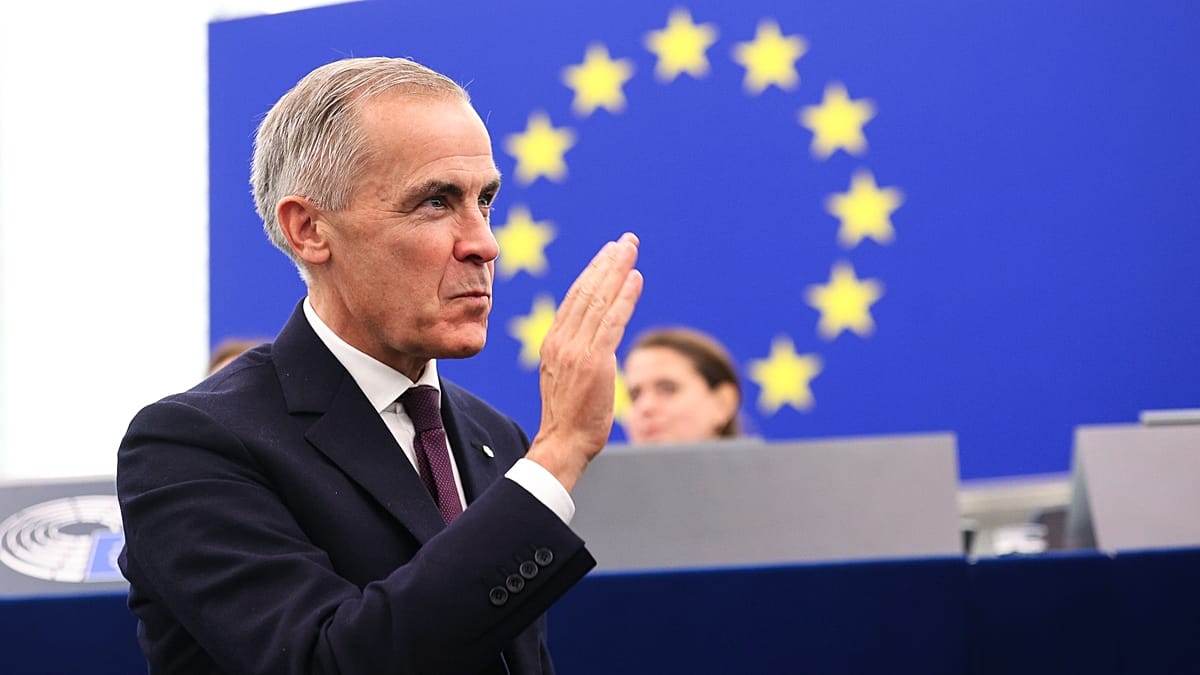
Brussels has pushed back against US President Donald Trump's characterization of a proposed EU-Canada partnership as a hostile act, insisting the initiative is about mutual strength, not confrontation. The exchange comes as Canadian Prime Minister Mark Carney prepares to address the European Parliament on Thursday morning, where he is expected to lay out a vision for a deeper and broader relationship between Ottawa and the 27-member bloc.
European Commission President Ursula von der Leyen formally invited Canada to become the EU's first-ever "associate member" on Wednesday, a novel concept with no legal precedent and many unanswered questions. The proposal has already drawn sharp criticism from Washington, with Trump threatening "very serious tariffs" on European goods if the plan moves forward.
"I think it's laughable," Trump told reporters, dismissing the idea as a provocation. But the Commission responded swiftly, issuing a statement that sought to lower the temperature: "The proposed strengthening of our partnership with Canada is not against anyone else, but for our common strength."
The spat underscores the growing transatlantic friction over trade and geopolitical alignment. For Brussels, the associate membership is part of a broader strategy to diversify partnerships and reduce reliance on traditional allies, particularly as Washington's trade policies have become more unpredictable. The proposal has already drawn tariff threats from the US, but EU officials insist the move is not aimed at undermining American interests.
What would associate membership mean?
The concept of associate membership is still being defined. Unlike full EU membership, which requires years of negotiations and the adoption of the entire acquis communautaire, associate status would likely offer Canada a privileged partnership in specific policy areas, such as trade, research, and education. Canada is already a member of the EU's Horizon Europe research programme and has been in talks to join the Erasmus+ student exchange scheme, as reported earlier.
European Parliament President Roberta Metsola has defended the plan, arguing that it represents a natural evolution of the EU-Canada relationship. "Canada shares our values and our commitment to rules-based international order," she said ahead of Carney's speech. The Canadian prime minister is expected to echo that sentiment, framing the partnership as a win-win for both sides.
However, the lack of a clear legal framework raises questions about how associate membership would work in practice. Would Canada gain access to the EU's internal market beyond the existing Comprehensive Economic and Trade Agreement (CETA)? Would it have a seat at EU decision-making tables? These are details that negotiators would need to hammer out, and the process could take years.
European industry sees opportunity
For European businesses, the prospect of closer ties with Canada is largely welcome. Canada's vast natural resources, skilled workforce, and stable political environment make it an attractive partner, particularly in sectors like clean energy, technology, and critical minerals. Analysts suggest that Canada's EU pivot could open new doors for European companies seeking to diversify supply chains away from Asia and the US.
But the political calculus is delicate. Trump's tariff threats are a reminder that the EU's overtures to Canada are being watched closely in Washington. The Commission's insistence that the move is "not against anyone" is an attempt to de-escalate, but it may not be enough to assuage a president who has repeatedly used tariffs as a tool of coercion.
Carney's speech at the European Parliament is being closely watched not only for its content but also for its tone. Will he strike a conciliatory note toward the US, or will he align more firmly with Europe? His remarks could set the stage for a new chapter in transatlantic relations, one where the EU and Canada are closer than ever—and where Washington's influence is correspondingly diminished.
As the debate unfolds, one thing is clear: the concept of associate membership, once a fringe idea, is now at the centre of European and North American geopolitics. Whether it becomes a reality depends on the willingness of all parties to navigate the legal, political, and economic complexities ahead.