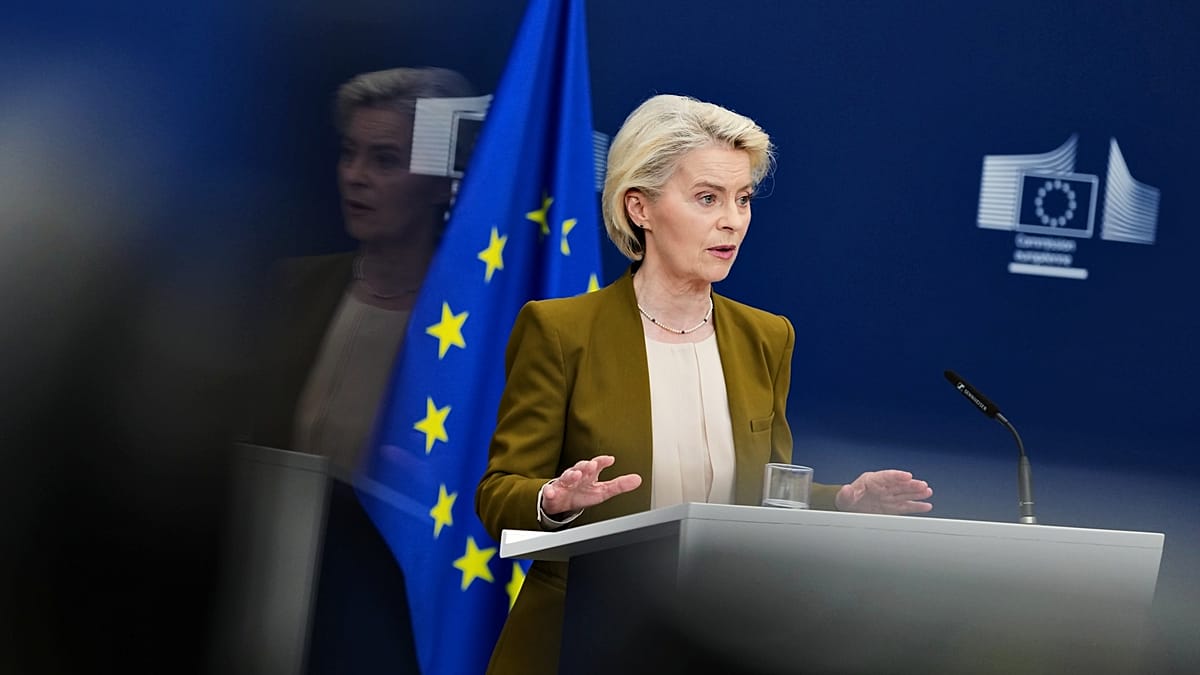
When European Commission President Ursula von der Leyen unveiled the blueprint for the EU's 20th sanctions package against Russia in early February, she made maritime services the centrepiece. The proposed full ban on providing shipping, insurance, and related services to Russian crude oil tankers was meant to slash Moscow's energy revenues and complicate its oil sales. Yet, just months later, the measure lies in political limbo, a victim of internal divisions, external indifference, and market upheaval.
From price cap to full ban: an unfinished agenda
The EU's original ambition, dating back to 2022, was to pair its import ban on Russian crude with a prohibition on maritime services, thereby cutting off Western support for Moscow's oil exports. However, soaring inflation and energy prices at the time prompted the Biden administration to push for a price cap instead, allowing services to continue if oil sold below $60 per barrel. The G7 adopted that mechanism in December 2022, but enforcement proved weak. Russia's shadow fleet, a motley collection of aging tankers, evaded Western oversight, while fluctuating oil prices and the absence of Chinese and Indian participation undermined the cap's effectiveness.
By early 2025, Brussels concluded that the price cap had outlived its usefulness and that a full ban was the logical next step. Von der Leyen's proposal, however, came with a crucial caveat: she tied its implementation to G7 coordination, a condition that would soon prove fatal.
The G7 hurdle and market turmoil
The G7 link, inherited from the price cap era, raised the bar beyond the Commission's control. Donald Trump's administration, which took office in January, showed no interest in the price cap or any joint sanctions initiative with Europe. The G7 blessing was thus unlikely, and the Commission quickly backtracked, with Economy Commissioner Valdis Dombrovskis insisting that a G7 deal was not an "absolute precondition." Most member states agreed, viewing G7 support as a plus, not a necessity.
But then, at the end of February, the US and Israel launched strikes against Iran, the Strait of Hormuz briefly closed, and oil prices spiked. The market turmoil empowered Greece and Malta, the bloc's most sceptical voices, which host powerful maritime industries with deep ties to Russian energy trade. Cyprus shared their concerns but remained neutral while holding the EU Council's rotating presidency. The Mediterranean duo argued that a ban would hurt European economies and hand business to competitors in China and India. In closed-door talks, they threatened a veto unless the G7 signed off.
A sanction in limbo
When the 20th sanctions package was approved in April, the maritime services ban was included only in principle, with activation postponed indefinitely pending "coordination and consideration" within the G7. Commission officials insisted the legal wording was flexible, but the reservations from Athens and Valletta, combined with Washington's disinterest and silence from London, Ottawa, and Tokyo, left Brussels isolated.
By June, when von der Leyen presented the 21st package, she did not propose activating the ban—she did not even mention it. Instead, she pivoted back to the price cap, the very mechanism she had sought to replace. At the G7 summit in Évian-les-Bains, the subject was conspicuously absent.
Advocates push on, but prospects dim
Sweden and Finland, the most vocal proponents, continue to press for implementation, joined by the Baltic states, Poland, Denmark, and the Netherlands, as well as Ukraine. They argue that energy revenues are the indispensable fuel of Russia's war machine. Swedish Foreign Minister Maria Malmer Stenergard told Euronews: "Working towards a full maritime services ban is a crucial part of this effort, since it would substantially increase transportation costs and ensure that no EU entity is involved in supporting trade with Russian oil, coal or gas."
Yet the path forward remains blocked. The EU's sanctions policy, once a pillar of its response to Russian aggression, now appears hostage to internal divisions and external indifference. The bloc's broader strategy, including its navigation of US tariffs and the China trade deficit, is already fraught. The maritime services ban, a bold idea that promised to complete unfinished business, has become a symbol of the EU's struggle to act decisively on the world stage.
As the war in Ukraine grinds on, the question is whether Brussels can overcome the veto threat and market fears to revive the ban, or whether it will remain a sanction in limbo, a testament to the limits of European unity.