When news emerged in late June that Taliban representatives had visited Brussels for closed-door talks with European Union officials, Sami Samar felt a deep sense of betrayal. The former Afghan minister for women's affairs, who served from 2001 to 2002 and now lives in exile in the United States, said the meeting amounted to a quiet endorsement of a regime she describes as overseeing a "human rights disaster."
"I was so disappointed because we really count on European countries as they believe the principle of human rights and the universality of human rights," Samar told European Pulse. "This is kind of endorsement of the Taliban, even if it's low rank of the Taliban."
Her comments come just days before the fifth anniversary of 15 August 2021, when the Taliban swept into Kabul and established itself as the de facto government of Afghanistan, following the withdrawal of US troops after nearly two decades of presence. Only Russia formally recognises the Taliban regime; the EU and its member states have maintained a policy of non-recognition.
Five years of crisis
Since the Taliban took power, Afghanistan has plunged into a profound humanitarian and human rights crisis. The International Committee of the Red Cross says the situation remains among the most severe in the world. The UN Office for the Coordination of Humanitarian Affairs estimates that roughly 21.9 million people—45% of the population—will need humanitarian assistance in 2026, driven by years of armed conflict, economic fragility, underinvestment in basic services, and the rapid erosion of rights.
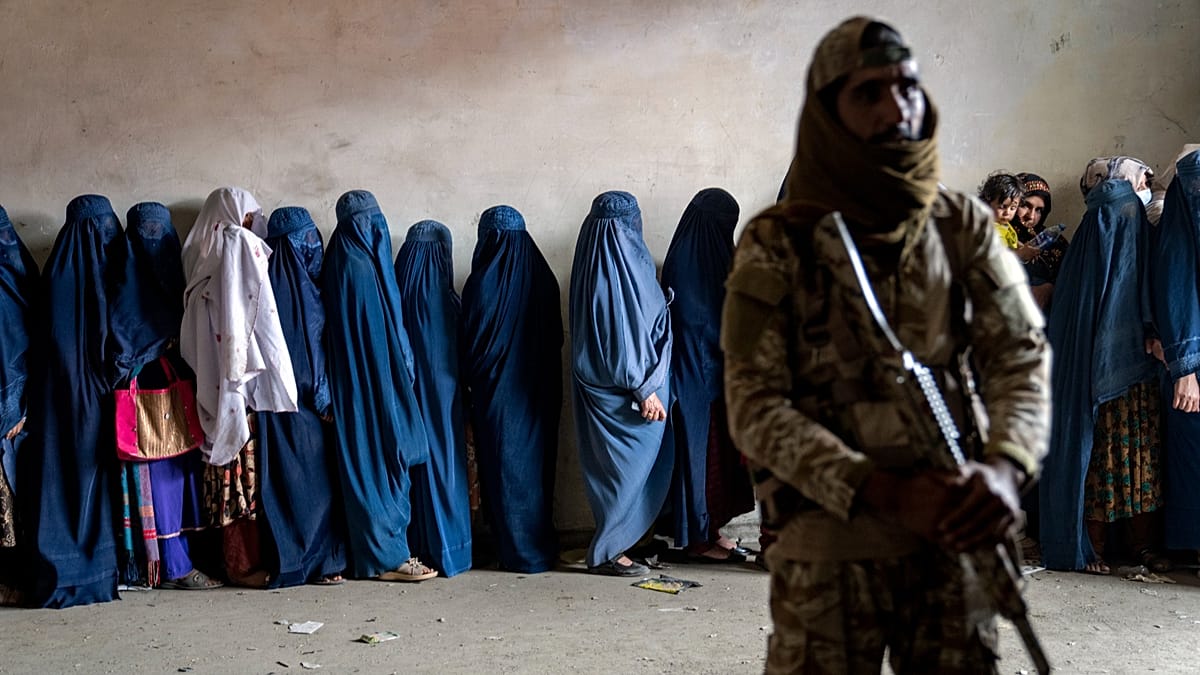
Samar, now a human rights advocate, said life has deteriorated as the Taliban's grip has tightened. "It's a human rights disaster," she said, pointing to more than 160 decrees that have systematically restricted the lives of women and girls. These include bans on girls' education beyond sixth grade, exclusion of women from universities and most workplaces, strict dress codes, and restrictions on travel without a male guardian. Human Rights Watch has described these policies as crimes against humanity through gender persecution.
"They are putting more restrictions on women's freedom and movement, and violating women's rights, including women's voice should not be heard. Can you imagine that you cannot even cry loudly?" Samar said.
The European Parliament has been vocal in its condemnation. In May, a majority of MEPs denounced the restrictions on the rights of girls, women, and minorities, as well as public floggings and executions. They also expressed "regret" over the decision to invite Taliban representatives to Brussels and called on the European Commission and member states to maintain non-recognition and non-normalisation of the regime.
EU defends operational engagement
European Commission spokesperson Anitta Hipper said on Tuesday that the EU remains "gravely concerned" about systematic human rights violations in Afghanistan. "The EU continues to call on the Afghan de facto authorities to respect, protect and fulfil the human rights and freedoms of all Afghans and to abide by Afghanistan's international obligation," she said.
Hipper noted that member states in 2021 mandated the EU executive to maintain "operational engagement" with the de facto authorities. "That being said, we do not recognise such or legitimise the authorities, but we speak with Taliban on topics that we consider our key values and interests," she added. These benchmarks include condemning human rights violations, such as gender-based discrimination, and standing ready to adopt targeted restrictive measures against those responsible.
But Samar sees a contradiction. "There is a slight, very light condemnation of the situation of human rights in Afghanistan, but then you receive their delegation quietly?" she asked. "How can we trust these partnerships?"
Migration talks draw fire
The closed-door migration talks on 23 June were conducted by officials from the European Commission and 15 member states, along with a Taliban delegation, and took place off official EU premises. The Taliban said the technical talks concerned the return of Afghan nationals without the right to stay in Europe, while the European Commission stressed they were about expediting returns of people convicted of serious crimes or considered security threats.
The talks drew fierce criticism. UN High Commissioner for Human Rights Volker Türk told European Pulse he was concerned about Afghan nationals being deported into a situation where "they may be tortured." Swedish Migration Minister Johan Forssell, however, told local media that it is "incredibly important" that such individuals are deported.
The debate over engagement with the Taliban is part of a broader European dilemma: how to balance security and migration concerns with human rights principles. Similar tensions have emerged in other contexts, such as the Ceuta border surge and its diplomatic fallout. As Europe grapples with these challenges, the fate of Afghan women and girls remains a stark reminder of the costs of pragmatic engagement.