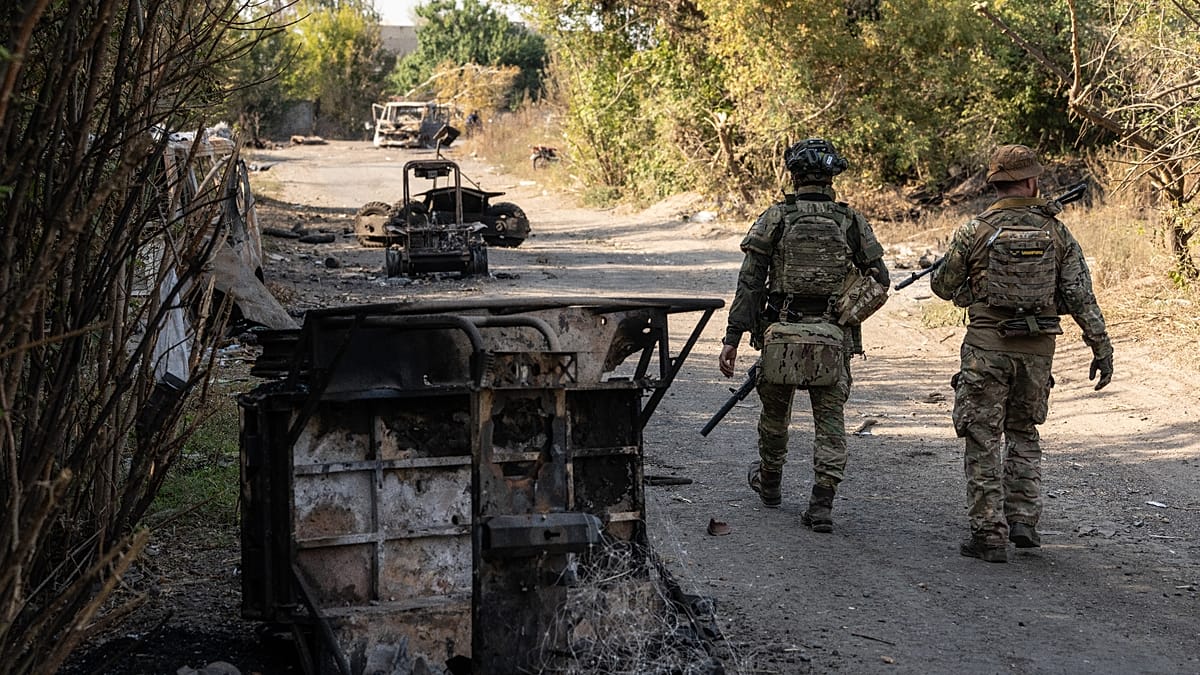
Weapons and military equipment carried back by soldiers returning from Ukraine's front line are raising fears inside the European Union that battlefield components could end up circulating across the bloc, according to a confidential EU Council document.
The paper, which examines how the war in Ukraine affects the EU's internal security, will be on the table when EU ambassadors meet on Wednesday. It states plainly that "member states have reported weapon components and military equipment in the possession of returning combatants."
While the document does not directly tie those individuals to organised smuggling networks, it argues that the discoveries reveal a potential risk that military parts and other battlefield gear could be moved from Ukraine into EU territory.
A widening security debate
The concern is not confined to Russian fighters. It also covers Ukrainians coming home from the front, especially in member states that host large Ukrainian refugee populations, among them Germany, Poland and Czechia. Authorities in those countries stress that the problem is European in scope because they sit inside Schengen, and that soldiers reuniting with their families are unlikely to sell their weapons through legal channels.
In recent months, several EU governments have pushed to keep former and active Russian combatants out of the bloc, citing the threat of sabotage and hybrid attacks on European soil. That visa ban was folded into the 21st sanctions package, but it was diluted after objections from France and Italy.
At an informal gathering of foreign ministers earlier this month, the EU's foreign policy chief, Kaja Kallas, said there was "broad support" for pressing ahead with the measure. Her remarks followed an attempted drone attack in Leipzig in which one suspect reportedly entered the Schengen area on a tourist visa issued by Italy.
Estonia, meanwhile, has launched an intelligence-sharing initiative with other countries on the so-called eastern flank to coordinate entry refusals against identified Russian combatants, based on judicial or administrative rulings.
The Council document warns that "foreign fighters, either volunteers or mercenaries, continue to pose a risk, as they acquire military skills and experience that could be further exploited once they withdraw from the conflict zone to engage in criminal activities or terrorism."
Tracking the weapons trail
A March report by the Global Initiative Against Transnational Organized Crime found no substantial flow of weapons from Ukraine into neighbouring countries at present, but described weapon circulation as a structural risk that requires sustained attention.
Kyiv has already set up a National Firearms Focal Point that provides Europol with lists of seized, stolen or lost firearms. Europol, the EU's law enforcement agency, is directly involved and is due to create a dedicated Firearms Hub by the first quarter of 2027 to sharpen analysis and data-sharing on confiscated weapons.
Ukraine is also expected to adopt a dedicated roadmap on firearms trafficking by the end of this year, modelled on one already used in the Western Balkans. Specific benchmarks on the issue have been written into Ukraine's accession negotiations.
Frontex, the EU's border agency, has issued detailed instructions to border guards and customs authorities on firearm diversion, with a particular focus on Ukraine.
The discussions come amid a broader push by Kyiv to keep EU sanctions policy aligned with its security priorities, as Ukraine warns the EU against political delistings from the Russia sanctions regime. European leaders have also been weighing diplomatic tracks, including Emmanuel Macron's talks with Donald Trump on Ukraine and the Red Sea.
For now, the confidential document makes clear that the EU sees the return of battle-hardened fighters and their equipment as a security question that will not fade as the war continues — and one that requires coordination across all 27 member states.