The European Union is reinforcing its maritime security operations in the Red Sea as reports emerge that Iran has asked its Houthi proxies to prepare to close the Bab el-Mandeb strait. The narrow waterway, roughly 30 kilometres wide at its narrowest point, separates Yemen from Djibouti and Eritrea and is a critical chokepoint for global trade, carrying 10 to 15 percent of the world's maritime commerce, including a substantial share of Europe's oil and gas imports.
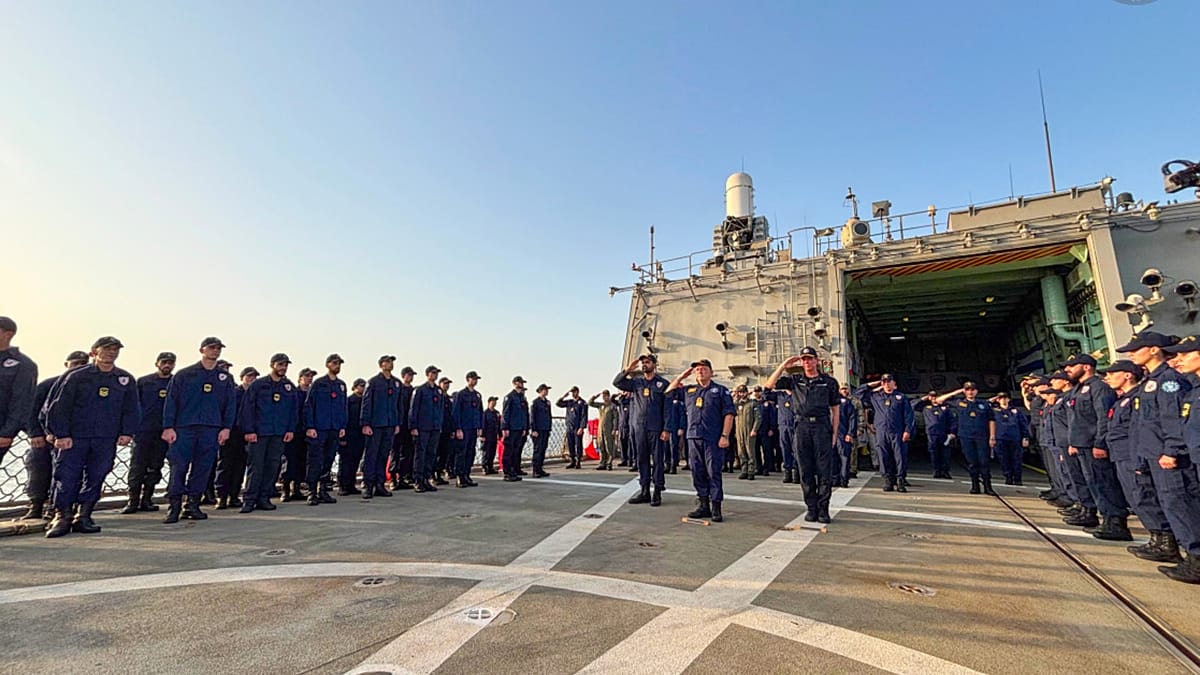
EU High Representative for Foreign Affairs and Security Policy Kaja Kallas concluded a visit to Djibouti on Thursday, where she signed a new Status of Forces Agreement with the Djiboutian government for Operation Aspides, the EU's defensive naval mission in the region. She also visited the crews of both Aspides and the older Operation Atalanta, which originally focused on countering Somali piracy.
“Maritime security is under growing pressure,” Kallas told journalists in Djibouti. “Iran's repeated attacks on commercial vessels transiting the Strait of Hormuz are unravelling the interim agreement with the United States, while the situation in the Red Sea is once again deteriorating.”
A Second Chokepoint Under Threat
The visit coincided with reports that Tehran has requested the Ansar Allah movement, commonly known as the Houthis, to be ready to shut the Bab el-Mandeb if the United States strikes Iranian infrastructure. Such a closure would force vessels to reroute around the Cape of Good Hope, adding two to three weeks to journeys between Asia and Europe and sharply increasing shipping costs.
The Houthis launched their Red Sea campaign in October 2023, declaring solidarity with Hamas during the war in Gaza and targeting vessels they alleged had Israeli connections. The campaign drove a roughly 50 percent drop in commercial traffic through the Red Sea between late 2023 and early 2024, forcing dozens of major shipping companies to reroute around Africa. The group paused most attacks after the US-brokered Israel-Hamas ceasefire in October 2025 but has since announced its readiness to resume them if conditions change.
“Seeing our sailors at work reminds me and reminds all of us that the freedom of navigation cannot be taken for granted. It must be protected every single day,” Kallas told Djiboutian officials.
Djibouti, which hosts military bases for more than half a dozen countries — including the United States, France, China, Japan, Italy, and Germany — has been a key partner for the EU. Kallas noted that the new agreement “ensures maintaining access to and support for our ships and air assets for as long as they are needed.”
Economic Consequences for Europe
If the Bab el-Mandeb were to be choked off, the cost would be borne by European homes and businesses. The Strait of Hormuz, another vital maritime artery, remains closed, and any additional disruption would compound supply chain pressures. “When shipping is threatened, supply chains disrupted, prices rise, and families and businesses feel the consequences far beyond this region,” Kallas said. “That is why today's agreement matters. It's about more than supporting European operations. It's about keeping one of the world's economic lifelines open together.”
EUNAVFOR Aspides, launched in February 2024, is a purely defensive mission covering the Red Sea, Gulf of Aden, Arabian Sea, and Gulf of Oman. It does not conduct strikes on land targets. Over the last two years, it has safeguarded more than 670 merchant ships and saved 128 seafarers, Kallas said. Operation Atalanta, established in December 2008, has been broadened to encompass broader maritime security in the western Indian Ocean.
The EU's moves come as the bloc continues to strengthen its defence posture across multiple domains. The EU Defence Commissioner has backed a military mobility plan with a 2028 deadline, and the EU defence chief has urged negotiations as Ukraine gains a military edge. These efforts reflect a broader push to secure European interests in an increasingly volatile geopolitical environment.