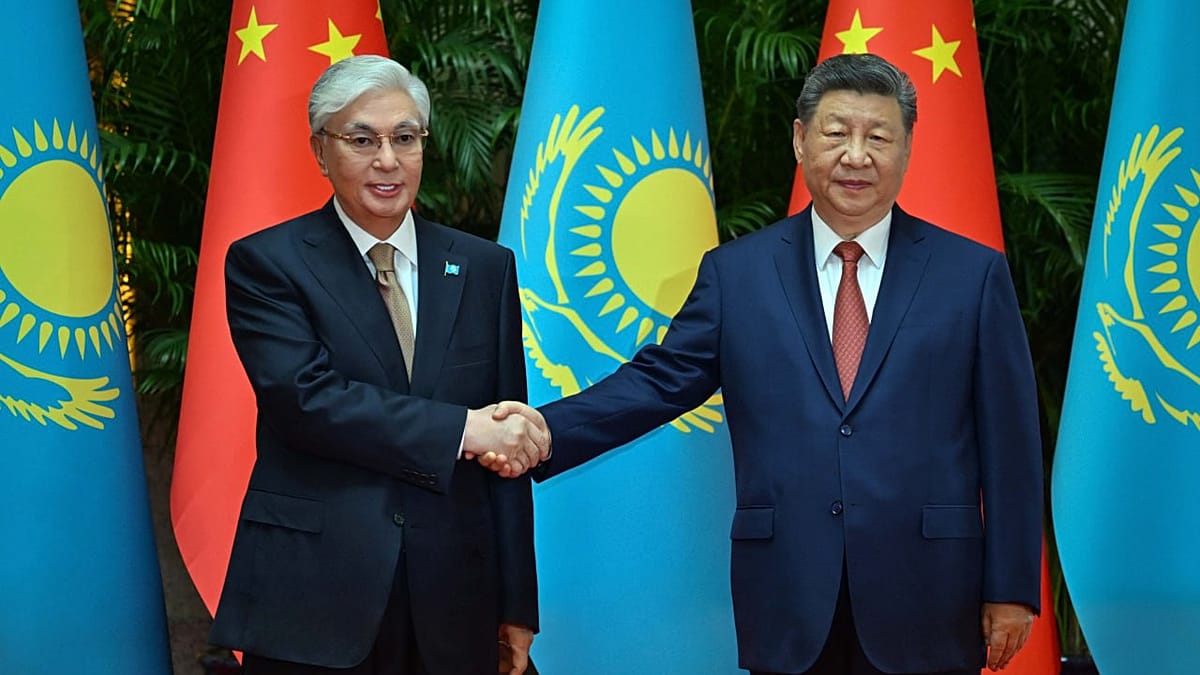
Chinese President Xi Jinping and Kazakhstani President Kassym-Jomart Tokayev signed more than 70 commercial agreements worth over €11.4bn during talks in Shanghai, with Xi declaring that bilateral relations had reached a "new level." The deals, announced on the sidelines of the World Artificial Intelligence Conference, span energy, manufacturing, logistics, and digital infrastructure, underscoring Beijing's deepening economic footprint in Central Asia.
"Thanks to our joint efforts, the permanent comprehensive strategic partnership between China and Kazakhstan has reached a new level. There is still considerable room for further development," Xi said. Trade between the two countries now stands at €42.8bn annually, with cumulative Chinese investment in Kazakhstan exceeding €26.2bn. More than 8,500 Chinese-backed companies operate in the country, making Beijing Astana's largest trading partner.
Tokayev, in turn, pledged a favorable environment for Chinese investors. "Our country is always ready to provide a business environment for Chinese investors. We guarantee legal protection for investments, modern infrastructure and a skilled workforce," he said.
Flagship Projects: Batteries, Petrochemicals, and Hydropower
Among the headline agreements is the construction of Central Asia's first battery manufacturing plant, developed in partnership with Chinese electric vehicle battery giant CATL. The facility is part of broader cooperation with Chinese automakers. Other major projects already under way include a petrochemical complex with Sinopec, a corn processing plant with Fufeng Group, and a cotton-textile cluster with Lihua Group.
Kazakhstan and China also agreed to jointly develop the country's first pumped-storage hydropower plant in the Kargaly River valley in the Almaty region, a project that will bolster renewable energy capacity.
Logistics as a Strategic Advantage
Kazakhstan handled roughly 85% of rail freight between China and Europe last year, a position Tokayev said he wanted to turn into a strategic advantage. "Kazakhstan should become the main transport and logistics hub connecting China with Central Asia, the Caucasus, the Middle East and Europe," he said.
The country is connected to 13 international transport corridors and has invested more than $35bn in transport infrastructure over the past 15 years. Two new projects aim to expand capacity further. The Bakty-Ayagoz railway line will open an additional rail crossing on the Kazakhstani-Chinese border. At Kuryk Port on the Caspian Sea, China's Guoyou Materials Group plans to build a multifunctional terminal with an annual capacity of 15 million tonnes. Kazakhstan and China also discussed establishing a joint venture to dredge the Caspian to maintain the port's depth and utility.
On the digital side, Kazakhstan is developing a Smart Cargo platform to integrate customs, logistics, and commercial operations into a single digital system. Tokayev also highlighted Alatau City, a new urban development built on a "Digital by Default" model featuring smart transport and digital payment infrastructure.
Tokayev used the AI conference setting to declare technology a national priority. "Today, it is no longer enough to rely on natural resources. Competitiveness is determined by technology, data and artificial intelligence," he said. Kazakhstan recorded a 27-million-tonne grain harvest, which Tokayev attributed in part to the spread of precision farming, drone monitoring, and satellite crop management. More than 200 agricultural enterprises now operate as smart farms.
The deepening ties come as the European Union reassesses its approach to China. In a recent development, EU ministers labeled China a 'critical long-term strategic challenge', while the bloc has signaled possible unilateral trade measures against China before an October deadline. For European policymakers, Kazakhstan's pivot toward Beijing—and its ambition to become a key transit hub for China-Europe trade—carries significant implications for supply chains and geopolitical alignment in Central Asia.