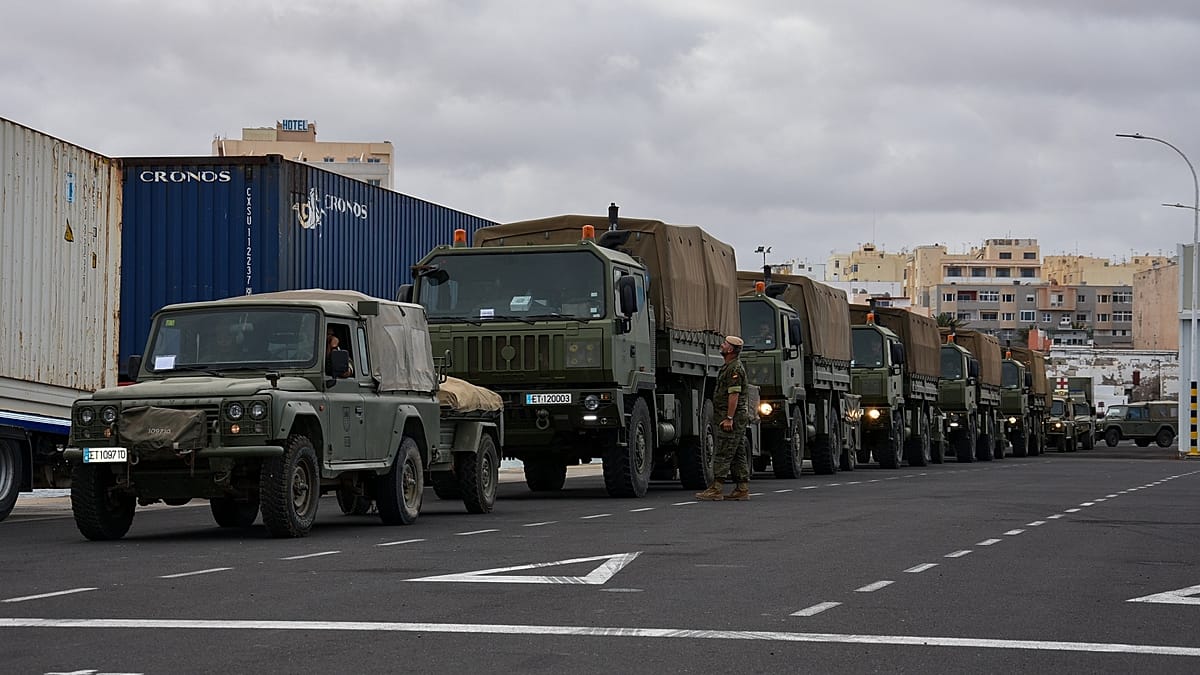
This month, the European Union is putting its military ambitions to the test in the fields of Zaragoza, Spain. The MILEX 26 exercise, hosted at the San Gregorio Training Centre, brings together around 2,500 troops from 13 member states to assess the bloc's Rapid Deployment Capacity (RDC) — a key initiative aimed at strengthening the EU's ability to respond to crises beyond its borders.
Spain is the lead nation for the exercise, contributing more than 1,600 of the deployed personnel. The core unit is the EU Battlegroup (EUBG26), under Spanish command, with the Canary Islands Brigade XVI providing the bulk of the force. The drills are designed to test coordination at strategic, operational, and tactical levels, from Brussels to the ground in Aragón.
From the Canary Islands to the Mainland
One of the most complex logistical challenges of MILEX 26 has been the transfer of troops and equipment from the Canary Islands to the mainland. The deployment is unfolding in five phases, moving personnel, vehicles, and military hardware by sea and air. The task force includes Infantry Regiment Soria No. 9, a Portuguese Army company, and units specializing in artillery, engineering, nuclear-biological-chemical defence, unmanned aerial vehicles, military police, canine teams, and signals.
Among the assets on display are Leopard 2A4 main battle tanks, Pizarro infantry fighting vehicles, reconnaissance drones, and Super Puma and AB-212 helicopters. The exercise also features dedicated medical support, force protection, intelligence and reconnaissance, information operations, and electronic warfare. Civil Guard units trained in investigations, border control, and interventions are also participating.
The drills will culminate on 18 June with a live-fire tactical demonstration before civilian and military authorities, simulating a fictional crisis scenario. Strategic command is handled by the EU's Military Planning and Conduct Capability (MPCC) in Brussels, while operational command falls to Eurocorps, deployed in Zaragoza as the force headquarters.
MILEX 26 is part of broader efforts to foster a shared strategic culture among member states and improve interoperability between national armed forces. The EU's Rapid Deployment Capacity was conceived as a flexible tool to respond to a range of crises, from natural disasters to armed conflicts, and exercises like this are essential to ensure it can function effectively.
The exercise comes at a time when the EU is seeking to bolster its defence credentials, particularly in light of ongoing geopolitical tensions. While the bloc has long relied on NATO for collective defence, initiatives like the RDC represent a push for greater strategic autonomy. The involvement of 13 member states — a significant number for a single exercise — underscores the growing willingness to cooperate on military matters.
Spain's role as host is notable given its strategic position in southern Europe and its experience in multinational operations. The country has also been a key player in other EU defence initiatives, and its unemployment rate recently hit a 17-year low, reflecting broader economic resilience. Meanwhile, the EU's six largest economies have agreed on a blueprint for a Capital Markets Union, which could further integrate financial systems and support defence spending.
For the troops on the ground, MILEX 26 is a chance to test procedures and build trust across national contingents. The exercise is designed to be demanding, with scenarios that require rapid decision-making and coordination under pressure. As the EU continues to develop its military capabilities, exercises like this will be crucial in turning political ambition into operational reality.



