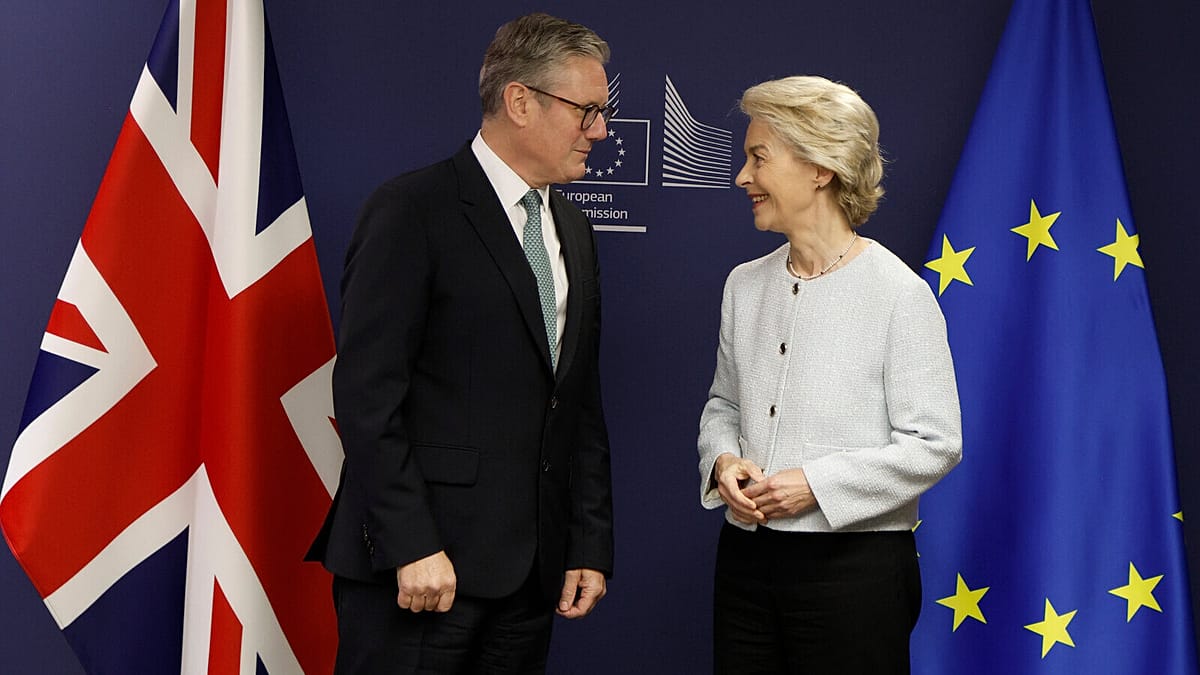
The European Commission confirmed on Monday that it is reassessing plans for a summit with the United Kingdom originally scheduled for July 22, after Prime Minister Keir Starmer announced a timetable for his resignation. The decision throws into question a key moment in the post-Brexit reset that Starmer had made a priority of his premiership.
“We are re-assessing with (European Council) President Costa and the UK the opportunity of still holding the summit as had been announced last week and we will take it from here,” said Paula Pinho, the European Commission’s chief spokesperson, in response to a question from Euronews.
The summit date had been confirmed only last week during a meeting between Starmer and European Commission President Ursula von der Leyen and European Council President António Costa on the sidelines of the G7 summit in France. It was intended to be the second such EU-UK leaders’ meeting, following the first in early 2024, and was meant to seal a series of sectoral deals aimed at mending the strained relationship since Brexit.
Starmer’s Exit Plan and the Rise of Burnham
Speaking from a podium outside 10 Downing Street on Monday, Starmer outlined a departure schedule that would see a new prime minister installed by September at the latest. However, the political landscape shifted dramatically after Andy Burnham, the former mayor of Greater Manchester, secured a convincing by-election victory in the constituency of Makerfield last Thursday, returning him to the House of Commons and positioning him as the frontrunner to succeed Starmer.
Wes Streeting, the former health minister who had been considered a potential contender, announced on Monday that he would back Burnham for prime minister, making a one-horse race highly probable. EU officials and diplomats are largely unfamiliar with Burnham, who could take office as early as July 17—just five days before the planned summit.
One EU official, speaking on condition of anonymity, suggested the summit would likely be postponed. Another source was more cautious, saying it is “too early” to speculate on next steps, which would depend on UK “domestic developments.”
The uncertainty has cast doubt on the ambitious reset that Starmer had championed. His government had been closing in on deals to bolster trade ties, integrate electricity markets, and boost youth mobility—all within the red lines of staying outside the EU Single Market and Customs Union. As Londoners reacted to Starmer’s resignation, the political mood in the capital reflected a sense of déjà vu.
While Burnham has recently promised not to “re-run” Brexit arguments, he stated last September that he would like to see the UK re-join the EU by the end of his lifetime. His stance could signal a shift in tone, but for now, Brussels is waiting to see who will be at the helm before committing to a summit.
The European Pulse will continue to monitor developments as the situation evolves. For context on the broader EU political landscape, see our coverage of Sánchez’s push for deeper integration.