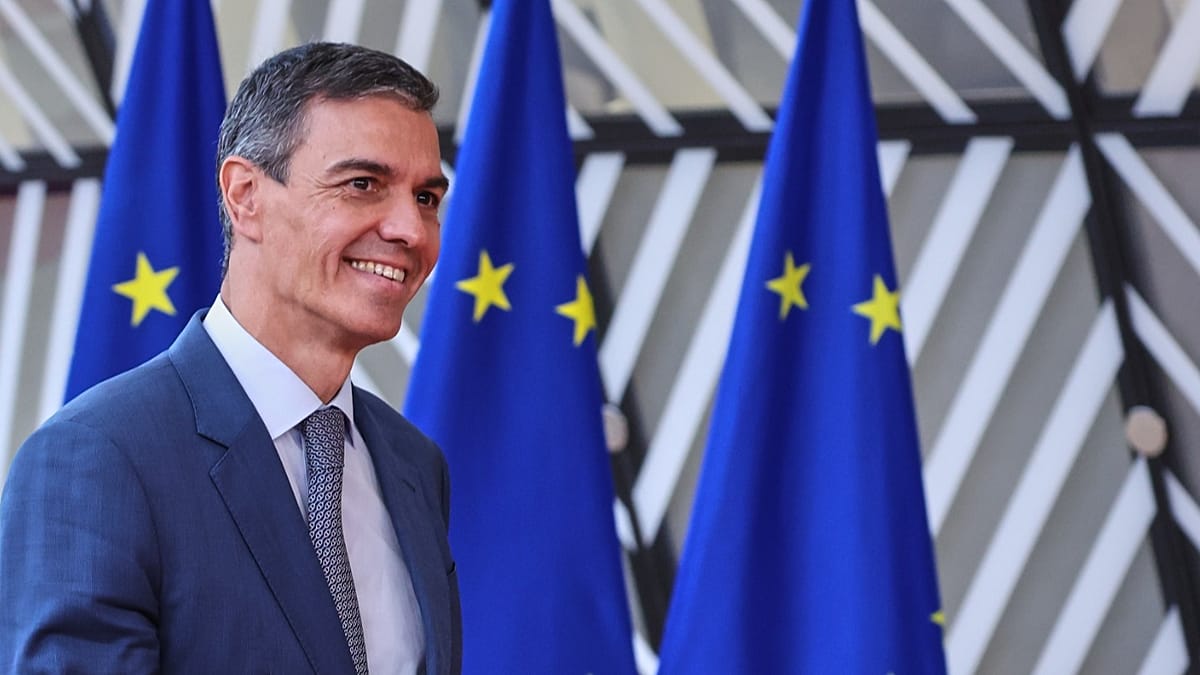
At this week’s European Council meeting in Brussels, Spain’s Prime Minister Pedro Sánchez made a forceful case for a more open and integrated Europe, urging member states to boost the bloc’s financial firepower and deepen its strategic autonomy. Speaking during discussions on the EU’s next multiannual budget and the shifting global landscape, Sánchez argued that without a more ambitious financial framework, Europe cannot become a true geoeconomic power.
A budget to match Europe’s ambitions
Sánchez stressed that the Multiannual Financial Framework must be large enough to enhance competitiveness and support greater strategic autonomy in an increasingly volatile international environment. He called for removing internal barriers and harmonising rules to deepen the single market, while also expanding trade agreements—pointing to recent deals with Mercosur, Mexico, and India as examples of an open policy that does not sacrifice European values.
This stance puts him at odds with several EU member states, particularly France, which advocate a tougher line toward China over accusations of overproduction harming European industry. Sánchez, who signed 19 bilateral agreements with Beijing in April, argued that Brussels should engage in dialogue with other regions rather than retreat into protectionism. “Europe does not need to step back from its values or its principles; it needs to take a step forward in its integration,” he said.
Migration policy: opposing return centres
On migration, Sánchez acknowledged the necessity of the ongoing debate across Europe but firmly rejected the idea of setting up return centres in third countries—a measure recently adopted in the EU’s Return Regulation and inspired by Italy’s model in Albania. He described such centres as a “smokescreen” that sends the wrong message to countries of origin and transit, implying that migration is solely their problem. His position aligns with that of French President Emmanuel Macron, as both leaders have rejected EU return hubs as ineffective and un-European.
The Spanish government’s own approach includes a controversial extraordinary regularisation measure approved in April, which could allow nearly 500,000 foreign nationals to legalise their status in Spain—a move that contrasts sharply with the stricter policies favoured by some other member states.
Solidarity with Meloni after Trump’s insult
In a notable moment of cross-party solidarity, Sánchez expressed support for Italian Prime Minister Giorgia Meloni after former U.S. President Donald Trump claimed she had “begged” him for a photo at the G7 summit in Évian, adding that he agreed only because he “felt sorry” for her. “I have expressed my solidarity in the face of this attack, which I really do not even know how to describe,” Sánchez said. The incident prompted Italy’s Foreign Minister Antonio Tajani to cancel a planned trip to the United States, calling Trump’s words “serious and offensive” and an insult to all Italians.
The exchange has fueled misinformation surges after the G7 summit, with false narratives targeting both Trump and European leaders. Sánchez’s gesture underscores the complex dynamics within the EU, where ideological differences often give way to a shared defence of dignity and respect on the international stage.
As the EU faces tough budget negotiations—with frugal states clashing with cohesion advocates—Sánchez’s call for a more open, better-funded Europe may resonate with those who see integration as the answer to global challenges. Whether his vision gains traction remains to be seen, but his message from Brussels was clear: Europe must invest in its future or risk irrelevance.