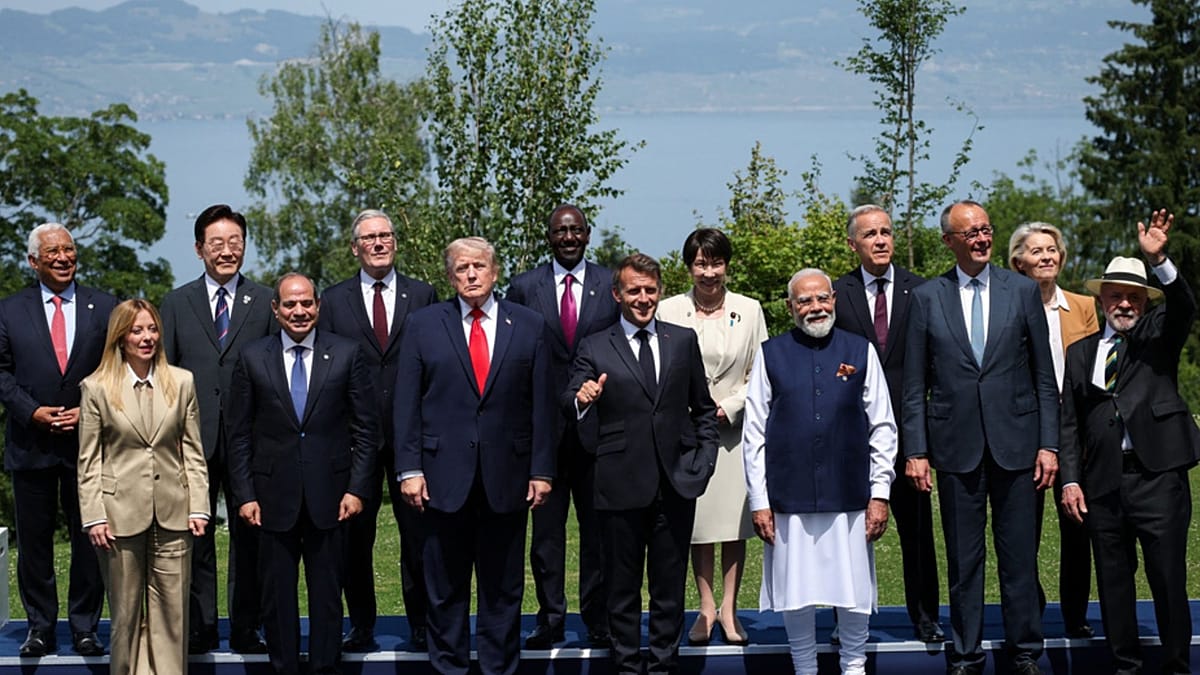
In the aftermath of the G7 summit held in Évian, France, a wave of misleading content has flooded social media platforms, targeting interactions between US President Donald Trump and European leaders. The posts, which include old video clips and decontextualized quotes, appear aimed at amplifying perceptions of a strained transatlantic relationship.
Old Clip Resurfaces with False G7 Attribution
One widely shared post claims that Trump told the G7 that “Europe has gone woke” and is “not recognisable” in many places, except for Hungary, Poland, the Czech Republic, and Slovakia. While Trump did utter those words, the footage originates from a press conference at the White House in February, not from the summit in Évian. In that earlier address, he criticized European energy and immigration policies, stating, “I want Europe to strengthen up… Europe is getting killed on two things: energy and immigration.” The clip’s background—featuring White House signage—clearly contradicts the G7 setting.
This is not the first time such claims have circulated. The Cube, Euronews’ fact-checking team, has previously debunked similar assertions about Trump’s critiques of European energy and migration policies.
Alleged Snub of Zelenskyy Lacks Evidence
Another set of posts mocks Ukrainian President Volodymyr Zelenskyy, suggesting that Trump deliberately turned his back on him during a G7 gathering. One video shows Trump pivoting to greet European Commission President Ursula von der Leyen as Zelenskyy approaches, but there is no clear evidence of intentional disregard. In fact, the two leaders met on the sidelines of the summit, with Trump describing it as a “good meeting” and calling for Russia to negotiate an end to its invasion of Ukraine. Zelenskyy later confirmed that he discussed the possibility of building Patriot interceptor systems in Ukraine during their talks.
For more on Ukraine’s engagement with European leaders, see our coverage of Zelenskyy’s arrival in Brussels as EU leaders seek to cement G7 Ukraine pledges.
Macron’s Digital Tax Remarks Stripped of Context
A third viral claim alleges that French President Emmanuel Macron declared that “it’s not the Americans or Trump who decide France’s future, nor do they decide French or European law.” While Macron did make a similar statement, it was in response to a specific question about US threats to impose 100% tariffs on French wine and champagne unless France scrapped its digital services tax. In an interview with TF1 at the G7, Macron explained that the tax—a 3% levy on digital interfaces, online advertising, and user data—was a law passed by several European countries, not a unilateral French decision. He emphasized that “it didn’t work like that” and that the US does not dictate European law, but he did not single out Trump personally.
Digital services taxes vary across Europe: Austria applies a 5% tax on online advertising, Hungary charges 7.5% on digital advertising, and other countries like Italy, Poland, Portugal, Spain, and the UK have similar measures. These interim levies target large multinational tech firms such as Google and Meta, which generate revenue from digital services without a physical presence in those markets.
For context on broader EU trade discussions, read about EU leaders tackling Ukraine, China trade imbalance, and the €2 trillion budget in Brussels.
Pattern of Misinformation Undermines Transatlantic Trust
The spread of these misleading posts reflects a broader trend of using decontextualized content to fuel narratives of discord between the US and Europe. As social media increasingly overtakes traditional outlets as a primary news source—a shift documented in our report on social media overtaking traditional outlets as the primary news source for the first time—the risk of such distortions grows.
Fact-checking initiatives like The Cube play a crucial role in verifying claims, but the viral nature of misinformation means that corrections often struggle to match the reach of the original falsehoods. For European audiences, understanding the context behind these posts is essential to maintaining informed public discourse on transatlantic relations.