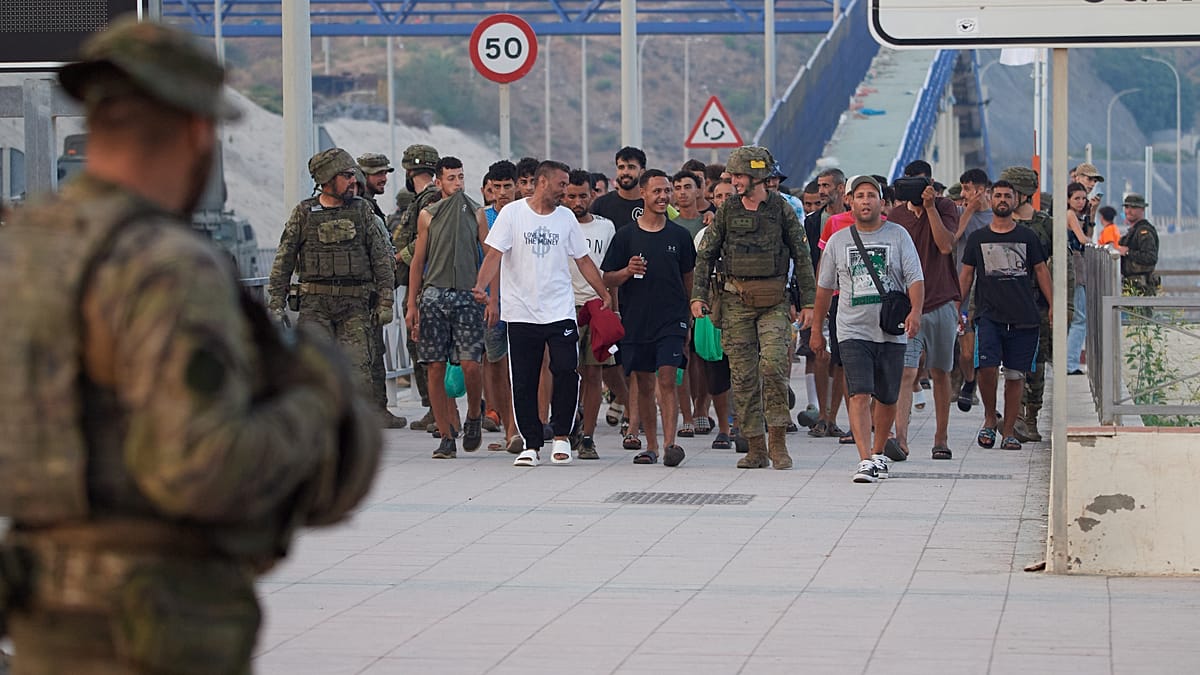
New details from military and civilian intelligence sources suggest the Spanish government was warned of the risk of a mass migrant arrival in Ceuta days before the crisis unfolded. Alerts were issued over several days, including in the hours immediately before tens of thousands of people crossed from Morocco, according to sources cited by The Objective.
The warnings reportedly indicated that King Mohammed VI might make a "gesture of magnanimity" at the border to coincide with Morocco's Throne Day celebrations. Subsequent reports described migrants swimming from Fnideq—known as Castillejos in Spanish—and buses carrying people from various parts of Morocco toward the border.
Over roughly ten days, nearly 1,000 people swam into Ceuta. Intelligence officials reportedly interpreted this as a test by Moroccan authorities and passed that assessment to the government. In the end, between 60,000 and 75,000 migrants crossed into the enclave, marking the largest migration crisis in Ceuta's history. Spain's Interior Ministry says about 53,000 people had returned to Morocco in the days that followed.
Border forces overwhelmed
The Civil Guard and National Police at the Tarajal border crossing were unable to stop the influx and instead focused on assisting the injured, several sources said. The same sources criticized Madrid for not deploying the army immediately, despite military units in both Ceuta and Melilla being on standby. "They could have been mobilized without prior meetings, simply following a political decision and an order from the operations command," they said.
Officers deployed in the area reported that the Moroccan gendarmerie stood "with their arms folded" while migrants attempted the crossing, both along the breakwater and on the access road to the border crossing, where others climbed over fences and roofs.
Civil Guard sources noted that the current situation differs from May 2021, when Morocco relaxed border controls in a diplomatic response to Spain's decision to admit the Polisario Front leader, Brahim Ghali. This time, they say, the number of people swimming into Ceuta had been rising for weeks, partly because of a Spanish Supreme Court ruling prohibiting the immediate return of migrants who reach Spanish territory by swimming.
The government's response
The Interior Ministry insisted hours later that cooperation with Morocco was "exemplary, loyal and permanent." Prime Minister Pedro Sánchez described the mass entry as a "violation of Spain's territorial integrity" and blamed people-smuggling networks, arguing they had exploited the Supreme Court ruling by encouraging thousands to attempt the crossing.
Sánchez also insisted that Moroccan authorities had cooperated "swiftly and consistently" from the outset, adding that Interior Minister Fernando Grande-Marlaska had reinforced border security as arrivals by sea increased. That reinforcement ultimately resulted in about thirty additional officers and a boat that, a few days later, broke down.
The crisis has had wider European repercussions. Italy has reinstated border checks on arrivals from Spain, and 22 EU states have demanded emergency talks on the situation. Meanwhile, Ceuta is cautiously returning to normal, though the legal and political fallout continues.
The revelations about advance warnings raise uncomfortable questions for Madrid. Why were the alerts not acted upon more decisively? Was the army's deployment delayed by political considerations? And what does this mean for Spain's relationship with Morocco, a key partner on migration control?
As the EU debates solidarity and border management, the Ceuta crisis serves as a stark reminder of the pressures on Europe's southern flank. The full story of what happened—and who knew what when—may take time to emerge, but the implications for Spanish and European policy are already being felt.