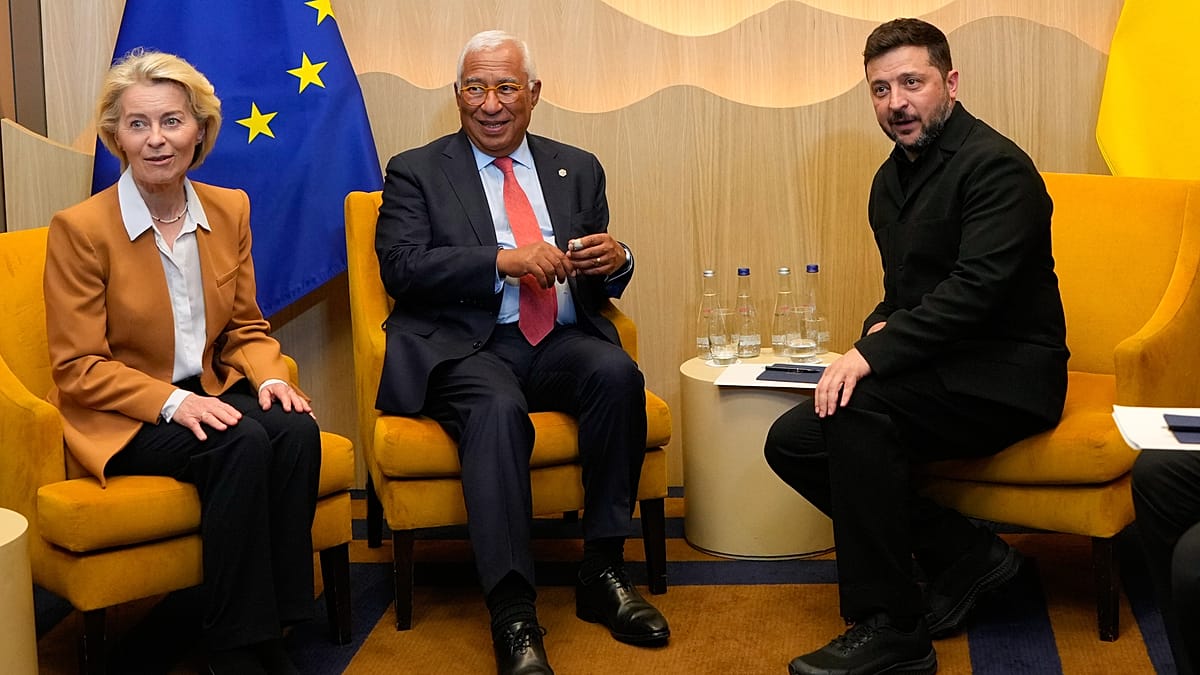
Ukrainian President Volodymyr Zelenskyy is in Brussels today for a series of high-stakes meetings with NATO and EU leaders, following a G7 summit in Évian that produced significant new commitments to bolster Kyiv’s defences. The Ukrainian leader will first attend a gathering of the Ukraine Defence Contact Group at NATO headquarters before joining EU heads of state and government for a two-day summit in the European Council building.
The G7 joint statement, endorsed by US President Donald Trump, pledged increased deliveries of weapons including air defence systems and long-range capabilities, and signalled that the moment has come to tighten sanctions on Russia’s energy sector. For European leaders who have struggled to secure Trump’s backing on Ukraine policy, the statement represents a notable diplomatic win — especially after the White House waived sanctions on Russian commodities to cushion the global economy from the impact of the Iran war.
Yet details and timelines remain vague, and the focus now shifts to implementation. As EU leaders gather in Brussels, the question is how to turn the G7’s political commitments into concrete action. Zelenskyy’s arrival in Brussels underscores the urgency: Ukraine needs not only promises but also deliveries of air defence systems and long-range weapons to counter Russian offensives.
Divisions on Russia Talks and China Trade
European Council President António Costa has made “brief contacts” with Russia at a “diplomatic level” to open communication channels, an EU official confirmed ahead of the summit. But member states remain sharply divided on the idea of direct talks with Moscow. The process of appointing an EU envoy to any future negotiations is still in limbo. Italian Prime Minister Giorgia Meloni, one of the first proponents of naming an envoy, told the G7 summit that the appointee should come from a “middle power” rather than a large member state.
Beyond Ukraine, EU leaders will grapple with what they see as an unsustainable trading relationship with China. Last year was the first on record that all 27 member states posted a trade deficit with Beijing, fuelling fears of de-industrialisation. “We’re not naive anymore. China’s five-year plan is an attack on our market,” a senior EU diplomat said. “The cost of action will be less than the cost of inaction. That’s something that’s not disputed now and that you wouldn’t have heard a few years ago.”
While the diagnosis is widely shared, the prescribed medicine is not. France, Poland, Belgium, the Netherlands, Sweden, Denmark, and Lithuania favour a more assertive stance to correct trade imbalances and crack down on Chinese subsidies. Germany, Spain, and Greece are more cautious, fearing retaliation and loss of business opportunities. The divisions are set to play out during Thursday’s dinner, designed as an open exchange. Our full preview of the summit has more details.
Le Maire Pitches an ‘E6’ Core
In a separate development, former French Economy Minister Bruno Le Maire told Euronews that the EU should function as a core group of six countries — France, Germany, Italy, Spain, Poland, and the Netherlands — rather than 27. “A Europe with six core countries instead of 27 is the best way of reinforcing Europe, of facing the threat posed by many empires around the world,” Le Maire said. His comments have sparked debate about the future of EU integration, though no official proposal is on the table.
Meanwhile, NATO defence ministers are meeting in Brussels amid cautious optimism that Trump’s Iran deal could improve transatlantic relations. US Secretary of Defence Pete Hegseth will join his counterparts to discuss the role NATO allies can play in reopening the Strait of Hormuz, which has been effectively shut since the US-Israel war on Iran. A coalition led by France and the UK is due to begin a minesweeping mission to re-secure the waterway.
NATO Secretary General Mark Rutte is travelling to Washington next Tuesday to meet Trump and lay groundwork for the annual NATO summit in Ankara on 7–8 July. Allies hope that a less distracted US president will be more receptive to their concerns.