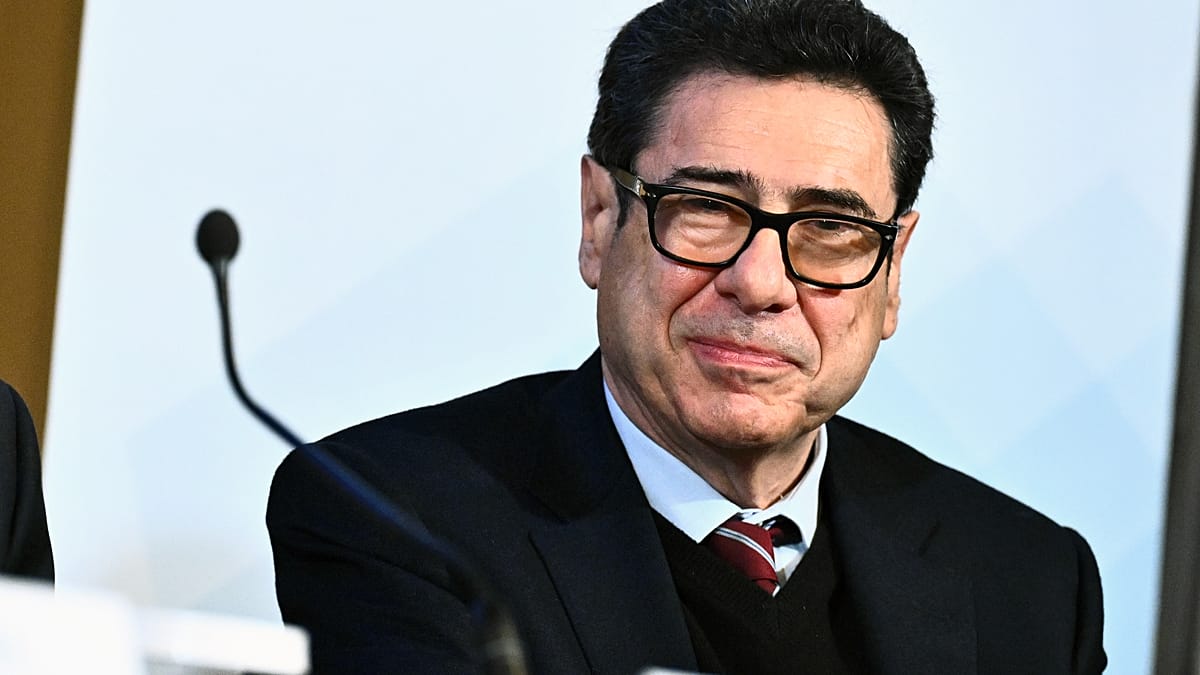
Nobel Prize-winning economist Philippe Aghion has called on the European Union to embrace the “creative destruction” brought by artificial intelligence, arguing that the bloc's competition rules and industrial policy must adapt to allow new players to challenge the dominance of a handful of US tech giants.
Speaking at an event in Brussels on Monday, Aghion, who shared the 2025 Nobel Prize in Economic Sciences for his work on how innovation displaces older technologies and jobs, warned that Europe risks falling behind unless it fosters an environment where new firms can emerge and scale.
Creative destruction and the labour market
“With AI, more than ever, there is creative destruction because if you look at the rate of job destruction and job creation, it's being accelerated by the AI revolution – and that's where it's so important to let new firms come in,” Aghion said.
He stressed that the EU's social safety nets are better equipped than those in the United States to cushion the impact of AI on employment. “We are ahead of the US when it comes to which labour market to accommodate AI revolution,” he noted, pointing to Denmark's “flexicurity” model, which combines flexible hiring and firing with generous unemployment benefits and active retraining programmes.
A recent European Commission report projects that AI could increase employment among highly skilled workers by 20% by 2040, while low-skilled workers could see job losses ranging from 20% to 60% across the continent. Aghion argued that institutions like flexicurity are essential to smooth the transition from old to new jobs.
Competition policy and state aid
Aghion also took aim at the EU's competition framework, which he said has been “precluding” the AI sector from receiving state aid, describing this as “a very anti-industrial policy.” He urged the bloc to draw inspiration from the US, where agencies like DARPA (Defense Advanced Research Projects Agency) fund cutting-edge research in a way that encourages competition.
“In the US, they have both competition policy and industrial policy. They have the DARPA, which is a competition-friendly way to do industrial policy,” Aghion said. “In Europe so far we don't have the equivalent of the DARPA and I would very well imagine one to develop AI computing power and that would also encourage new firms to enter [the market].”
He called for EU competition rules to be revised to promote new entrants and to facilitate data sharing across the entire AI value chain, including cloud computing. The dominance of US tech giants in AI has already drawn scrutiny from EU regulators; in December 2025, the European Commission opened an investigation into Google over concerns it may be distorting competition by imposing unfair terms on publishers and content creators.
Aghion's remarks come at a time when European policymakers are debating how to balance innovation with regulation. The EU's AI Act, which entered into force in 2024, imposes strict requirements on high-risk AI systems, but some economists and business leaders argue that over-regulation could stifle the very innovation the bloc needs to compete globally.
For Aghion, the answer lies not in protectionism but in a dynamic approach that combines open markets with strong social support. “It is important to have institutions like the flexicurity system that smooths out transition from old jobs to new jobs, because it helps manage the critical disruption,” he said.
As Europe navigates the AI revolution, the challenge will be to craft policies that encourage the emergence of European champions while ensuring that the benefits of productivity gains are widely shared. Aghion's call for a European DARPA and a more flexible competition regime offers a concrete starting point for that debate.