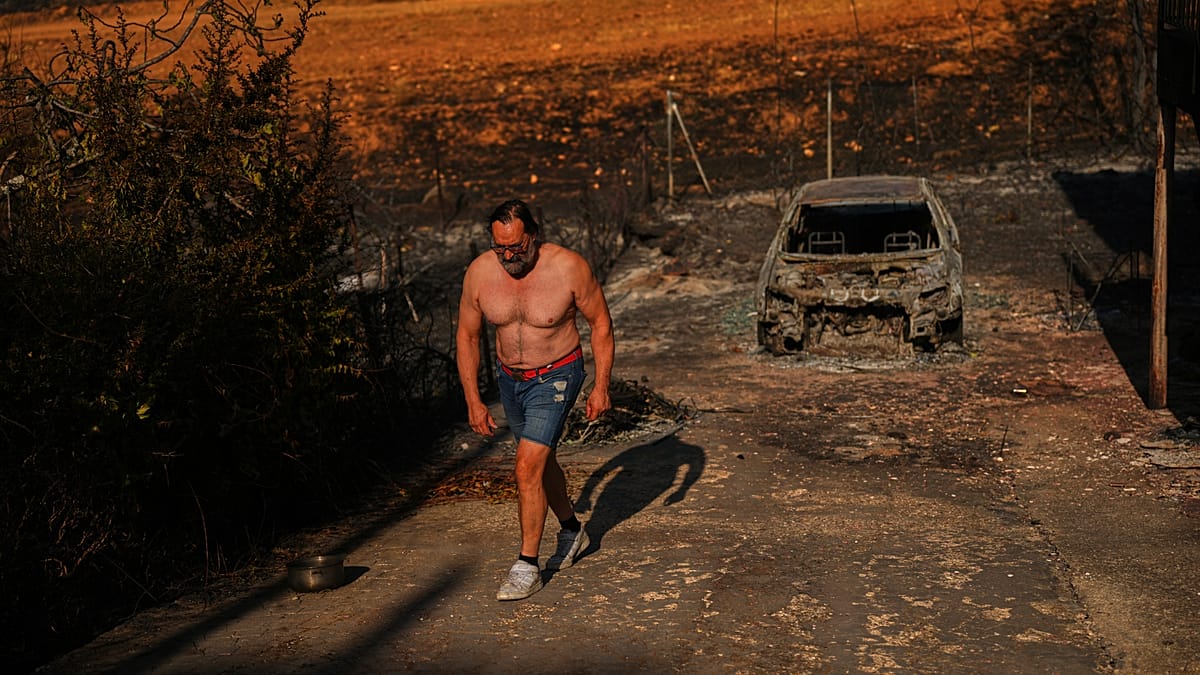
Europe's wildfire season in 2026 has already carved a grim place in the continent's recent history. By the end of July, cumulative burnt area in the European Union had reached 489,826 hectares, making this the fourth-worst year since comparable records began in 2012. Only 2012, 2022, and 2017 saw larger areas consumed by flames at this point in the calendar.
The figures, compiled by the Global Wildfire Information System and analysed by Our World in Data, show that the EU's burnt area is 13% above the 14-year average for this period. The toll is not just in hectares: more than 320,000 people have been evacuated from their homes in France and Spain alone, and heatwaves continue to fuel new outbreaks as mid-August approaches.
Spain and France bear the brunt
Spain has been the hardest-hit country, with 185,948 hectares burnt by early August – 38% of the EU total. That is more than double the country's average of 85,626 hectares for this point in the year. Only 2012 and 2022 saw larger areas lost in Spain since 2012.
France is not far behind, with 99,092 hectares burnt – three times its 14-year average of 31,648 hectares. This is now France's worst wildfire season in over a decade, surpassing the 86,888 hectares recorded in 2019.
Italy (79,084 ha), Portugal (47,776 ha), and Greece (23,839 ha) have also suffered significant losses, though for Greece the season has been comparatively mild. Italy and Portugal are both experiencing their fifth-worst years since 2012.
Northern Europe feels the heat
Perhaps more striking is the spread of fire risk beyond the Mediterranean. Several northern and central European countries have seen burnt areas far exceed their historical averages. Austria has lost 1,687 hectares (average 513), Denmark 1,177 hectares (average 404), Germany 6,045 hectares (average 3,098), and the Netherlands 1,677 hectares (average 352).
The United Kingdom has also been badly affected, with 22,206 hectares burnt – nearly double its average of 12,311 hectares. For the UK, as for several other countries, 2026 is already the worst year in the last 15.
Turkey, by contrast, has seen a dramatic reduction, with 39,556 hectares burnt compared with an average of 134,707 hectares.
The hidden costs of wildfire
Measuring the true cost of these fires is complex. Burnt area is a straightforward metric, but the economic and social consequences extend far beyond scorched earth. Professor Simone Varotto from Henley Business School at the University of Reading warns that the final bill will be substantial.
“Europe's wildfires this year confirm that their economic cost reaches far beyond restoring burnt land,” Varotto said. “The eventual bill will include destroyed homes, businesses and crops, disrupted tourism and industry, smoke-related health effects, added strain on public finances and potentially higher insurance premiums.”
Varotto also cautioned that the UK should treat southern Europe as an early warning system. “This summer's heatwaves and wildfires in southern England, which have already burnt more than 20,000 hectares, show that fire risk is no longer confined to the Mediterranean,” he said.
As the season continues, the numbers are likely to rise. With heatwaves still spreading across the continent, the final tally for 2026 could yet surpass even the worst years of the past decade. For policymakers, the message is clear: wildfire is no longer a southern European problem, but a continental one.