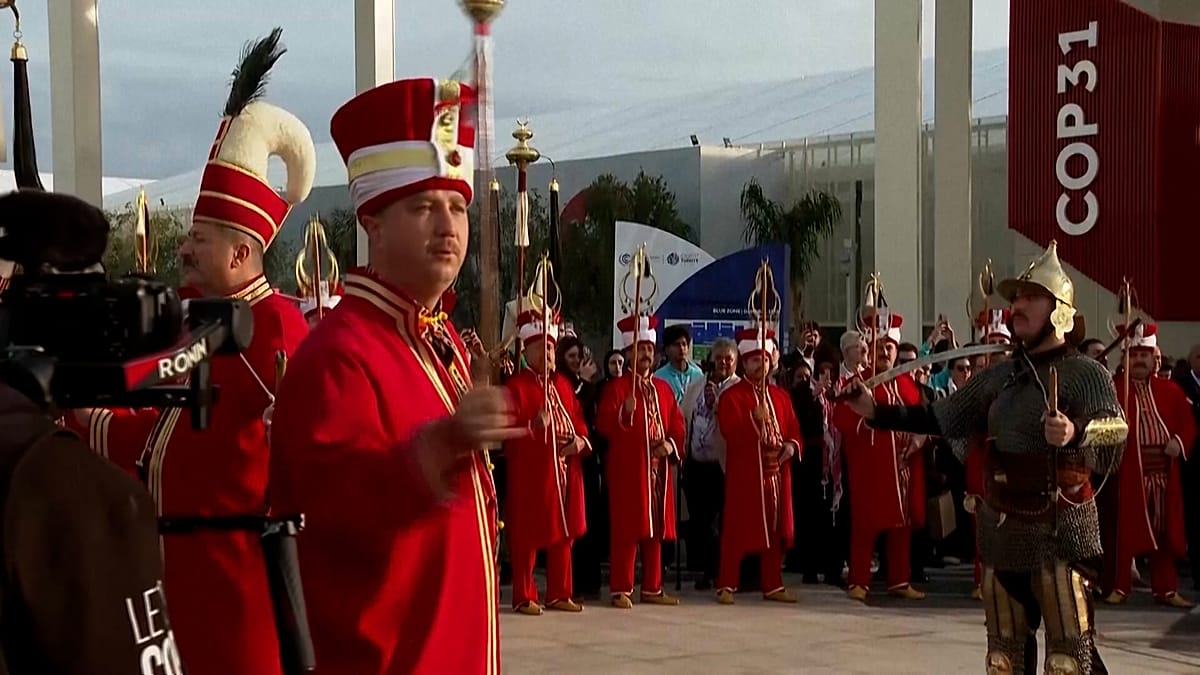
As delegates from nearly 200 countries descended on the Turkish resort city of Antalya for the COP31 climate summit, they were greeted not by the usual airport bustle but by the thunder of drums and the skirl of zurna pipes. An Ottoman-style military band, resplendent in crimson and gold uniforms, performed traditional marches and lively rhythms at the conference venue, setting a distinctly Anatolian tone for the two weeks of negotiations ahead.
The ceremonial welcome, organized by the Turkish hosts, was more than a colorful photo opportunity. It underscored the country's ambition to position itself as a bridge between Europe, the Middle East, and Central Asia — a role that resonates in the climate talks, where issues of energy security, migration, and cross-border cooperation are never far from the agenda. For many European delegates, the music was a reminder that Turkey, though not an EU member, remains a vital partner on climate and energy issues.
A cultural overture to climate diplomacy
The band's repertoire drew on the centuries-old tradition of the mehter, the military ensemble that once accompanied Ottoman armies into battle. Today, its martial cadences served a different purpose: to signal unity and shared purpose in the face of a common threat. "The music is a call to action," said one Turkish official involved in the summit's organization. "It reminds us that we are all part of a long history, and that we have a duty to future generations."
The choice of Antalya itself was deliberate. The city, on Turkey's Mediterranean coast, is a popular tourist destination and a showcase for the country's efforts to reconcile economic development with environmental protection. Nearby, solar farms and wind turbines dot the landscape, and Turkish officials have been keen to highlight their renewable energy ambitions. Yet the summit takes place against a backdrop of challenges, including the recent industrial tragedy in Aliağa, where a steel plant blast killed 17 workers, and the ongoing tensions over EU enlargement and strategic alignment.
The absence of several EU heavyweights has cast a shadow over the proceedings. Leaders from Germany, France, and other major economies have skipped the summit, raising questions about the bloc's commitment to climate leadership. Their no-shows have been interpreted by some as a snub to Turkey, which has sought to play a more prominent role in global climate governance. Others see it as a sign of summit fatigue, with the rotating COP format struggling to maintain momentum between landmark agreements.
Nevertheless, the Ottoman band's performance was a reminder that cultural diplomacy can sometimes bridge gaps that political negotiations cannot. For the delegates who paused to listen, the music offered a moment of respite from the dense technical documents and late-night working groups. It also served as a subtle rebuke to the notion that climate action is a purely Western concern. Turkey, with its young population and growing economy, has a stake in the outcome of these talks, and its hosts were determined to make that point felt.
The summit's agenda includes the usual contentious issues: financing for developing countries, the transition away from fossil fuels, and the mechanics of carbon markets. But the setting in Antalya, with its turquoise waters and ancient ruins, provided a backdrop that was hard to ignore. "We are meeting in a place that has seen empires rise and fall," said one European negotiator. "The climate crisis is our generation's test. We need to show that we can do better than those who came before us."
As the band played on, delegates filed into the conference halls, their briefcases heavy with proposals and counter-proposals. The music faded into the background, but its echo lingered — a reminder that even in the midst of crisis, there is room for celebration, for culture, and for the shared humanity that underpins all diplomatic endeavor. Whether the talks in Antalya will produce the breakthroughs that many hope for remains to be seen, but for one afternoon, at least, the spirit of cooperation was alive and well.