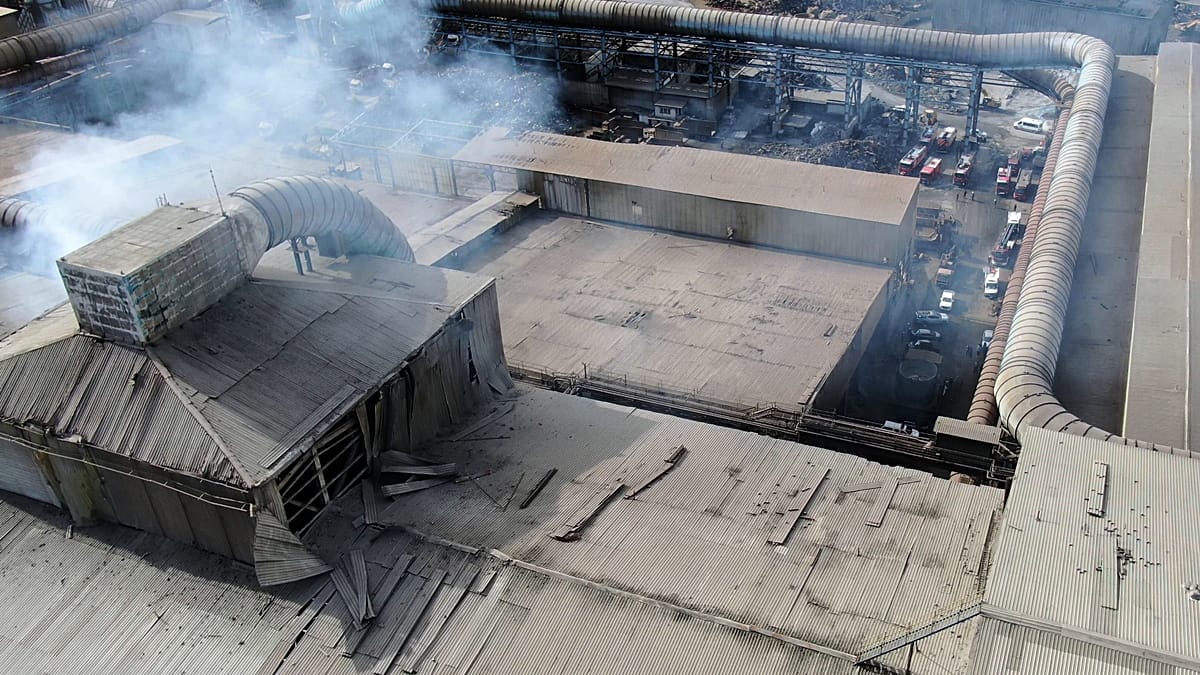
A devastating explosion ripped through the Habaş iron and steelworks in Aliağa, a coastal district of İzmir province in western Turkey, killing at least 17 people. The blast, which occurred on [date], sent a towering column of fire and smoke into the sky and was felt several kilometres away, with witnesses comparing the shockwave to an earthquake.
Emergency services rushed to the scene, where firefighters battled intense flames for hours. Local health officials confirmed that 17 workers lost their lives, and several others were injured, some critically. The exact number of casualties could still rise as search and rescue teams comb through the damaged sections of the plant.
Witnesses describe terrifying scenes
Footage broadcast on Turkish television showed panicked relatives gathered outside the factory gates, desperately seeking news of loved ones. One worker, who asked not to be named, told local media: “The ground shook like an earthquake. We ran out, and then we saw the fire. It was like a nightmare.” Another witness described seeing “a huge ball of fire” rising from the steelworks, followed by a thick plume of black smoke that could be seen from the centre of Aliağa, about 10 kilometres away.
The blast is believed to have originated in the plant’s steel production area, possibly involving a furnace or a gas line. Turkish authorities have launched a full investigation, with labour inspectors and forensic teams examining the site. The company, Habaş, one of Turkey’s largest industrial groups, said in a statement that it was cooperating fully with the authorities and expressed its condolences to the families of the victims.
Industrial accidents are not uncommon in Turkey, where rapid industrialisation has sometimes outpaced safety regulations. In 2020, a similar explosion at a steel plant in İskenderun killed several workers. The Aliağa region, home to a dense cluster of heavy industry, has seen its share of incidents, prompting calls for stricter oversight.
The tragedy has also reignited debate about worker safety in Turkey’s industrial sector. Labour unions have long criticised working conditions, arguing that profit often takes precedence over safety. “Every worker has the right to return home safely,” said a representative of the Türk-İş union. “We need a thorough investigation and accountability.”
The blast comes at a time when Turkey’s economy is under strain, with high inflation and a weak lira. The steel industry, a key export sector, has been struggling with rising energy costs and global competition. The Habaş plant in Aliağa employs thousands of workers and is a major local employer.
As the investigation unfolds, the focus will be on determining the exact cause of the explosion and whether any safety lapses contributed to the loss of life. For the families of the victims, the wait for answers is agonising. “My brother called me just before the blast,” one woman told reporters. “He said it was a normal day. Now I don’t know if he’s alive.”
This incident adds to a series of industrial disasters across the region. In neighbouring Greece, a train collision in 2023 killed dozens, and a school bus crash in eastern France earlier this year highlighted the fragility of infrastructure safety. While these events are unrelated, they underscore the importance of robust safety protocols across Europe and its periphery.
Turkey’s relationship with the European Union has been strained in recent years, but the EU has expressed condolences and offered assistance. The European Commission’s enlargement report has often cited the need for Turkey to align with EU standards on labour rights and workplace safety. This tragedy may add pressure on Ankara to demonstrate progress in these areas.
As Aliağa mourns, the broader question remains: how to balance industrial growth with the safety of those who power it. For now, the families of the 17 victims are left to grieve, and a community is left to wonder why such a disaster was allowed to happen.