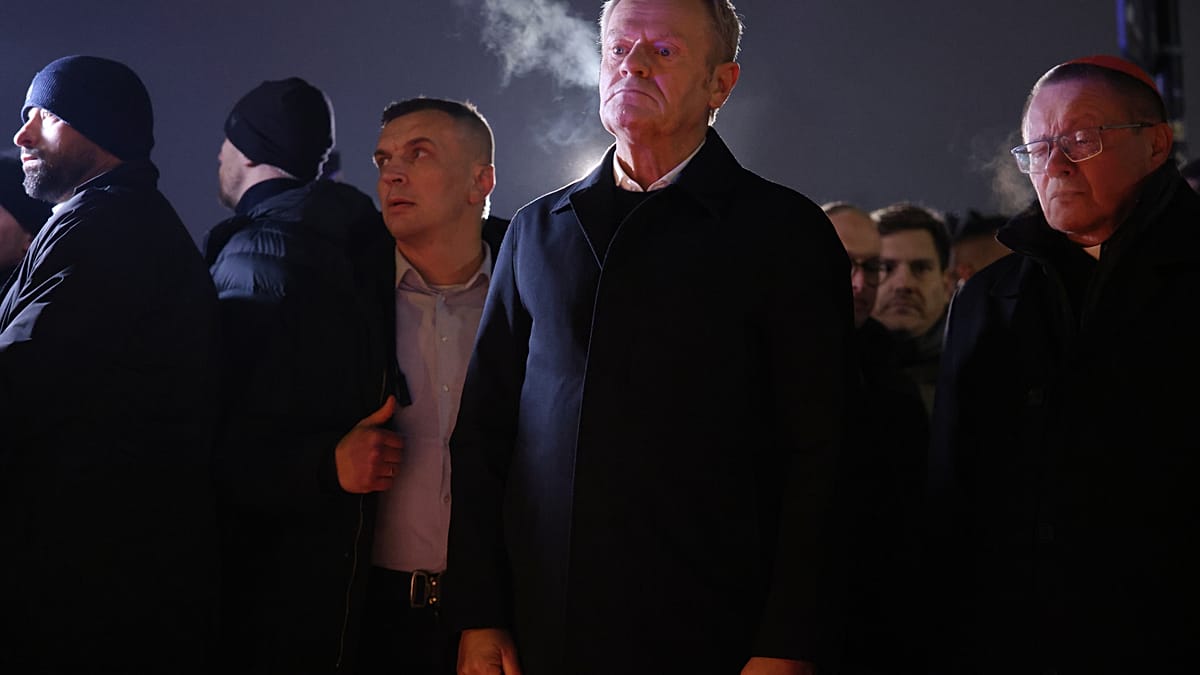
In a rare display of cross-party solidarity, Poland's President Andrzej Duda and Prime Minister Donald Tusk set aside their often fraught political rivalry on Tuesday evening to honour the six people killed in the Kraków shooting. The two leaders knelt side by side at a candlelit vigil in the city's historic Main Market Square, a scene that resonated far beyond the immediate tragedy.
The attack, which took place in the heart of Kraków's UNESCO-listed old town, has sent shockwaves through Poland and prompted an outpouring of grief across the country. As the Main Square reopens to residents and visitors, the focus has shifted to questions of security, mental health, and the societal pressures that may have driven the perpetrator.
A moment of unity in a divided political landscape
Duda, aligned with the conservative Law and Justice party (PiS), and Tusk, leader of the centrist Civic Coalition, have clashed repeatedly over judicial reforms, media freedom, and Poland's place in the European Union. Yet on this occasion, their shared presence at the vigil sent a clear message: grief transcends party lines. The two men laid candles among the flowers and tributes that have accumulated at the site, bowing their heads in silence as onlookers watched.
Local officials reported that the suspect, a 21-year-old Polish man, was arrested shortly after the shooting and later died in hospital from injuries sustained during his apprehension. Police have not yet disclosed a motive, but investigators are examining the suspect's social media activity and personal history. Early indications suggest he may have been radicalised online, a concern that has prompted experts to warn about the role of social media in fuelling violent extremism among young Europeans.
The attack has also reignited a broader debate about public safety in Poland's urban centres. While gun violence remains relatively rare in the country, the Kraków shooting has exposed vulnerabilities that many Poles had assumed were distant concerns. In Warsaw, politicians from across the spectrum have called for a review of security protocols in public spaces, though no concrete legislative proposals have yet emerged.
European leaders have expressed their condolences, with messages from Brussels, Berlin, and Paris underscoring the sense of shared loss. The European Commission president, Ursula von der Leyen, described the attack as "a tragedy for Poland and for all of Europe," while French President Emmanuel Macron offered France's support in a phone call to Duda. Such gestures reflect the deep ties that bind EU member states, even as national politics often pull in different directions.
For the people of Kraków, the vigil was an opportunity to mourn collectively. Many residents placed white and red roses—the colours of the Polish flag—among the candles. Others stood in silence, some wiping tears, as church bells tolled across the city. The atmosphere was sombre but defiant, a reminder that the city's resilience is as much a part of its identity as its medieval walls and cobblestone streets.
The shooting has also raised questions about the adequacy of mental health services in Poland, where access to psychiatric care remains uneven, particularly for young adults. Experts argue that the suspect's apparent isolation and online behaviour point to a broader crisis that cannot be addressed by policing alone. As one Kraków-based psychologist told local media, "We need to invest in prevention, not just reaction."
In the coming days, the focus will shift to the funerals of the victims, whose names have been released by authorities. They include a university student, a retired teacher, and a tourist from Germany, reflecting the international character of the city. The German foreign ministry confirmed that one of its citizens was among the dead, adding a cross-border dimension to the tragedy.
As Poland mourns, the images of Duda and Tusk kneeling together may prove to be a lasting symbol of this moment. Whether it translates into lasting political cooperation remains uncertain, but for now, the nation's leaders have shown that even in the midst of deep divisions, there are moments when unity prevails. The security debate that has emerged in the wake of the attack is likely to continue for weeks, but the immediate priority is healing.
Kraków's Main Market Square, one of Europe's largest medieval squares, has long been a place of celebration and commerce. This week, it has become a place of remembrance. As the city slowly returns to normal, the candles will eventually burn out, but the memory of the six lives lost will endure.