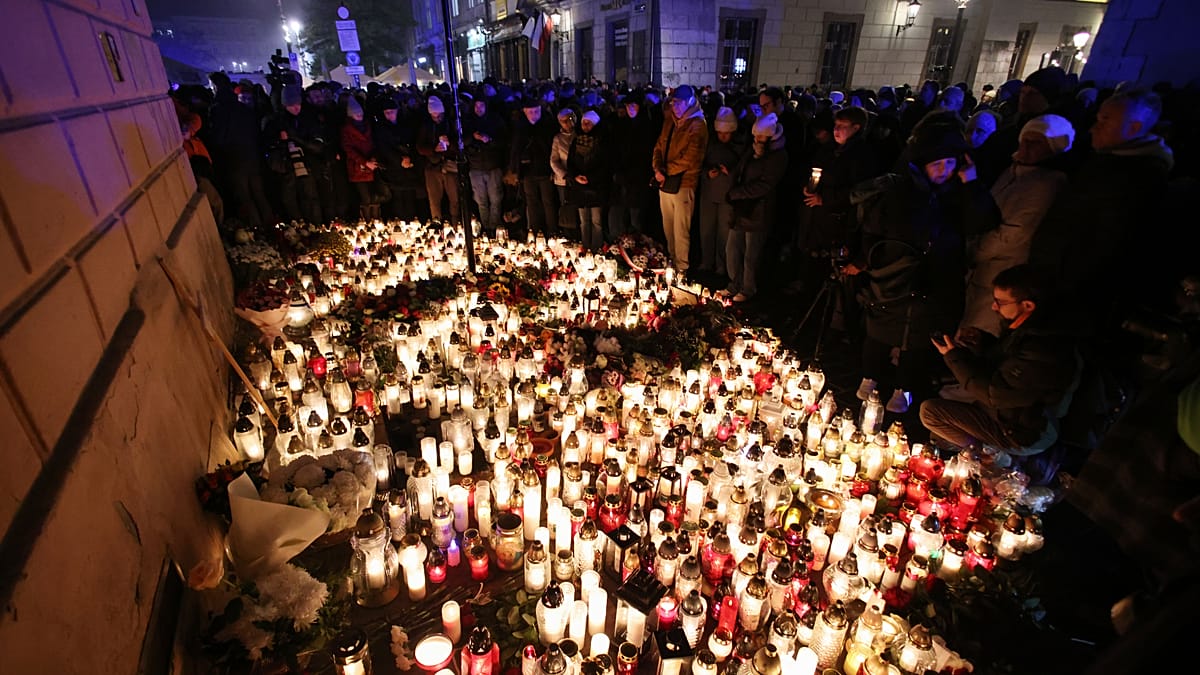
Kraków came to a standstill on Monday evening as thousands of residents, led by Poland's president and prime minister, took part in a silent march to honour the victims of Saturday's shooting on the city's Main Market Square. The procession set off at 20:00 from the junction of the Main Square and Sławkowska Street — the spot where the first shots were fired — to the sound of the St Mary's bugle call, and made its way to St Mary's Basilica before concluding near the Town Hall Tower.
Among those walking were President Karol Nawrocki, Prime Minister Donald Tusk, the Archbishop of Kraków, Cardinal Grzegorz Ryś, and regional officials including Małopolska governor Krzysztof Klęczar and regional marshal Łukasz Smółka. The mayor of Kraków, Łukasz Gibała, had invited residents to join the commemoration, writing on social media: "In this difficult time, let us show solidarity and show that Kraków will always be a proud city, but also hospitable and open." Prime Minister Tusk also urged participation, posting on X: "This evening in Kraków thousands of Poles have gathered to pay tribute to the victims of the attack of 7 November. May they rest in peace."
As the mayor had announced in advance, no speeches were made during the march. Instead, the focus was on quiet remembrance. Candles were lit at each of the three locations where victims lost their lives, and at the end of the procession the bugler played "The Sound of Silence" on the trumpet. Cardinal Ryś then offered a short prayer for the dead.
A city in mourning
The March of Silence took place on the final day of the two-day national mourning declared by President Nawrocki for 8 and 9 November. Kraków's local authorities have extended the period of mourning until Wednesday 11 November, with flags on public buildings remaining at half-mast or draped in black crepe. Buses and trams in the city are also carrying black-ribboned flags as a sign of respect.
Residents wishing to express their condolences can sign a book of condolence at the lobby of Kraków City Hall on Wszystkich Świętych Square, open daily from 9:00 to 19:00 until Wednesday. An online condolence book is also available until 19:00 on 11 November.
The attack, carried out by 24-year-old Michał Oksiński, who drove a car onto the Main Market Square and opened fire with an automatic weapon, left six people dead and 16 injured. The victims included four Polish citizens, a British man, and an Austrian woman. Among the wounded are nationals of Britain, Portugal, Russia, Germany, and Austria. The suspect died in hospital early Monday morning.
The shooting has reignited debates about public safety and the influence of social media on radicalisation. A Polish expert has warned that online platforms can fuel extremist behaviour, a concern that has echoed across Europe. The attack also drew expressions of solidarity from leaders across the continent, underscoring the shared sense of shock and grief.
Heroic officers honoured
Before the march began, President Nawrocki awarded the Officer's Cross of the Order of Polonia Restituta to two police officers who were seriously wounded while confronting the attacker. Senior Constable Jakub Kulik and Senior Constable Artur Morański were the first to intervene, managing to neutralise the gunman but suffering gunshot wounds in the process. Both were placed in medically induced comas and have since begun the slow process of recovery.
Bartosz Grodecki, head of the National Security Bureau, announced the honours on social media, praising the officers' "heroic conduct" and "readiness to defend others." He conveyed the president's wishes for a swift recovery. The decorations were presented in person by President Nawrocki.
On Monday, Mayor Gibała reported that Morański had been extubated and his condition was improving. According to the mayor of Muszyna, Jan Golba, the 27-year-old officer's first words after waking were: "Is Kuba alive?" — a poignant reminder of the bond between the two officers who risked everything to stop the attacker.
As Kraków continues to mourn, the city's resilience and unity have been evident. The silent march was a powerful display of collective grief and defiance, reaffirming that Kraków remains a proud, hospitable, and open city in the face of tragedy.