Almost five years after Russia launched its full-scale invasion, Ukraine's housing crisis has become one of the most pressing humanitarian challenges on the continent. Millions of Ukrainians remain displaced, and millions more live in homes scarred by shelling, fire, and neglect. The response, led by UNHCR with substantial backing from the European Union, is evolving from emergency repairs to longer-term solutions that help people rebuild their lives—whether that means returning to a repaired home or putting down roots somewhere new.
A country scarred, but not abandoned
The latest Rapid Damage and Needs Assessment, conducted by the World Bank Group, the Government of Ukraine, the European Commission, and the United Nations, estimates that 14 per cent of Ukraine's housing stock was damaged or destroyed by the end of 2025. That translates into more than three million affected families. The cost of reconstruction and recovery in the housing sector alone approaches €77 billion ($90 billion USD), making it one of the country's largest recovery needs.
Since 2022, the EU has contributed over €264 million ($310 million USD) to UNHCR's response in Ukraine, funding emergency assistance, winter supplies, and shelter programmes. This support has enabled UNHCR and its partners to repair more than 62,000 war-damaged homes, providing construction materials, cash assistance, and direct renovation work.
Repairing what remains
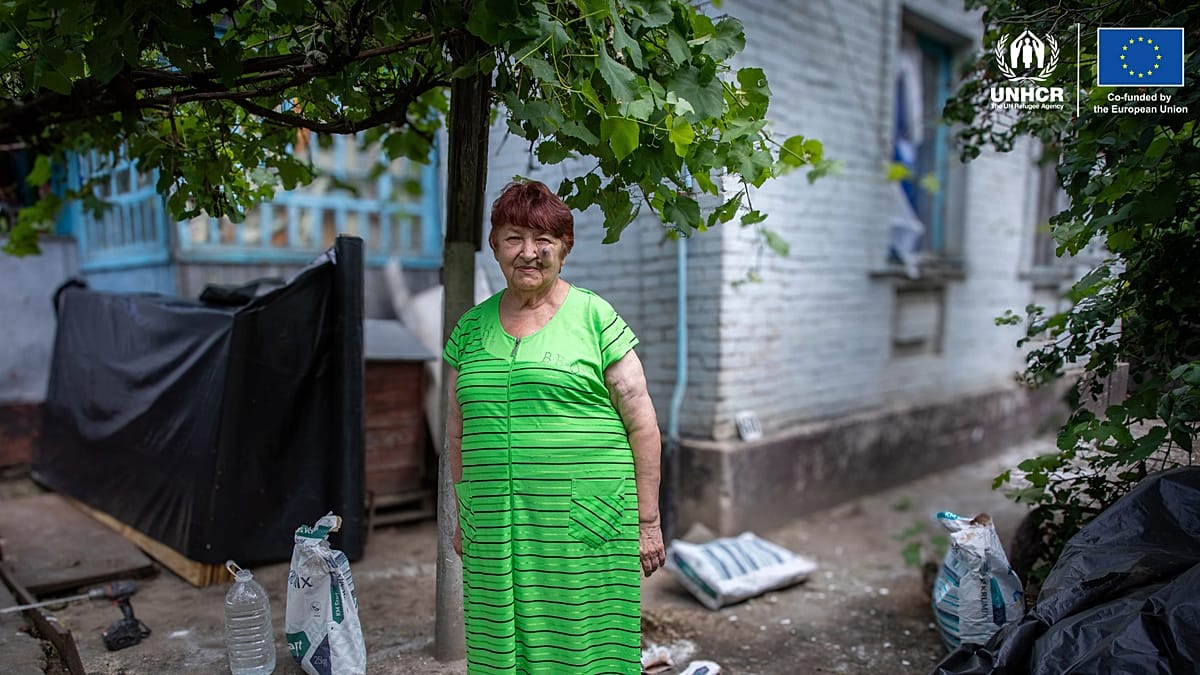
For Lidiia, a pensioner in Izium in the Kharkiv region, staying home meant enduring years in a house with a shattered roof and broken windows. She and her adult daughter, who has mobility difficulties, lived through nearly six months of Russian occupation. With only a pension to rely on, they could not afford repairs themselves. UNHCR and its partner Caritas stepped in, fixing the roof, replacing windows, and overhauling the heating system, electricity, and bathroom.
Such repairs are the most immediate form of housing support: helping people who stayed or returned to war-affected communities make their homes habitable again. But for many, returning is not an option—at least not yet.
Building a life elsewhere
Raisa and her family fled their home in 2022, initially renting in the Zaporizhzhia region. In 2024, they moved into a house under a rent-to-own agreement, and by March 2026 they had purchased the property outright. UNHCR and Caritas helped repair the roof, replace windows and doors, and adapt the house to the family's needs. For Raisa, this is not about preparing for an imminent return—it is about making a life elsewhere more stable and sustainable.
That kind of support is increasingly vital as displacement becomes protracted. According to UNHCR, around 3.9 million people remain internally displaced in Ukraine, with 69 per cent having been displaced for more than two years. Many live in collective accommodation—temporary shelters that were never meant for long-term habitation.
Moving beyond collective accommodation
Nataliia and her visually impaired son fled the occupied city of Bakhmut in the Donetsk region. They were evacuated to western Ukraine before moving to a collective site in the Dnipropetrovsk region. They were among 70,000 vulnerable internally displaced people accommodated in 1,500 collective sites across the country since the start of the full-scale war.
Through a programme run by UNHCR and local authorities, Nataliia applied for temporary housing and eventually moved into her own property. The dedicated space has supported her son's rehabilitation, and she hopes the stability will allow her to be reunited with her elderly mother, who remains in collective accommodation in Dnipro.
UNHCR is working with national and local authorities to expand longer-term options: renovating unused buildings, adapting public premises, providing rental support, and rehabilitating homes for displaced families. Alongside emergency shelter assistance after aerial attacks, these efforts aim to give people a foundation on which to rebuild their lives.
Housing as part of recovery
Housing alone cannot resolve Ukraine's displacement crisis. Security, livelihoods, and access to essential services all play a role in determining whether people can return and rebuild. But after nearly five years of full-scale war, the humanitarian response must address people at very different points in their displacement journeys: those who need urgent repairs, those establishing lives elsewhere, and those looking to move beyond temporary accommodation.
The scale of the challenge means continued support is necessary. As Europe's leaders debate security guarantees and reconstruction financing, the EU's role as a major donor to UNHCR's housing programmes remains a tangible expression of solidarity. For Lidiia, Raisa, and Nataliia, the path forward is not just about bricks and mortar—it is about dignity, agency, and the chance to rebuild a life after years of upheaval.
As the war grinds on, the definition of "home" for Ukraine's displaced population is shifting. For some, it means repairing what the war destroyed. For others, it means putting down roots somewhere new. Both are part of the same challenge: helping people displaced by the full-scale war find somewhere they can live, recover, and rebuild.