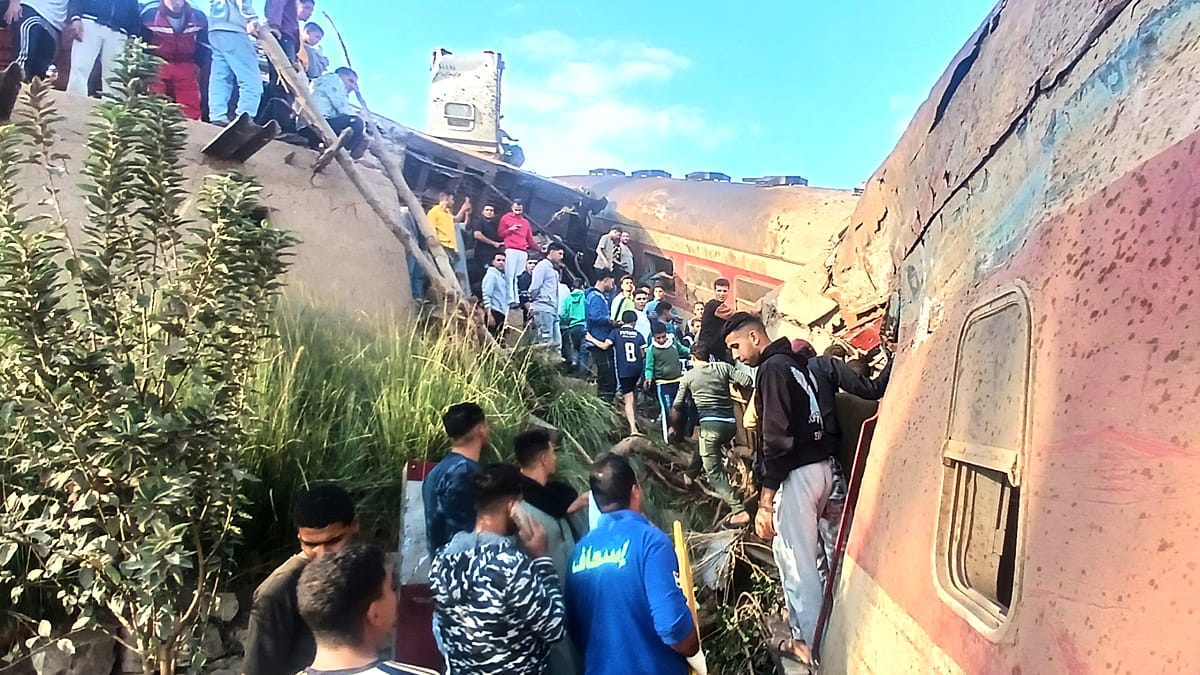
Rail workers in Egypt began repairing damaged tracks in Al-Ayyat on Monday, a day after two passenger trains collided south of Cairo, killing seven people and injuring at least 125 others. The crash, which occurred on Sunday, has once again put the spotlight on the safety of Egypt's ageing railway network, a system that has seen repeated deadly incidents over the past decade.
Details of the collision
The collision took place near Al-Ayyat, a town in Giza governorate roughly 80 kilometres south of the capital. According to initial reports, one train rear-ended another while both were in motion, causing several carriages to derail and overturn. Emergency services rushed to the scene, transporting the injured to nearby hospitals, with many suffering fractures and minor wounds.
Egypt's railway authority said an investigation has been launched to determine the exact cause of the accident. Early indications point to a possible signal failure or human error, but officials have not yet confirmed any specific factor. The transport minister has promised a thorough inquiry and said those responsible would be held accountable.
The crash is the latest in a series of rail disasters in Egypt. In 2021, two trains collided in Sohag province, killing 32 people and injuring more than 100. In 2017, a collision near Alexandria left 43 dead. These repeated tragedies have fuelled public anger and raised questions about the effectiveness of government efforts to modernise the network.
European context and safety concerns
While the incident occurred in Egypt, it resonates with European readers who follow rail safety across the Mediterranean. The European Union has long supported infrastructure projects in North Africa, including Egypt, through investment and technical cooperation. The European Bank for Reconstruction and Development (EBRD) has financed railway upgrades in Egypt, aiming to improve safety and efficiency.
However, critics argue that such investments have been slow to yield results. Egypt's railway system, one of the oldest in the region, suffers from outdated signalling equipment, poorly maintained tracks, and a shortage of trained staff. The government has announced ambitious plans to overhaul the network, including the introduction of high-speed rail lines, but progress has been uneven.
For European travellers and businesses, the safety of Egypt's transport infrastructure is not just a local concern. Egypt is a key partner for the EU in trade, tourism, and energy, and a stable and safe transport system is vital for regional connectivity. The recent expansion of Egypt's Mediterranean gas reserves has deepened economic ties with Europe, making reliable infrastructure even more important.
Reactions and next steps
Local authorities have declared a period of mourning for the victims. The injured are being treated in hospitals in Giza and Cairo, with some in critical condition. The railway authority has suspended services on the affected line while repairs are underway, causing delays for commuters.
Egyptian President Abdel Fattah el-Sisi has expressed condolences and ordered an immediate investigation. In a statement, he emphasised the need to improve safety standards and prevent future tragedies. The transport minister has pledged to implement new safety measures, including upgrading signalling systems and increasing staff training.
Yet, for many Egyptians, such promises ring hollow. The country's railway has a long history of deadly accidents, and public trust remains low. A recent similar collision south of Cairo in recent months, which killed at least four people, shows that the problem is persistent.
International observers, including European rail safety experts, have called for a more comprehensive approach. They argue that piecemeal fixes are insufficient and that Egypt needs a systemic overhaul, including independent oversight and a stronger safety culture. The EU, through its neighbourhood policy, could play a role in supporting such reforms, but it requires political will from Cairo.
As the investigation unfolds, the focus will be on identifying the root causes and ensuring accountability. For now, the families of the victims mourn, and the injured recover, while the broader question of railway safety in Egypt remains unresolved.