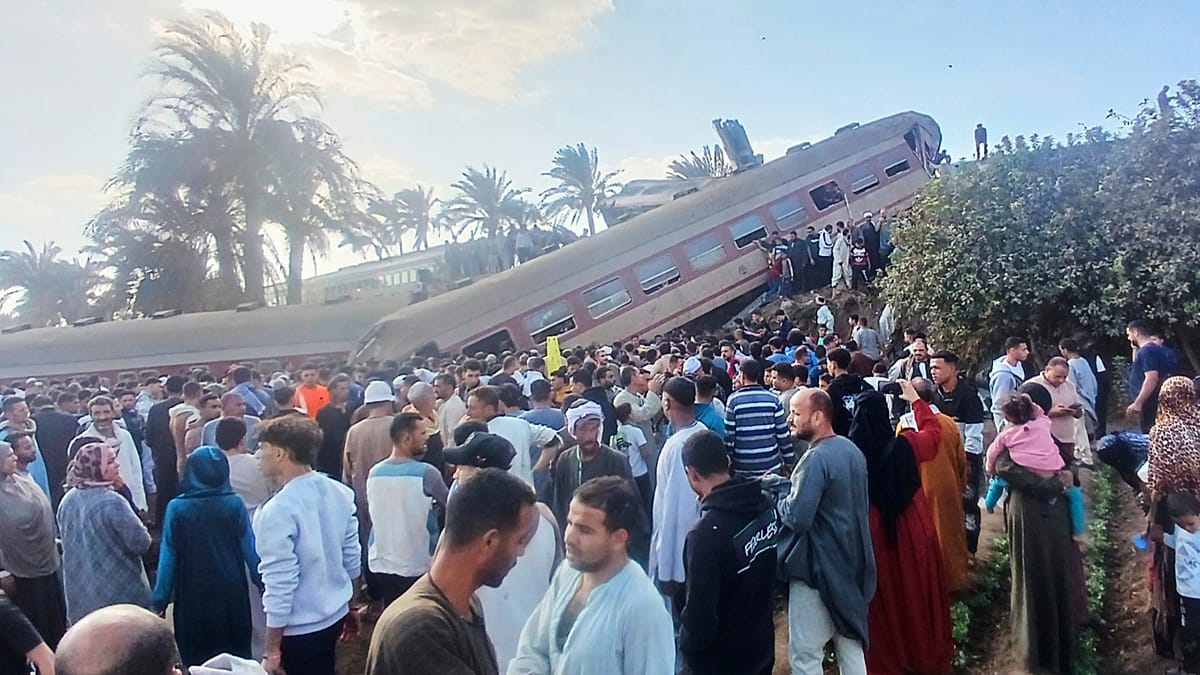
At least four people were killed and 88 others injured on Sunday when two passenger trains collided south of Cairo, according to Egyptian authorities. The crash occurred near the town of Al Ayyat in Giza province, roughly 52 kilometres from the capital, when a train bound for Fayum in the southwest hit the rear of another service heading to Aswan in the south.
The impact caused one of the trains to derail, though officials did not specify which. Egypt's Ministry of Health confirmed the death toll and said the injured had been taken to nearby hospitals for treatment. Emergency crews and cranes were dispatched to the scene to clear the wreckage and restore rail traffic as quickly as possible, the Egyptian Railways Authority said.
Investigation ordered
President Abdelfatah al-Sisi said on social media that he had ordered an immediate investigation to determine the causes of the accident and to ensure those responsible are held to account. The statement did not provide further details, but such incidents often prompt scrutiny of Egypt's ageing rail infrastructure and safety record.
Sunday's collision is the latest in a series of deadly train accidents in Egypt. In September, a driver and his assistant were injured when two freight trains collided in the same district. More broadly, the country has seen several high-profile crashes in recent years, including a collision in 2021 that killed at least 32 people and injured more than 100.
Egypt's rail network, one of the oldest in the region, has long suffered from underinvestment and maintenance problems. The government has announced modernisation plans, including new signalling systems and rolling stock, but progress has been slow. The European Union has supported some of these efforts through technical assistance and loans, reflecting broader European interest in improving transport safety in the Mediterranean neighbourhood.
The crash comes as Egypt grapples with economic challenges and a growing population, which puts additional strain on public services. The government has sought to attract foreign investment, including from European partners, to upgrade infrastructure. However, critics argue that safety lapses persist, and that more needs to be done to protect passengers.
Local media reported that the injured were taken to hospitals in Al Ayyat and nearby cities, with some in serious condition. The health ministry said it had mobilised additional ambulances and medical teams to the area. The railway authority said it was working to clear the tracks and resume normal services, but did not give a timeline.
The incident has reignited calls for greater accountability and investment in rail safety. In a country where millions rely on trains for daily travel, the human cost of such accidents is high. The investigation ordered by President al-Sisi is expected to focus on the actions of the train crews and the condition of the signalling equipment.
European observers have noted that similar accidents have occurred elsewhere, including a deadly high-speed train collision near Toledo in Spain, which killed at least 64 people in 2013. That disaster led to significant reforms in Spanish rail safety. Whether Egypt will follow suit remains to be seen.
As the investigation unfolds, families of the victims are demanding answers. The government has promised to provide compensation to the families of the deceased and to cover medical costs for the injured. The railway authority said it would cooperate fully with the inquiry.
This latest tragedy underscores the urgent need for modernisation and stricter oversight of Egypt's railways. With the country's strategic importance in the region, and its close ties to Europe, the international community will be watching closely to see if concrete steps are taken to prevent future disasters.