The Prix Versailles, an international award series that has previously celebrated museums, hotels, and restaurants, has now turned its attention to the world's newest railway hubs. For its 2026 edition, the jury selected seven stations, and three of them are in Europe: Lyon Part-Dieu, Rome's Colosseo - Fori Imperiali, and Naples' Monte Sant'Angelo.
Jérôme Gouadain, the Prix Versailles secretary general, highlighted the unique challenge of designing transport stations in the 21st century. "In the realm of transport stations, the stakes are high when it comes to creating cultural expressions that are simultaneously beautiful, fashionable and sustainable," he said. "These strategies, with their ability to stimulate exchanges and assert a project's local roots, remain all too rare on today's global scene. In succeeding in this endeavour though, the winning travel hubs give us proof that 21st century passenger stations can be the bridges to a more desirable future."
Lyon Part-Dieu: a multimodal hub for the city
After a decade of renovation, Lyon Part-Dieu Station has been transformed into what the jury calls a "real community space." Designed by architectural firms AREP and L'AUC, the station now functions as a sprawling multimodal hub, serving not only rail passengers but also residents moving between neighbourhoods. The project is part of a broader effort to revitalise the Part-Dieu district, one of Lyon's main business areas, and to improve connections between the city's tram, metro, and regional rail networks.
The station's redesign prioritises natural light and open sightlines, making navigation easier for the 150,000 daily users. It also includes new retail and public spaces, blurring the line between transit infrastructure and urban living. For Lyon, which has long positioned itself as a hub for sustainable mobility, the station is a statement of intent.
Rome's Colosseo - Fori Imperiali: an archaeological journey
Rome's new Metro C station, Colosseo - Fori Imperiali, made headlines when it opened late last year, not just for its engineering but for the archaeological treasures uncovered during construction. The station, located steps from the Colosseum, displays ancient Roman finds in situ, turning the daily commute into a descent through history.
Prix Versailles praised the design for its seamless integration of archaeology and transit. "More than a station within a museum or a museum within a station, the structure has turned travel into an archaeological adventure," the jury wrote. "The public's descent towards the platforms is a literal dive into the city's history, and where an oculus treats transferring passengers to an unexpected view of the Colosseum."
The station is a key part of Rome's efforts to expand its metro network while preserving its heritage. It also offers a practical link for tourists and residents alike, connecting the city's historic centre with the rest of the metro system.
Naples' Monte Sant'Angelo: a subterranean sculpture
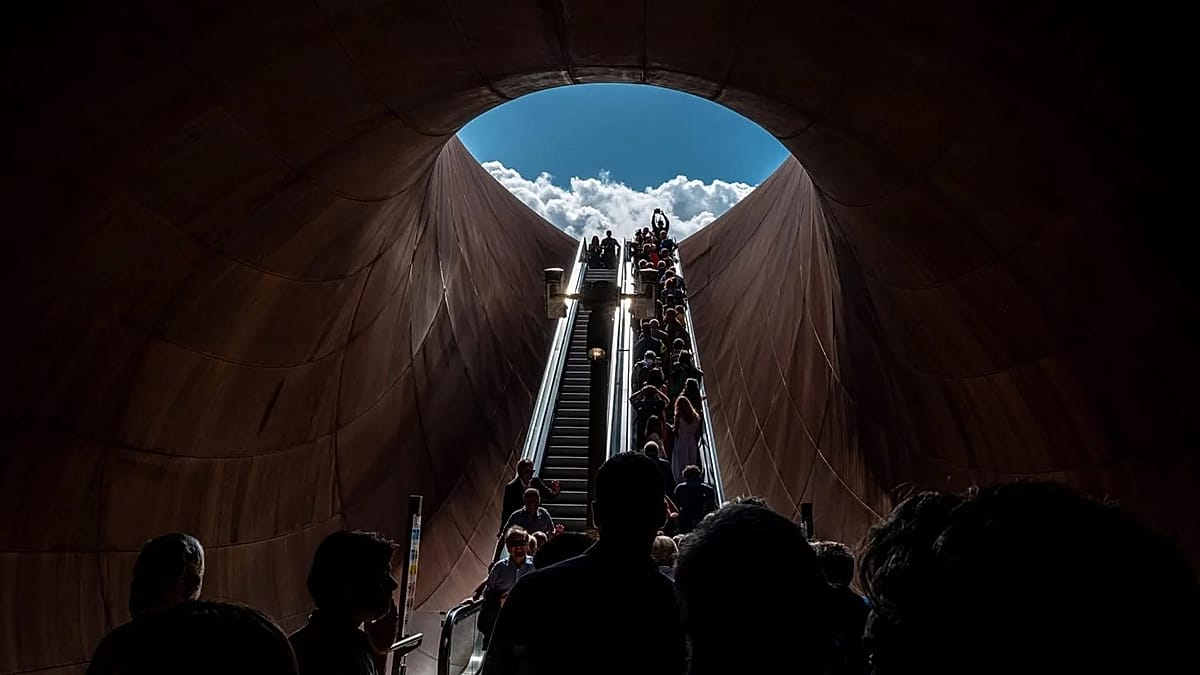
In Naples, the Monte Sant'Angelo Station, designed by artist Anish Kapoor in collaboration with architectural firms Future Systems and AL_A, offers a very different experience. The subterranean space evokes Mount Vesuvius, a cave, and the legend of the Cumaean Sibyl, creating what the jury describes as "a sculpture that the public can enter."
The station serves the university district of Fuorigrotta and is part of a broader plan to extend Naples' metro system. Its dramatic, organic forms and play of light and shadow make it a destination in its own right, drawing visitors who might otherwise never step into a metro station.
The full list of the world's most beautiful stations
Alongside the three European winners, the Prix Versailles list includes Town Hall Station in Melbourne, Australia, and two stations in Riyadh, Saudi Arabia: National Museum Station and Western Station. The selection reflects a global trend towards stations that are not just transport nodes but cultural landmarks.
For Europe, the recognition comes at a time when rail travel is gaining momentum. Recent data shows that trains have overtaken buses in EU travel for the first time in a decade, a sign that investment in infrastructure is paying off. The new stations in Lyon, Rome, and Naples are not only beautiful but also functional, designed to handle growing passenger numbers while enhancing the urban fabric.
As European cities continue to prioritise sustainable transport, these stations set a benchmark for what is possible. They prove that infrastructure can be both practical and inspiring, and that the journey itself can be as rewarding as the destination.