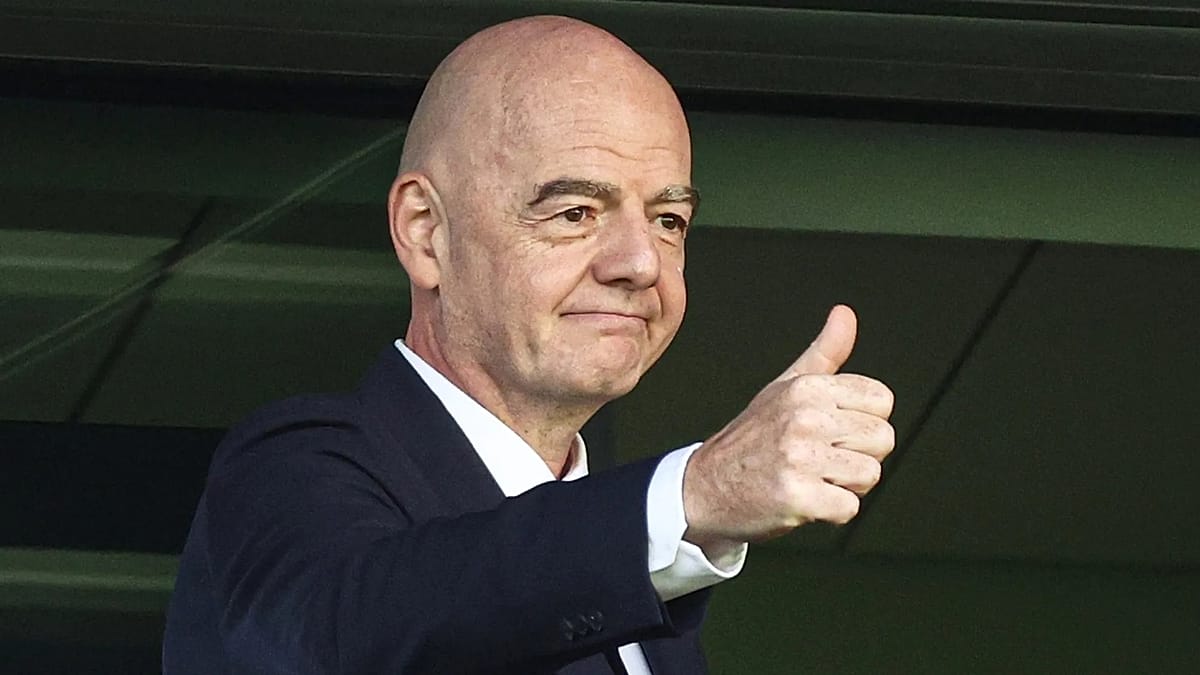
The Premier League, along with the top divisions in Spain, Italy, and Germany, has issued a rare joint statement demanding sweeping governance reforms at FIFA. The move intensifies the pressure on FIFA president Gianni Infantino, who is already facing the most serious crisis of his decade-long tenure.
The statement, co-signed by the English Premier League, Spain's La Liga, Italy's Serie A, and Germany's Bundesliga, said football had “suffered one of the biggest abuses of power in FIFA's history.” It accused Infantino of actively promoting “exploitative ideas rather than safeguarding against them.”
The four leagues, which represent the wealthiest and most watched domestic competitions in Europe, stopped short of explicitly calling for Infantino's resignation, as UEFA has done. But their language was unmistakably critical, attacking FIFA's “relentless expansionism” and warning that the sport's “longstanding foundations” have been undermined by a “fundamental governance problem.”
“Now is the moment to decide not only who will lead FIFA, but also how FIFA should be led,” the leagues said. They are urging all candidates in next year's presidential election to stand on a platform of structural reform.
A governance crisis beyond one man
The leagues' intervention is the latest in a series of clashes between European football's domestic competitions and Infantino, whose major projects have often been seen as encroachments on national leagues. The failed plan in question involved creating a $20 billion (€17 billion) commercial subsidiary, the FIFA Forward Enterprise, to manage World Cup revenues with private investors, including the Kushner family. The proposal, revealed in July, caught the football world off guard and drew immediate backlash from within FIFA and from national federations.
Infantino has since apologised for the errors and committed to ensuring they do not happen again, but the criticism has not subsided. The four leagues, which are also members of the European Leagues network, filed a formal complaint with the European Commission in Brussels in 2023 over what they called “abusive” FIFA governance standards.
The joint statement goes further, questioning whether FIFA's president should simultaneously hold regulatory, commercial, and political power without effective checks and balances. “FIFA's governance problem goes far beyond the role of one individual,” they wrote.
Despite the backlash and the loss of support from several national federations, Infantino is expected to stand for re-election next year, seeking a final term that would run until 2031. The deadline for candidates to enter the race is 18 November, exactly four months before the vote in Morocco.
The timing of the leagues' statement, just weeks before that deadline, is deliberate. They want to shape the debate and force candidates to commit to meaningful reform. The Premier League's involvement is particularly significant, given its global influence and financial muscle.
This is not the first time European football has pushed back against FIFA's centralising tendencies. Earlier this year, UEFA and the European Leagues successfully resisted Infantino's plans for an expanded Club World Cup, which they saw as a threat to domestic calendars. The current dispute, however, strikes at the heart of FIFA's governance model.
As the pressure mounts, the question is whether Infantino can weather the storm or whether the combined weight of Europe's top leagues will force a change in direction. For now, the leagues are making it clear that they expect more than apologies—they want a fundamental rethink of how world football's governing body operates.