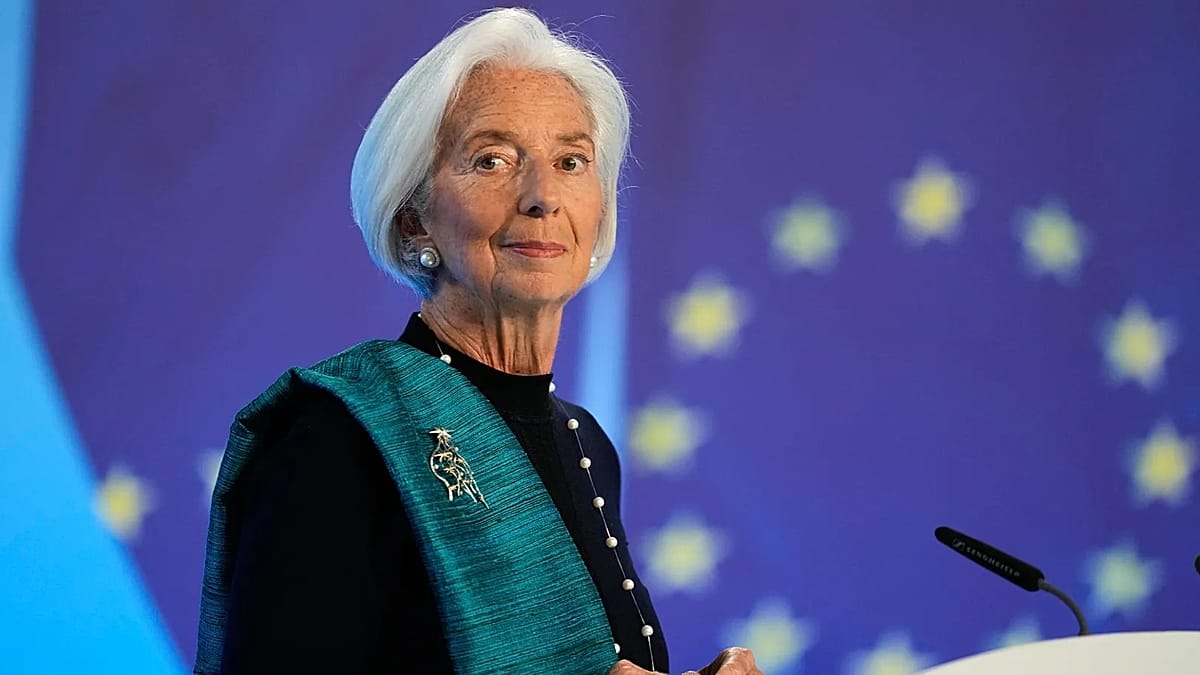
European stock markets opened in positive territory on Thursday, with investors bracing for the European Central Bank's widely expected interest rate decision later in the day. The ECB is anticipated to raise its benchmark rate by 25 basis points, from 2.0% to 2.25%, marking the first increase since 2023. Policymakers are responding to rising inflation, driven in part by higher energy prices linked to the ongoing conflict involving Iran.
The Euro Stoxx 50 opened 1.2% higher, while the broader pan-European Stoxx 600 was flat in early trading. Germany's Dax and France's CAC 40 both gained 1%, and the UK's FTSE 100 led with a 1.2% rise. Italy's FTSE MIB added 0.7%. Analysts at ING noted in a Thursday morning analysis that they expect the ECB to hike by 25 basis points, supported by a hawkish tone, but added that the bar has risen to surprise markets. Despite oil prices testing new lows earlier this week, the euro curve is increasingly set on three rate hikes.
Global Market Pressures
Asian shares mostly fell on Thursday after another sell-off in artificial intelligence stocks weighed on Wall Street. Japan's Nikkei 225 lost 0.5%, South Korea's Kospi fell 0.2%, and Australia's S&P/ASX 200 slipped 0.2%. Taiwan's Taiex declined 0.4%. Hong Kong's Hang Seng index edged 0.2% higher, while Shanghai's Composite index dropped 0.2%.
On Wall Street, the S&P 500 fell 1.6% on Wednesday, marking its first consecutive decline in three weeks. The Dow Jones Industrial Average dropped 1.9%, while the Nasdaq Composite lost 2%. The sell-off was driven by a reversal in AI-related stocks, which had hit record highs last week. Super Micro Computer, which sells AI servers, plunged 28% after announcing plans to raise $7 billion through sales of common stock and convertible preferred shares. Micron Technology ended down 4.7% after sharp volatility, while Nvidia fell 3.7%, dragging the S&P 500. Broadcom lost 5.1%.
Some pressure on AI shares may also be linked to investors raising cash ahead of several high-profile stock market debuts in the United States, including SpaceX's potential initial public offering. The recent pullback has raised questions about whether it eases concerns over excessive optimism or signals a more prolonged downturn. The European Union's Digital Markets Act has also drawn scrutiny over its impact on tech giants, with fines and delayed features raising questions about consumer benefits. Read more about the EU's Digital Markets Act.
Oil Prices and Inflation
Brent crude rose 1.8% to $93.10 a barrel on Wednesday after President Donald Trump warned that Iran would "pay the price" for stalled negotiations over the conflict. The war has effectively closed the Strait of Hormuz to oil tankers, disrupting crude shipments from the Persian Gulf. In early European trading, Brent crude was up by 0.5% at $93.60 a barrel, while US benchmark crude gained 0.7% to $90.70.
Higher oil prices have added to inflationary pressures. A report released on Wednesday showed US consumer prices rose in May at the fastest annual pace in three years. Traders are increasingly betting that the Federal Reserve will need to raise its benchmark interest rate at least once this year in response to persistent inflation and a resilient labour market. Higher yields can slow economic growth and weigh on a range of investments, including stocks and cryptocurrencies. They tend to hit the most highly valued assets hardest, and some critics argue that enthusiasm around AI has inflated a market bubble.
In currency markets, the US dollar traded at 160.58 Japanese yen in the morning. The euro rose slightly to $1.1542, and the UK pound cost $1.3377. The ECB's decision will be closely watched for guidance on future rate moves, as markets price in further tightening. The broader European economic outlook remains uncertain, with geopolitical tensions and energy prices adding to the challenges.