The European Parliament voted overwhelmingly on Wednesday to permit proxy voting for female MEPs during pregnancy and after childbirth, a move designed to ease the tension between parliamentary duties and parenthood. Yet the decision has ignited a controversy over gender equality, as the new rules apply exclusively to women, leaving fathers without the same flexibility.
The changes, passed in Strasbourg with 616 votes in favour, 24 against, and eight abstentions, introduce a temporary exemption to the Parliament's requirement for in-person voting during plenary sessions. Female MEPs can now delegate their vote to a trusted colleague for up to three months before their due date and for six months after giving birth. This builds on existing maternity leave provisions, which allow six months of absence—two months before and four months after birth—but previously left lawmakers unable to cast ballots during that period.
French Socialist MEP Chloé Ridel, who has a three-month-old baby, highlighted the practical challenges. 'I spent three months on maternity leave not being able to vote,' she told Euronews. 'When you have a small baby, you cannot come to Strasbourg without him. If you cannot vote, you cannot represent the people who elected you.' Ridel noted she still misses one day per plenary session to care for her child, who remains in Brussels while she travels to Strasbourg. 'I have to miss the votes on Monday evening. Voting implies not being with my baby for three days and three nights, which is already a lot for me.'
Gender Equality Questions
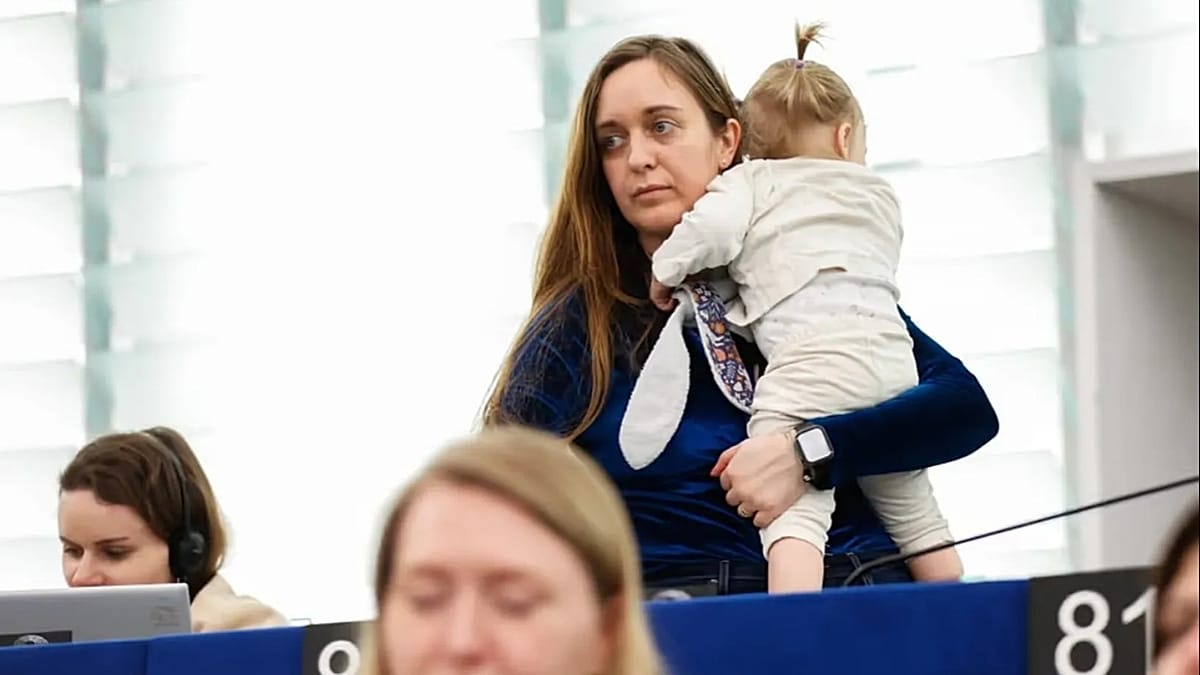
The exclusion of male MEPs has drawn sharp criticism, particularly from left-leaning groups who argue it undermines the Parliament's stated commitment to gender equality. Italian Green/EFA MEP Cristina Guarda, who has also recently given birth and is known for bringing her baby into the chamber to vote—even breastfeeding during debates—said, 'Introducing a proxy vote for fathers was impossible, due to a male-dominated view of parenthood.'
An amendment to extend the rule to fathers was rejected in November 2025, though the vote was not a roll call, leaving the identities of those who opposed it unknown. Far-right group Patriots for Europe (PfE) fiercely resisted the broader measure. Dutch PfE MEP Marieke Ehlers argued during the debate, 'The liberals and the Greens demanded that this arrangement be extended to all parents, either because they believe it is not only women who can become pregnant and give birth, or because they think that fathers spending three nights on a camping bed in hospital is somehow to be compared with the situation of women giving birth.'
The Parliament's parental leave policy covers both parents, but the proxy voting option remains gender-specific. This discrepancy has prompted questions about how the institution balances support for new parents with its broader equality goals. The rule now requires ratification by EU national parliaments before it can take effect.
This development comes amid broader debates in the EU about work-life balance and gender roles. The European Parliament has previously pushed for policies like an EU-wide consent-based definition of rape, as reported in European Parliament Urges EU-Wide Consent-Based Definition of Rape. Meanwhile, the institution is also grappling with other internal reforms, such as the push to end unanimous voting after Hungary's Orbán blocked key decisions.
The proxy voting measure reflects a growing recognition of the need to accommodate parenthood in political life, but its gendered application may fuel further calls for reform. As the Parliament awaits national ratification, the debate over whether fathers deserve the same flexibility is unlikely to fade.