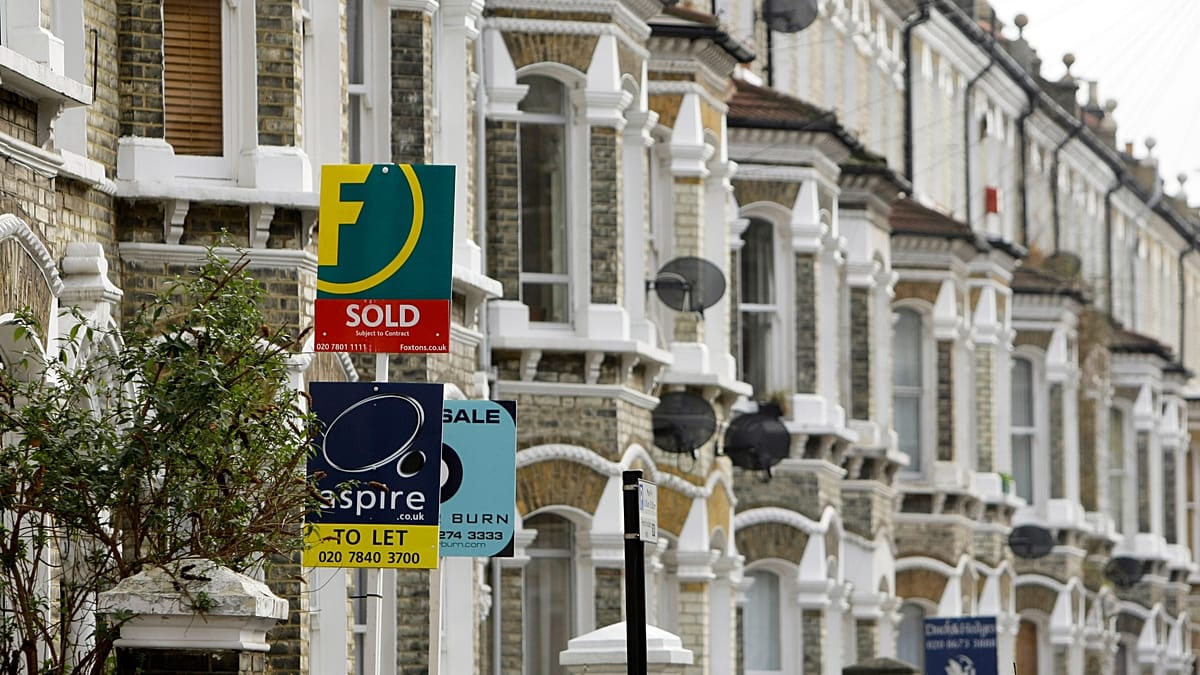
Housing remains the single largest household expense across the European Union, accounting for nearly a quarter of spending when utilities are included, according to the latest Eurostat figures. But the cost of renting a home varies enormously depending on which capital city you choose.
Eurostat examined 40 cities across 38 countries — including all EU member states, candidate and potential candidate countries, EFTA members, and the United Kingdom — and found that the average monthly rent for a two-bedroom flat ranges from €470 in Skopje, North Macedonia, to €3,350 in Geneva, Switzerland.
London leads, but EU capitals also pricey
London is the only capital where average rents exceed €3,000, at €3,050 per month. Among EU capitals, Dublin and Stockholm share the top spot at €2,650 each, followed by Oslo at €2,550. Paris, at €2,500, is the most expensive of the EU's four largest economies — ahead of Berlin (€1,750), Madrid (€1,700), and Rome (€1,650).
Other cities where rents surpass €2,000 include Copenhagen, Luxembourg, and Reykjavik (all €2,350), as well as The Hague (€2,150), Bern (€2,150), and Munich (€2,050). A cluster of capitals — Lisbon (€1,750), Prague (€1,650), Vienna (€1,600), Zagreb (€1,550), Helsinki (€1,550), and Athens (€1,500) — fall in the €1,500–€1,750 range.
At the lower end, Pristina (€520) and Ankara (€770) are among the cheapest, while within the EU, Sofia (€900) and Nicosia (€910) are the most affordable capitals. Tirana (€920) and Bucharest (€930) also remain below €1,000.
Why rents diverge so sharply
Mikk Kalmet, a real estate expert at Global Property, explained that housing markets are inherently local. “In places like Geneva, London, Dublin, or Stockholm, strong demand from well-paid workers, international companies, students, and newcomers exists, while housing supply has not grown fast enough,” he told Euronews Business. When more people want to live in a city than there are homes available, rents tend to rise.
Income levels also play a role. “Countries with higher salaries can generally support higher rents, which is one reason why some of the most expensive cities are found in Western and Northern Europe,” Kalmet noted. “At the same time, lower rents in Central and Eastern Europe do not necessarily mean housing is more affordable, because local wages are often lower as well. Looking only at rent levels can therefore be misleading without considering incomes.”
Brussels, the EU's administrative capital, sits roughly in the middle of the ranking at €1,450 per month — 22nd out of 40 cities.
Rising rents across the continent
Kalmet pointed out that rents have increased across much of Europe in recent years, driven by a combination of post-pandemic urban demand, population growth, migration flows, rising interest rates, and elevated construction costs. Higher interest rates have made buying a home more difficult for many households, pushing more people into renting and adding further demand. “In many major/capital cities, supply has simply struggled to keep up with these changes,” he said.
Eurostat's data excludes charges and utilities and covers unfurnished properties of good or very good quality, but not luxurious. The figures offer a snapshot of a market under pressure, with implications for household budgets and policy decisions across the continent.
For context on how other costs vary across Europe, see our analysis of EV charging costs and density and the factors driving ticket prices in major events.