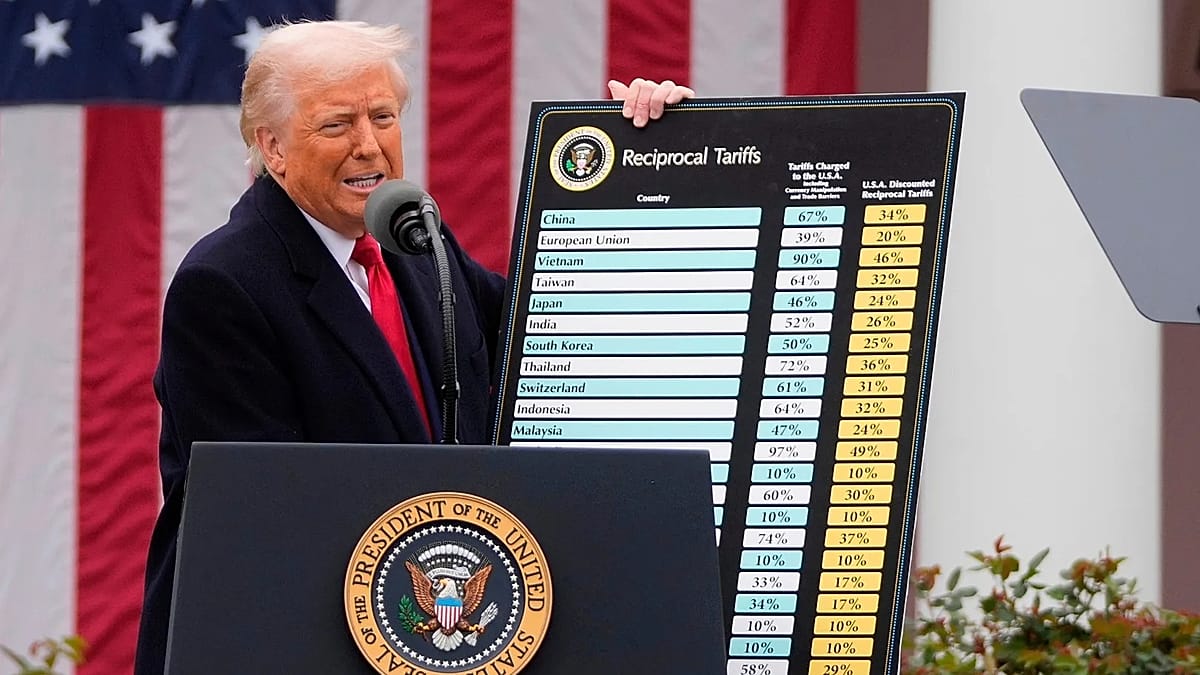
The administration of US President Donald Trump has reimbursed approximately $100 billion (€86.6 billion) in so-called “Liberation Day” tariffs to thousands of businesses, according to court documents filed by US Customs and Border Protection. The repayments, processed through customs officials, represent about 60 percent of all duties collected under the initiative.
In total, the administration had gathered around $165 billion (€143 billion) from these import taxes, as reported by the Financial Times. However, nearly $29 billion (€25.1 billion) in potential refunds remains under review by trade authorities, while roughly $1.6 billion (€1.4 billion) has not yet been disbursed because some importers have failed to provide their banking details.
The refund process began in April, when a long-awaited online portal was launched for US businesses to claim their money back. At that time, eligible claims—including interest—had already reached about $127 billion (€110 billion), out of the $166 billion (€143 billion) in tariffs paid by more than 330,000 importers across over 53 million shipments, according to the Associated Press.
A legal rebuke from the Supreme Court
The repayments follow a landmark ruling in February, when the US Supreme Court voted 6-3 that Trump had overstepped Congress’s tax-setting authority and had no constitutional basis to impose these import duties. The “Liberation Day” tariffs had been introduced under the International Emergency Economic Powers Act (IEEPA), a 1977 law that grants the president broad powers to “regulate” trade during emergencies. The court found that this authority did not extend to levying tariffs.
The IEEPA does not offer a precise definition of what constitutes an emergency. Instead, it gives the president wide latitude to declare a national emergency under 50 U.S.C. § 1701, requiring only that the threat be “unusual and extraordinary” and that it originate from a foreign source, with vague references to national security or the economy.
The ruling has had significant repercussions for US trade policy, and the refunds are a direct consequence. For European businesses and governments, the episode underscores the volatility of relying on US executive actions for trade relations. The European Union has already faced similar tariff threats, and the Supreme Court’s decision may encourage EU policymakers to push for more predictable trade frameworks.
Domestic backlash and corporate responses
The tariffs, a cornerstone of Trump’s economic and leverage strategy, have sparked widespread anger among US businesses. Importers and domestic firms bear the cost of these duties when goods arrive at customs, rather than foreign exporters or governments. This has placed a heavy financial strain on companies, which have often passed on higher costs to consumers through increased retail prices.
Some corporations have begun to use their refunds in notable ways. Amazon, for instance, has already received around $600 million (€519.7 million) and has chosen to allocate part of that sum to customer relief and to subsidise lower store prices. However, such decisions are entirely voluntary; US customs law does not mandate how refunds must be used.
The refund process is not without its challenges. Trade authorities are still scrutinising nearly $29 billion in claims, and the remaining $1.6 billion awaits importers’ banking information. For many small and medium-sized enterprises, the delays add to the uncertainty that has plagued transatlantic trade since the tariffs were first imposed.
European observers have watched these developments closely, particularly given the EU’s own experiences with US tariffs on steel, aluminium, and other goods. The Supreme Court’s ruling may set a precedent that limits future presidential overreach, but it does not eliminate the risk of new trade barriers. As the EU continues to navigate its relationship with Washington, the refunds serve as a reminder of the legal and economic complexities inherent in transatlantic commerce.
Meanwhile, the Trump administration has shown no sign of abandoning tariffs as a tool. Recent proposals, such as a US Senate sanctions bill that could hand Trump new tariff powers against Europe, suggest that the legal setback may not deter future attempts. For European businesses, the lesson is clear: the stability of US trade policy cannot be taken for granted, and legal challenges may offer only temporary relief.
As the refunds continue to be processed, the broader implications for global trade remain uncertain. The EU, for its part, has been strengthening its own trade defence mechanisms, as seen in its recent channelling of €1.4 billion from frozen Russian assets to Ukraine, a move that underscores the bloc’s resolve to act independently on the world stage. Whether Washington’s tariff saga will lead to a more rules-based approach remains to be seen, but for now, the refunds are a tangible step toward rectifying what the courts have deemed an overreach of executive power.