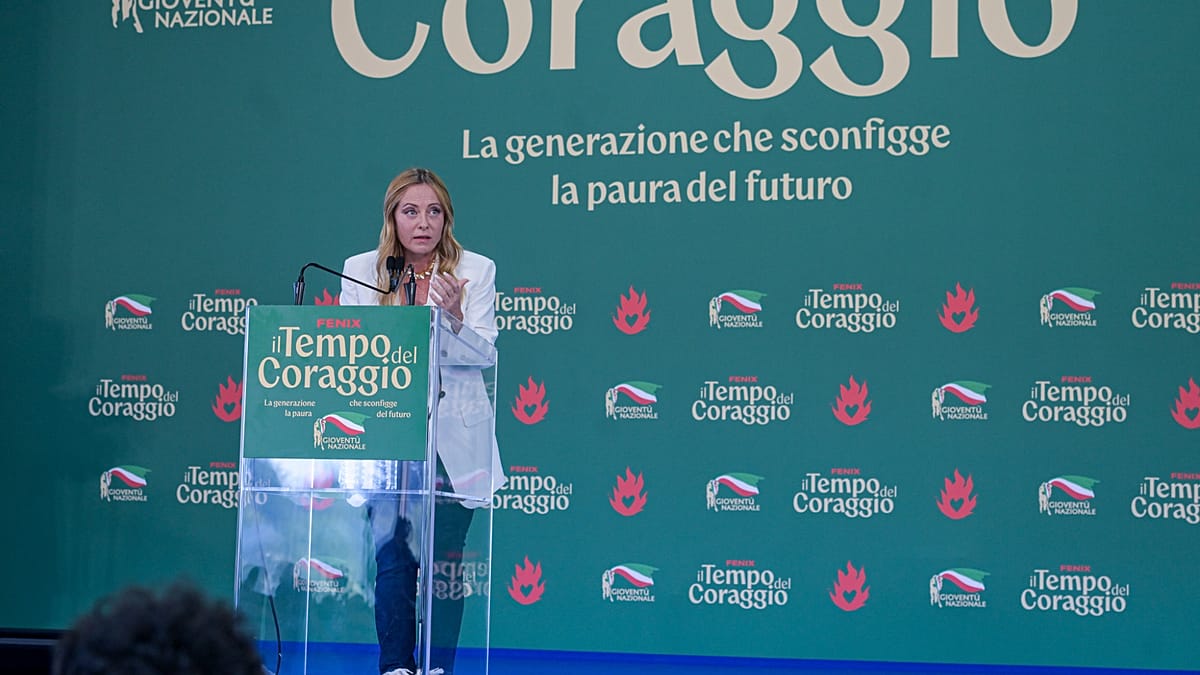
Italian Prime Minister Giorgia Meloni has unveiled plans to introduce a school bill that would ban full-face veils in classrooms and set a maximum number of foreign students per class. The announcement, made on Sunday at the Fenix festival of her party's youth wing, Gioventù Nazionale, signals a hardening of the government's stance on integration and security.
Speaking in front of a young audience, Meloni framed the measures as a corrective to what she called a "convenient lie" of integration. "It is unacceptable that in an Italian classroom the children who end up feeling pushed into a corner are Italian children because they have become the minority," she said. "Calling all this integration is yet another lie, a convenient lie for those who live off ideology, for those who preach to us from their living rooms and then send their own children to schools where this problem does not exist."
The bill, which is expected to go before the Council of Ministers, would also make Italian language classes compulsory for parents of foreign students with serious integration difficulties. Meloni's remarks come after months of preparatory moves, including an amendment floated by Education Minister Giuseppe Valditara in early August and a resolution against the full-face veil approved in the Chamber of Deputies' Culture Committee in July, backed by the centre-right.
Legal and political context
The initiative builds on earlier legislative efforts. In March, the League party tabled a Senate bill to amend the 1975 "Reale" law, originally introduced during the Years of Lead to ban masking in public places. The proposed amendment would create a new offence of forcing someone to conceal their face, punishable by one to two years in prison and fines of up to €30,000, and would also bar convicted offenders from obtaining citizenship.
Roberto Vannacci, the far-right MEP who founded the Futuro Nazionale party, has already voiced support for Meloni's measure. The debate over face coverings in schools is part of a broader European conversation about religious symbols, security, and integration.
European rules on full-face veils
Across the continent, regulations vary widely. France was the first to introduce a blanket ban on face coverings in public spaces in April 2011, a law later upheld by the European Court of Human Rights. Belgium followed with a similar ban in July 2011, imposing fines and prison sentences. Bulgaria has prohibited full-face veils in state, administrative, and educational institutions since September 2016.
Austria passed an anti-mask law in October 2017 requiring facial features to remain visible in public, and from September 2026, girls up to age 14 will be barred from wearing any head covering "according to Islamic traditions" in schools. Denmark introduced a nationwide ban in August 2018, with escalating penalties for repeat offences. The Netherlands opted for a partial ban in August 2019, applying to schools, hospitals, government offices, and public transport. Switzerland adopted a federal ban following a 2021 referendum, with implementing legislation in force since 2023. Portugal completed its legislative process in August 2026, prohibiting face concealment in public spaces with financial penalties.
Germany has no nationwide ban, but federal law prohibits public employees, judges, soldiers, and motorists from covering their faces while driving. Several Länder impose restrictions on full-face veils in schools and universities for both students and teachers, reflecting a fragmented approach based on state neutrality and road safety.
Quotas for foreign students: a first for Europe
If Italy adopts a cap on foreign students per class, it would be the first EU country to do so. Currently, Italy's 30% limit on non-Italian pupils is set out in a 2010 ministerial circular, but it has often been ignored due to demographic pressures and a lack of flexibility in urban areas.
Denmark has the toughest policies in Europe, allowing upper secondary schools to cap enrolment of students of "non-Western origin" at 50% and to organise classes based on parents' income to encourage social mixing. The Italian government has expressed interest in this model. In France, the approach has been different, focusing on language support and integration programmes rather than quotas.
Critics argue that such measures risk stigmatising immigrant communities and may not address the underlying challenges of integration. Supporters, however, see them as necessary to preserve social cohesion and ensure that all children, regardless of background, have equal opportunities in the classroom.
The announcement has already sparked debate across the political spectrum, with some comparing it to Meloni's broader political strategy ahead of the 2027 general election. As the bill moves through the legislative process, its fate will be closely watched both in Rome and in other European capitals, where similar debates are ongoing.