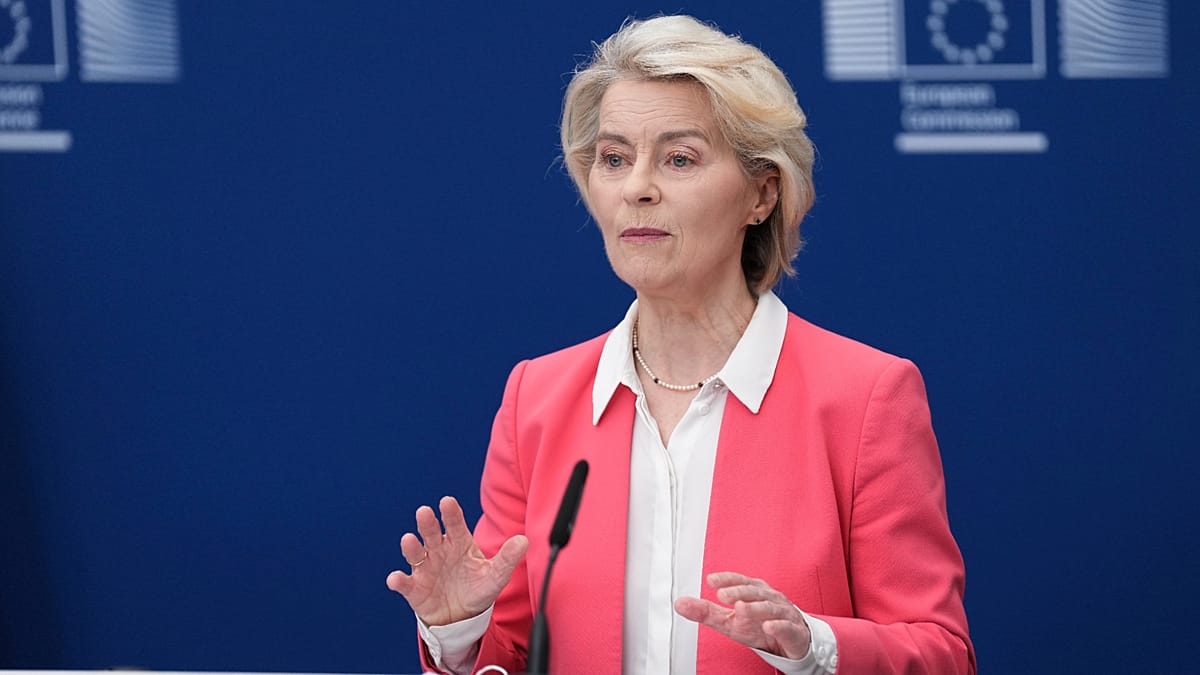
European Commission President Ursula von der Leyen has condemned Russia's "horrible atrocities" after a night of deadly strikes on Kyiv, and announced a fresh €1.4 billion transfer to Ukraine drawn from profits on immobilised Russian assets.
The announcement came a day after Russian ballistic missiles and drones hit the Ukrainian capital, killing at least 17 people. Moscow has intensified its aerial campaign in recent weeks, repeatedly targeting civilian infrastructure and residential areas.
"Once again we wake up to the news of horrible atrocities by Russia through its aerial attacks on Ukraine. Russia must pay for the destruction it has caused," von der Leyen wrote on X. She added that the funds would "support Ukraine's continued resistance against Russia's illegal war."
How the money is allocated
Although the headline figure is €1.4 billion, the bulk of it — 95%, or €1.33 billion — will not go directly to the Ukrainian military. Instead, it will be channelled through the Ukraine Loan Cooperation Mechanism to help service loans extended to Kyiv under G7 and EU initiatives. The remaining €70 million is earmarked for military assistance.
The European Commission says the immobilised Russian Central Bank assets have generated roughly €8 billion in windfall profits since they were frozen in 2022, shortly after Russia's full-scale invasion. The assets themselves remain untouched, but the interest and other income they produce have become a key funding source for Ukraine.
This latest tranche is part of a broader effort by Brussels and its allies to make Russia pay for the destruction it has caused. The mechanism is designed to provide predictable, long-term support without adding to the debt burden of EU member states.
Ukraine's allies have been grappling with how to use the frozen assets effectively. While the EU has moved ahead with its profit-based scheme, discussions about seizing the principal amount remain legally and politically fraught. The G7 has also been working on a separate loan package, backed by future profits from the same assets.
The timing of the announcement is significant. Kyiv has been under intense pressure, with overnight strikes killing 15 in the capital and sparking large fires. The attacks have also extended to other regions, including Zaporizhzhia, where glide bombs killed one and wounded dozens.
European support for Ukraine remains a contentious issue in some member states, but the EU's executive has consistently pushed for a unified response. The question of Ukraine's eventual EU membership is also a live debate, with support for Kyiv's bid varying sharply across the continent.
Meanwhile, the United States has yet to finalise a decision on providing Patriot air defence systems to Ukraine, leaving European allies to fill the gap. The EU's latest funding is a tangible sign that Brussels intends to stay the course, even as the war enters its third year.
For now, the €1.4 billion transfer offers Kyiv a measure of financial certainty. But the human cost of the war continues to mount, and European leaders are under pressure to do more — both militarily and economically — to help Ukraine withstand the onslaught.