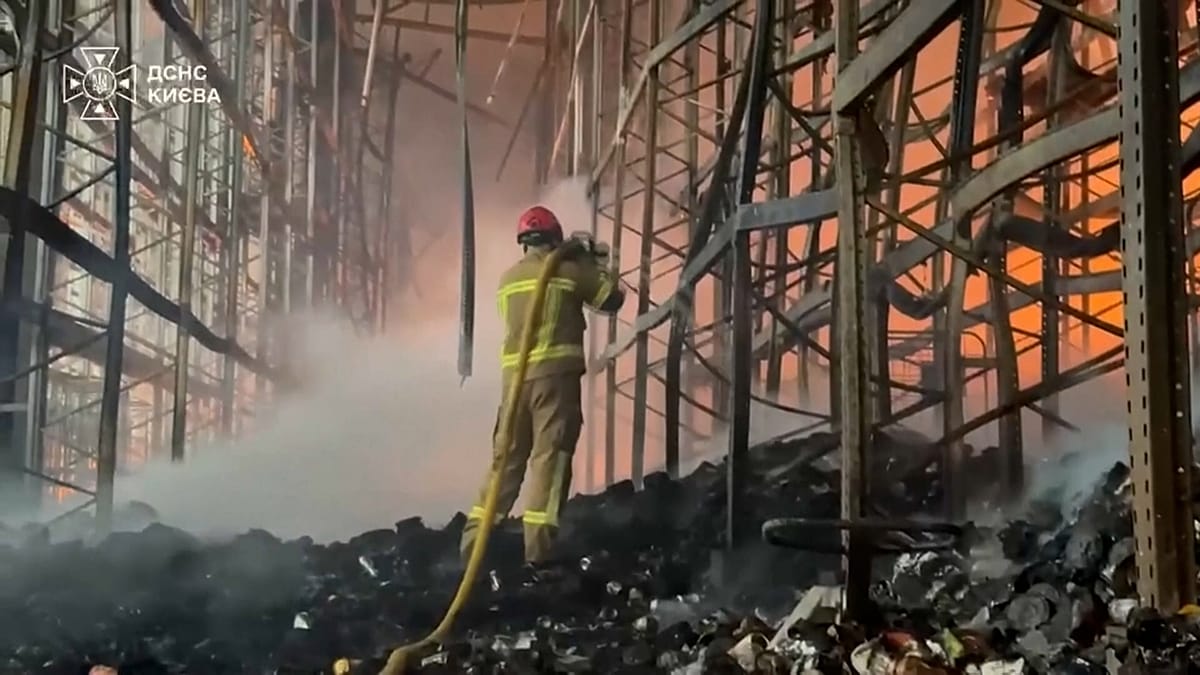
Kyiv endured one of its deadliest nights in recent weeks as Russian missile and drone strikes pounded the capital and its outskirts, killing at least 15 people and wounding 42 others. The attacks, which began late in the evening and continued into the early hours, ignited fires across several industrial and residential sites, forcing firefighters to battle blazes in warehouses and apartment blocks simultaneously.
Emergency services reported that rescue teams worked through the night, pulling survivors from the rubble and extinguishing flames that threatened to spread to neighbouring buildings. In the Darnytskyi district, a large warehouse complex was reduced to smouldering ruins, while in the Solomianskyi district, debris from intercepted drones damaged a residential building, shattering windows and setting balconies alight.
Ukrainian officials said the attack involved a combination of cruise missiles and Iranian-designed Shahed drones, launched from Russian territory and occupied areas in the south. Air defence systems intercepted a significant number of the projectiles, but several penetrated the city's defences, causing widespread destruction. The regional military administration reported that falling debris from downed drones also started fires in at least three locations.
Civilian toll and emergency response
The casualties include residents who were sheltering in their homes when the strikes hit. Among the dead were two women and a child, according to the Kyiv city military administration. Dozens of ambulances rushed the wounded to hospitals, where medical teams treated injuries ranging from shrapnel wounds to burns and smoke inhalation. The health ministry said that 12 of the injured remain in serious condition.
Firefighters faced a daunting task, with more than 200 personnel and 40 pieces of equipment deployed across the city. By dawn, most of the major blazes had been contained, but crews continued to damp down hotspots in the affected areas. The State Emergency Service released footage showing firefighters battling towering flames against a backdrop of darkened apartment blocks, a stark reminder of the war's relentless toll on civilian life.
Kyiv's mayor, Vitali Klitschko, described the night as "one of the most difficult" since the start of the full-scale invasion. He urged residents to heed air raid warnings and to stay in shelters until the all-clear was given. "The enemy is trying to break our spirit, but we will not be broken," he said in a statement.
Wider pattern of attacks
The assault on Kyiv is part of a broader wave of Russian strikes across Ukraine in recent days. In the southern city of Kherson, a market vendor recounted a deadly drone chase that killed a civilian, highlighting the increasing use of drones against non-military targets. Police have documented multiple incidents of drones targeting civilians in the region, including an attack on a market that was captured on video.
The strikes also come amid heightened tensions in the Black Sea, where Turkey condemned drone strikes on two civilian ships, underscoring the risks to maritime trade. Meanwhile, the EU's efforts to tighten sanctions on Russian oil have stalled, with a proposed ban on maritime services facing deadlock among G7 members.
European leaders have condemned the latest attacks, with several calling for increased military aid to Ukraine. The European Union's foreign policy chief, Josep Borrell, said the strikes were "another blatant violation of international humanitarian law" and reiterated the bloc's support for Ukraine's right to self-defence.
As the sun rose over Kyiv, residents emerged from shelters to assess the damage. In the Brovary district, east of the capital, a local school was partially destroyed, and a nearby gas station was engulfed in flames. The full extent of the destruction is still being assessed, but officials say the recovery will take weeks.
The attacks have also reignited debates about air defence capabilities. Ukraine has repeatedly called for more advanced systems, including Patriot batteries, to protect its cities from Russian missiles. Western allies have pledged additional support, but deliveries have been slow, leaving civilians exposed to nightly bombardments.
For many Kyivans, the latest assault is a grim reminder that the war is far from over. "We have become used to the sirens, but not to the loss of life," said Olena, a resident of the Darnytskyi district, as she surveyed the charred remains of a warehouse near her home. "Every night we pray that the next morning will bring good news. Tonight, it did not."