From the Western Balkans to the Southern Caucasus, the Euronews Enlargement Summit in Brussels offered a snapshot of a European Union that is closer to expanding than at any point in the past decade – yet still grappling with the political fractures that could derail the process.
Leaders and ministers from candidate countries gathered to discuss their ambitions and the bloc's readiness to admit them. The mood was cautiously optimistic, but the summit also laid bare the uneven pace of reform and the diplomatic friction that persists across the continent.
European Council President António Costa, in a written address to the summit, stressed that the accession process must be a force for reconciliation. “The ambition to join the European Union must help overcome historical grievances, reject nationalist rhetoric, and encourage countries to move towards genuine cooperation,” he said. “Europe's experience demonstrates that enlargement benefits us all.”
Armenia and Georgia head in opposite directions
In the Southern Caucasus, the two candidate countries are moving in opposite directions. Armenia's Prime Minister Nikol Pashinyan said a formal application for EU membership in 2027 or 2028 was “realistic,” describing the bloc as the main guarantor of his country's democracy since the 2018 revolution. “Our first intention is to create an alternative for the people of Armenia and for the Republic of Armenia, because, traditionally, the perception of our society and maybe our neighbourhood was that Armenia has no alternative,” he added.
Pashinyan acknowledged the difficult trade-off between EU membership and remaining in Russia's Eurasian Economic Union, saying the choice would ultimately be for the Armenian people.
Georgia, by contrast, is stuck. Its candidacy has been frozen since 2024 over controversial laws on foreign influence and family values. Prime Minister Irakli Kobakhidze insisted he remained “very committed” to joining the bloc, but offered no clear path to restarting negotiations. He refused to repeal the contested legislation, accusing the European Commission of double standards and of “political blackmail.” He likened the EU's demands to Soviet methods, arguing that the laws were passed “with dignity” and were in line with international standards. Asked why Georgia still wanted to join, Kobakhidze said he was “optimistic” that the EU itself would change its attitude.
Montenegro enters the final stretch
Montenegro is leading the accession race, aiming to become the EU's 28th member state by 2028. But European Affairs Minister Maida Gorčević warned that her country would not accept second-class membership. The European Commission recently proposed a 15-year probation period for new members, which in the most serious cases could lead to the suspension of voting rights. “We don't want second-grade membership inside the European Union, because that wouldn't be fair and that wouldn't be full membership as well,” Gorčević said, while adding that Podgorica was not opposed to additional safeguards.
She also said Montenegro was working to resolve outstanding bilateral issues with Croatia, though the border dispute could be settled after accession. Croatian Prime Minister Andrej Plenković, for his part, warned that the upcoming French election could derail enlargement, as Eurosceptic candidates lead in the polls. “The political events may affect the enlargement more substantially than anybody can imagine today,” he said. He also questioned the wisdom of setting a fixed deadline, noting that “something always unpredictable happens and things get postponed.”
Western Balkans moving at different speeds
Albania, the second-closest candidate, is also the second-fastest. Prime Minister Edi Rama reiterated his commitment to conclude negotiations by the end of 2027. He called for a “Helmut Kohl moment” for the EU, a reference to the chancellor who unified Germany, and defended enlargement as a merit-based process. He also warned that Serbia's new leadership was unlikely to soften Belgrade's opposition to recognising Kosovo, a major obstacle to its own EU ambitions.
On Albania's controversial deal with Italy to transfer irregular migrants to deportation camps, Rama said “the deal will stay for as long as need be,” promising to keep it in force as long as Giorgia Meloni remains in power.
North Macedonia, meanwhile, has been stalled for years over a dispute with Bulgaria about the treatment of the Bulgarian minority. President Gordana Siljanovska-Davkova said her country's EU hopes are being held hostage by Bulgaria, which is demanding constitutional changes to recognise the minority.
Ukraine pushes back against farm restrictions
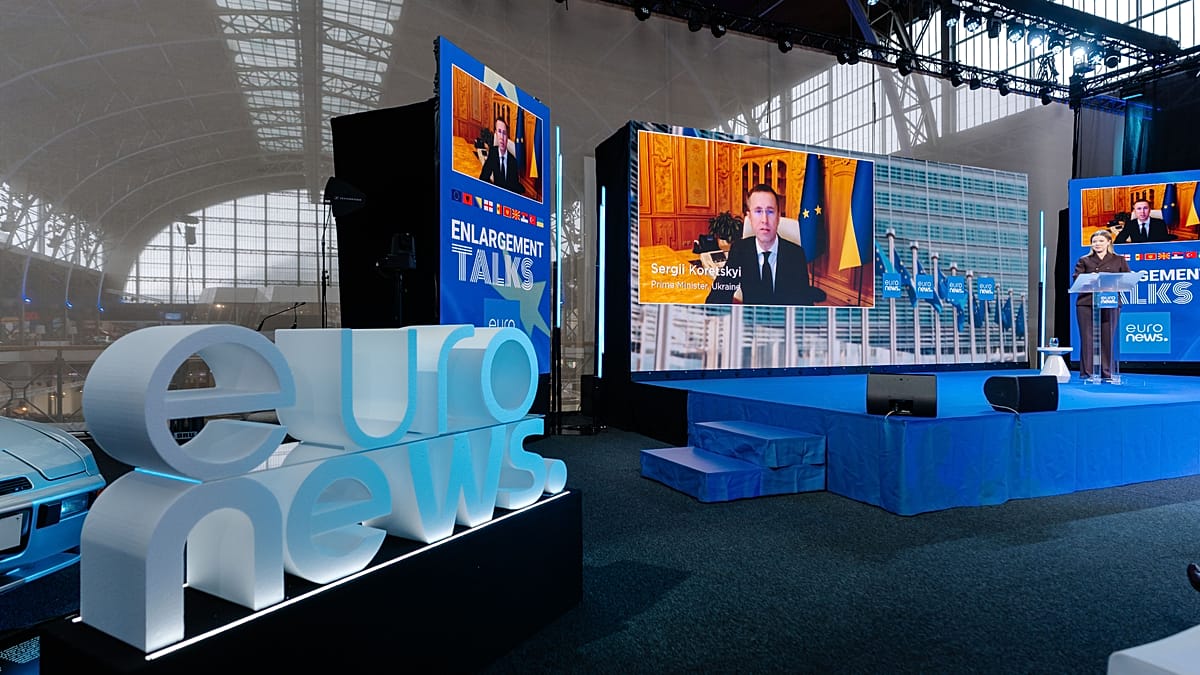
Ukrainian Prime Minister Sergii Koretskyi rejected the proposed exclusion of certain agricultural products, such as wheat and grain, from the EU market even after Kyiv becomes a full member. The European Commission pitched the measure last month after pressure from several member states that feared Ukraine's agricultural output could threaten their farmers. Koretskyi argued that transitional measures can be part of enlargement, but they must address specific risks and have clear review and exit conditions. “They cannot become a permanent restriction or a subset of the single market,” he said.
The summit underscored that while the EU's enlargement agenda is more tangible than it has been in years, the road to accession remains uneven and politically charged. As frontrunners surge and laggards fall behind, the bloc's ability to manage these divergent paths will be crucial. The coming months, including the French election, could prove decisive for the entire process.