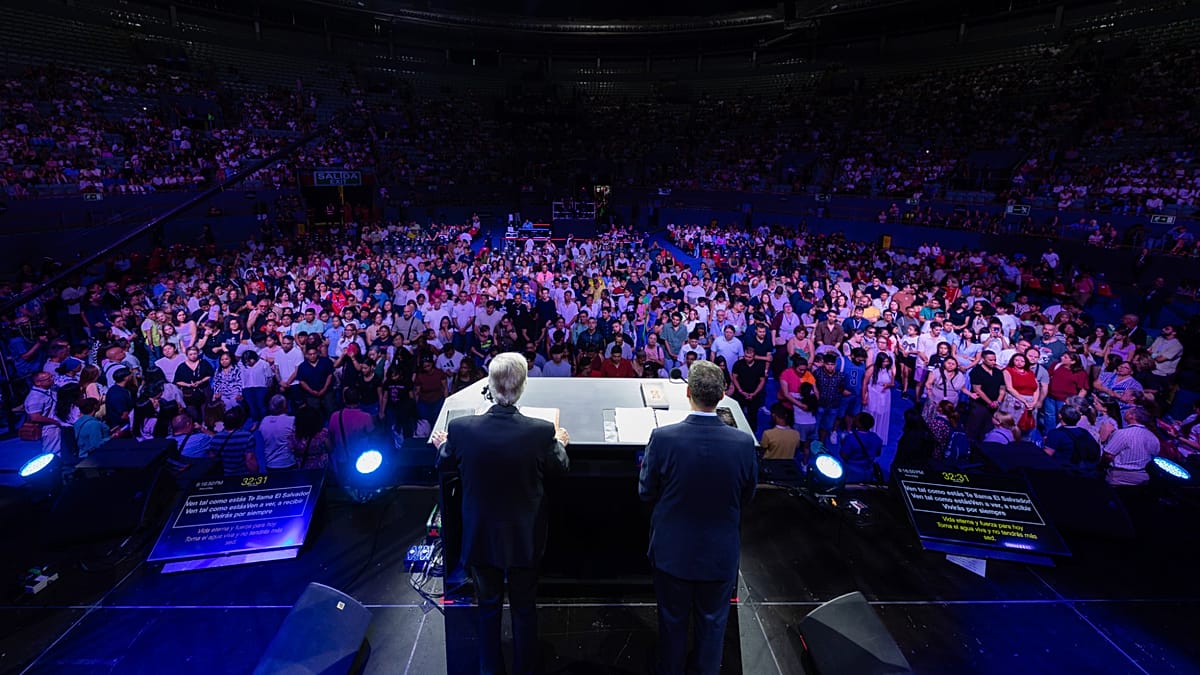
On a late May weekend, Madrid's Palacio Vistalegre resembled a concert venue more than a place of worship. Thousands raised their hands in song as Franklin Graham—son of the late evangelist Billy Graham, president of the Billy Graham Evangelistic Association, and a prominent ally of US President Donald Trump—took the stage. The Festival of Hope, held on 30 and 31 May, drew an estimated 18,700 people over two days, according to the association, with 12,600 attending the first day alone and roughly 2,000 turned away for lack of space.
“Spain needs hope, and that hope is found in Jesus Christ,” Graham told the crowd. He noted a renewed interest in Christian faith across several European countries and expressed a wish for Spain to experience a “spiritual awakening.” The event, prepared over 18 months, mobilised around 840 churches from various evangelical denominations in the Madrid region. Nearly 9,800 people participated in training and evangelisation activities in the months leading up to the festival.
Evangelical Growth in Numbers
The scale of the Festival of Hope reflects a deeper transformation in Spain's religious landscape. According to the Observatorio del Pluralismo Religioso en España, the country had 4,763 evangelical places of worship as of September 2025, up from 4,455 a year earlier and far above the 2,944 recorded in 2011. Catalonia leads with 1,010 evangelical churches, followed by Madrid (855), Andalusia (744), and the Valencia region (510). While the Catholic Church remains dominant with 22,922 registered places of worship, evangelical churches now account for more than half of all non-Catholic religious centres.
In the Madrid region alone, the number of evangelical churches has grown from around 662 to 855 in just over a decade. Evangelical organisations estimate the community now numbers roughly 1.5 million people, though official statistics on worshippers are lacking. The movement has also gained visibility in universities, neighbourhood associations, media, public events, and social networks—a far cry from its low profile two decades ago.
Latin American Immigration as a Catalyst
A key driver of this expansion is Latin American immigration. Spain's population continues to hit record highs, fuelled by arrivals from Colombia, Venezuela, and other countries where evangelical and Pentecostal churches have seen strong growth for decades. For many migrants, congregations serve as more than places of worship; they offer community networks, guidance, and a family-like environment for those arriving without established social support.
“Churches act as a first safety net, helping newcomers build personal and work contacts and offering a sense of belonging,” notes the Observatorio. This social role is a recurring theme in analyses of evangelical growth.
The movement's growing public profile was also evident weeks before the Festival of Hope, when The Change Madrid gathered around 35,000 people at the Metropolitano stadium, according to organisers. The event featured international preachers and former Brazilian footballer Dani Alves, who shared his religious conversion story after his time in prison. Such mega-events combine live music, audiovisual production, digital broadcasts, and personal testimonies—a blend of religious fervour and spectacle that has raised the movement's profile.
The timing of these gatherings is notable: they come just days before Pope Leo XIV's scheduled visit to Spain, which includes a 2,500 km itinerary across four cities. The contrast between the traditional Catholic hierarchy and the rapidly growing evangelical movement underscores a shifting religious dynamic in a country long considered a Catholic stronghold.
As Spain grapples with broader societal changes—including record heatwaves and debates over health worker statutes—the evangelical surge adds another layer to its evolving identity. Whether this growth will translate into lasting political or cultural influence remains to be seen, but for now, the movement is filling venues and reshaping the religious map of the continent.