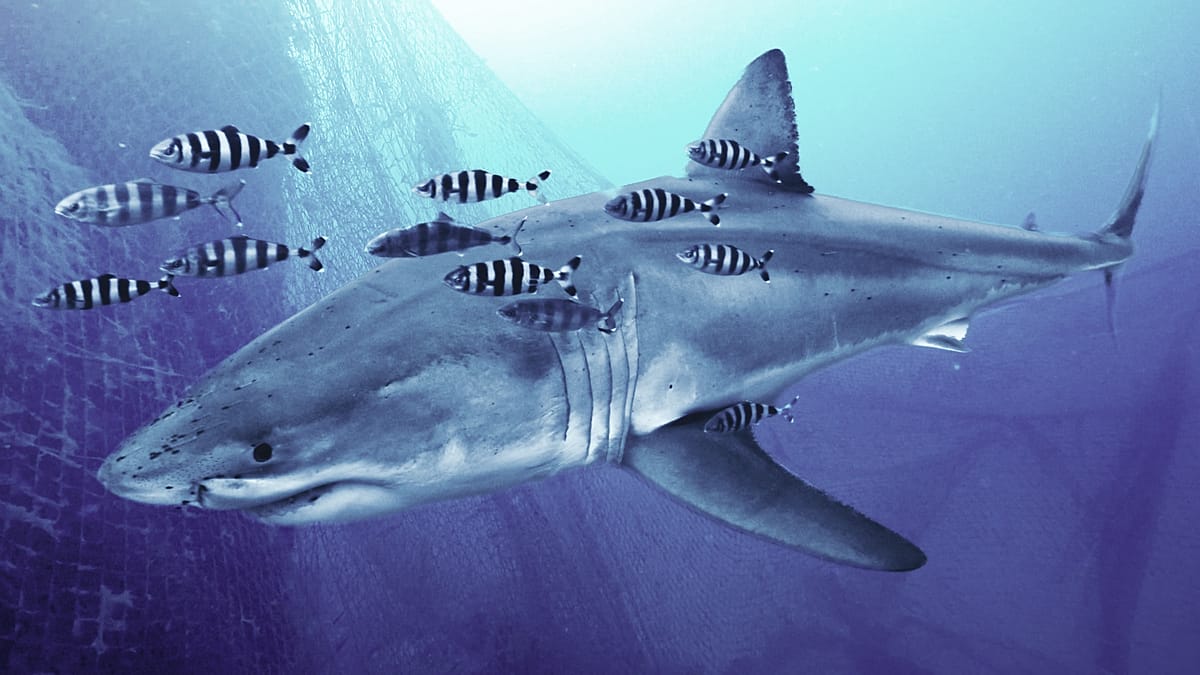
Volunteer technical divers working to clear abandoned fishing nets from a shipwreck in the Strait of Sicily have captured what is believed to be the first underwater footage of an adult great white shark in the Mediterranean Sea. The encounter, which occurred at a depth of roughly 40 metres, was recorded by Derk Remmers, head of Ghost Diving's German chapter, during a mission organised by the Healthy Seas Foundation, Ghost Diving, and the Society for Documentation of Submerged Sites (SDSS).
“We were all a bit shocked – and amazed,” Remmers told the foundation. “My fingers were trembling, that's for sure – it was a big animal and we didn't expect this at all.” The shark circled the group before apparently losing interest. “He swam by and then he turned around and faced us and came back. It seemed clear that he was curious and not aggressive – he was really laid back, like he had the attitude of being the boss down there. And when we started releasing a few bubbles from our mouth, he started speeding up a little bit and vanished into the blue.”
Scientific Significance
Marine biologists consulted after the mission described the sighting as highly unusual and scientifically valuable. “Most of our knowledge on white sharks in the Mediterranean comes from records of dead specimens caught by fishing operations. Observations like this are extremely valuable for improving our understanding of the distribution, habits, and behaviour of this critically endangered species,” said Dr Carlo Cattano, a researcher at the Sicily Marine Centre of the Stazione Zoologica Anton Dohrn, in a statement released by Healthy Seas.
The Strait of Sicily is one of the most heavily exploited fishing areas in the Mediterranean. The shipwreck the team was targeting had been accumulating ghost nets – fishing gear lost or abandoned at sea – for years. Ghost nets continue to trap and kill marine life indefinitely, entangling species such as loggerhead sea turtles and large fish. The team recovered sections of net during this mission, which will be discarded safely or recycled where possible.
“They are made to kill fish and they still do that when they're not attached to the fishing boat anymore,” Remmers explained. “Year by year, the amount of nets caught on this wreck gets bigger and bigger.” The scale of the problem is staggering: between one and ten per cent of all fishing gear worldwide is lost annually, potentially amounting to more than half a million tonnes per year.
The shark's presence underscored the broader threat to the marine food web. “We feel somehow blessed to have this encounter, which also shows us the importance of our work,” Remmers said. “Because if a predator like that is hunting close to this wreck, that also means that there's a big amount of fish and a big amount of animals he could hunt there. And if they are trapped, there's also a chance we trap some of these predators. And if we trap them – there are only very few around there – that would be a big disaster.”
Beyond Cleanup: Addressing the Root Cause
Remmers emphasised that volunteer clean-up operations alone cannot solve the ghost net crisis. “We can only do so much – we are only a few people,” he said. “One thing is to remove the nets, which is the least we could do as humans. But it's also our idea to inform the public about this problem, so that work can be done before we need to collect the nets.” He argued that tackling the issue requires confronting illegal and large-scale industrial fishing, noting that family-run fishing businesses have strong incentives not to lose gear, whereas industrial and illegal operators pose the greatest threat.
“We should, as humans and as Europeans, try to enable our politicians to work against this threat and be more careful about our environment underwater,” Remmers urged. The mission also included environmental DNA sampling and underwater monitoring to improve understanding of species around the wreck. Further analysis is expected in the coming months, with additional footage and scientific material to be released.
This story highlights the intersection of marine conservation and European environmental policy. For more on how geopolitical tensions affect energy and trade routes, see our coverage of Houthi Red Sea Ban and Hormuz Blockade Threaten Global Energy Routes and US-Iran Military Exchanges Threaten Fragile Middle East Ceasefire and Strait of Hormuz Shipping.