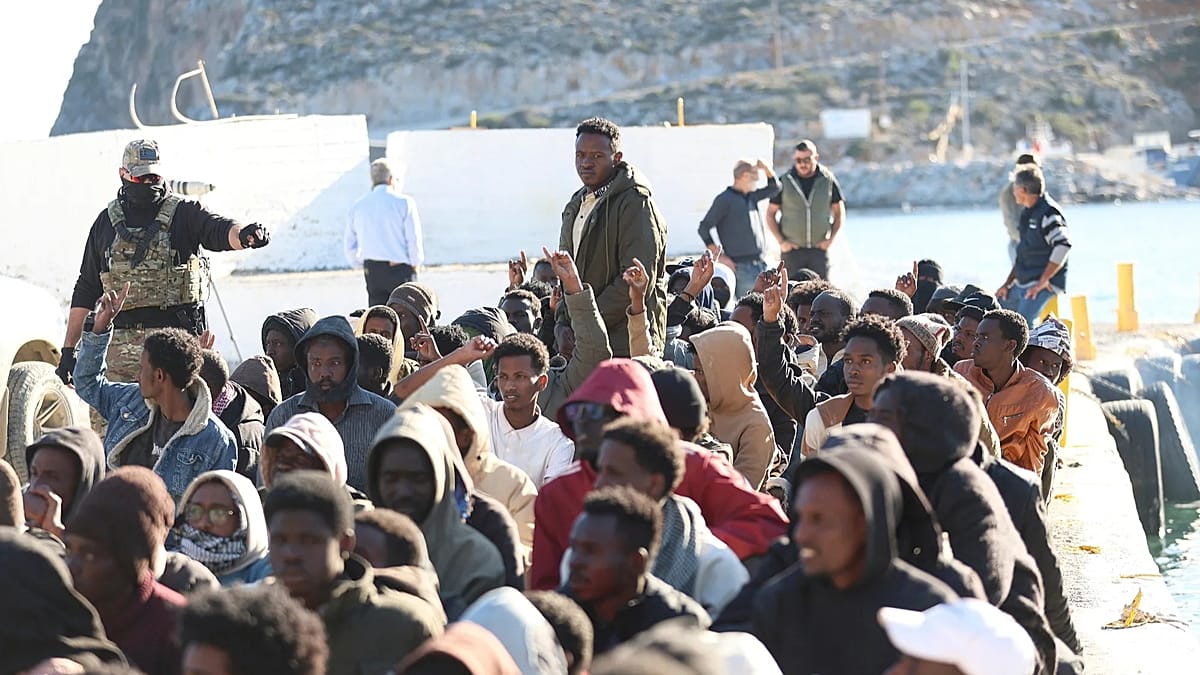
Five European Union member states are on the verge of announcing the bloc's first-ever migrant return hub outside its borders, a move that would see irregular migrants sent to Rwanda, a country with which they have no prior connection. The agreement, expected to be unveiled in Vienna on Monday, follows months of closed-door negotiations between Kigali and the governments of Denmark, Austria, Germany, the Netherlands and Greece.
According to two people familiar with the matter, the interior and migration ministers of the five countries will gather in the Austrian capital, joined by Rwanda's Interior Minister Vincent Biruta. Later in the day, Austrian Chancellor Christian Stocker and Danish Prime Minister Mette Frederiksen are scheduled to hold a joint press conference to formalise the announcement.
A pilot project with open facilities
The first hub is envisaged as a pilot, initially accommodating a few hundred people deported from the participating states. Operations could begin in spring or summer 2027. Unlike traditional detention centres, the facilities would be open, allowing migrants to move freely within Rwanda, receive residence permits, and be encouraged to integrate into local society and the labour market.
In principle, return hubs are meant to be temporary accommodation for people awaiting deportation to their countries of origin. But there is no fixed time limit on stays, raising the possibility that some individuals could remain in Rwanda indefinitely, never actually being returned home.
The European border agency Frontex could also become involved in deportation operations, provided the European Parliament and member states approve a reform of its mandate proposed by the European Commission.
Legal and human rights concerns
The plan has drawn sharp criticism from legal experts and human rights organisations. The EU regulation that permits such hubs stipulates that they can only be established in non-EU countries where international human rights standards are respected. Yet the United Nations has repeatedly flagged Rwanda's questionable human rights record.
A similar arrangement between the UK and Rwanda was struck down by the UK Supreme Court in 2023 due to the risk of human rights abuses. The five EU governments insist their project will comply fully with EU law and international obligations, and say it will be run in partnership with organisations such as the UN Refugee Agency (UNHCR) and the International Organization for Migration (IOM).
However, neither UNHCR nor IOM has been directly involved in the negotiations, and both could withdraw if safeguards are not met. An IOM spokesperson told Euronews: "IOM's support requires a formal request from the receiving government, and assurances that adequate safeguards are in place."
Legal challenges are likely once deportations begin, as the European Court of Human Rights prohibits transferring individuals to countries where they may face torture or inhuman treatment. Eleonora Celoria, from the Italian legal association Asgi, warned: "With this system, migrants may be subjected to torture and inhuman or degrading treatment."
Unclear costs and broader implications
The financial burden will fall entirely on the five EU countries, but no cost estimates have been published, nor is it clear what Rwanda will receive in return. In 2025, Kigali signed a separate agreement to accept third-country nationals expelled from the United States in exchange for roughly $7.5 million in financial support.
Italy's own attempt to set up a hub in Albania offers a cautionary tale. That five-year partnership cost €670 million, and a study by an Italian university found that each available place in Albania cost over €153,000, compared with about €21,000 per place in comparable facilities in Sicily. The financial inefficiency has sparked widespread debate.
The move comes as the EU continues to explore migration deals with third countries, often with opaque terms. Nineteen of the EU's 27 governments have already signalled support for such "innovative solutions" in a joint letter to EU leaders last June.
Observers note that the Rwanda hub could set a precedent for other member states, potentially reshaping the bloc's approach to migration management. But the legal and ethical questions remain unresolved, and the project's future may ultimately be decided in the courts.