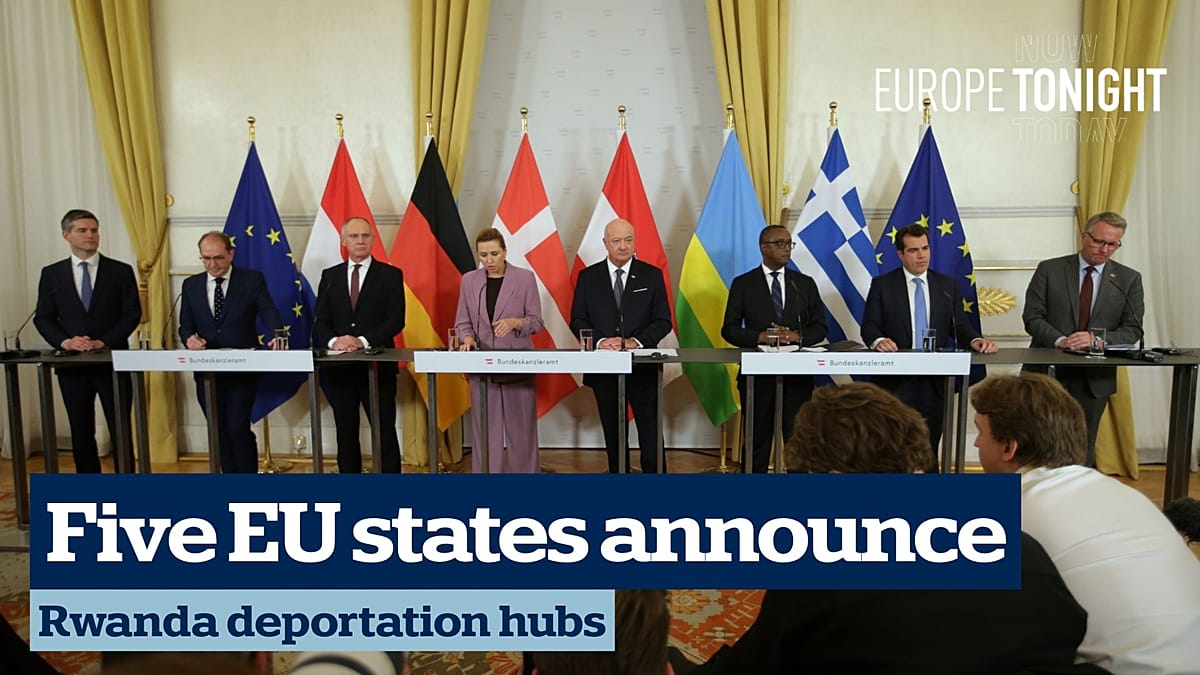
Five European Union member states have confirmed they will establish offshore deportation centres in Rwanda for irregular migrants, a decision that marks one of the most significant shifts in the bloc's asylum policy in years. Greece, Denmark, Germany, Austria and the Netherlands concluded months of negotiations with an agreement to open pilot facilities by mid-2027, according to the five-state Rwanda plan.
The arrangement echoes — though does not replicate — the UK's stalled Rwanda scheme, which was scrapped by the Labour government in 2024. Unlike that programme, the EU initiative is being framed as a coordinated, multi-state return mechanism rather than a single national policy. The first centres are expected to process migrants whose asylum claims have been rejected, with the aim of returning them to their countries of origin or to third countries.
A hardening consensus on migration
The deal reflects a broader political realignment across Europe. Governments in Copenhagen, Vienna and The Hague have pushed for tougher migration controls for years, while Berlin's participation signals a notable shift under its current coalition. Athens, which has long shouldered frontline pressure on the Aegean routes, has been among the most vocal advocates of external processing.
Human rights organisations have already signalled opposition, arguing that offshore centres risk violating the EU's Charter of Fundamental Rights and the 1951 Refugee Convention. The European Commission has not yet issued a formal legal assessment of the plan. Whether the Rwanda hubs can survive a likely challenge before the Court of Justice of the European Union remains an open question.
Lahbib: winter as a weapon
Speaking on the same evening, the EU's humanitarian aid chief, Hadja Lahbib, accused Russia of deliberately targeting Ukraine's energy infrastructure to weaponise the cold season. "Russia is turning winter into a weapon of war," she said, unveiling a fresh package of humanitarian assistance for Ukraine.
Lahbib declined to rule out a new wave of Ukrainian refugees entering the EU in the coming months, a prospect that would intensify pressure on member states already debating migration policy. Her warning aligns with repeated assessments from Brussels that Moscow's strikes on power grids are designed to break civilian morale rather than achieve military objectives.
"Europe should not speak to Moscow until a ceasefire is in place." — Kęstutis Budrys, Lithuania's foreign minister
Lithuania's foreign minister, Kęstutis Budrys, told the programme that the EU should hold off on direct talks with the Kremlin until a ceasefire is secured in Ukraine. His remarks followed the bloc's appointment of peace negotiators last week, a move that has divided member states. Budrys also expressed scepticism about a new Austrian proposal on how Europe should approach peace talks, suggesting that Vienna's diplomatic instincts may not match the security realities on the eastern flank.
The Baltic states have consistently taken a harder line on Russia than Western European capitals. Estonia recently closed border crossings with Russia after a foiled GRU arson plot, and Sweden has urged the EU to tap frozen Russian assets for Ukraine's reconstruction — both signs of a widening security consensus in northern and eastern Europe.
Bond, and other business
In cultural news, British actor Robert Pattinson has been confirmed as the next James Bond, succeeding Daniel Craig. The announcement ends weeks of speculation about the future of cinema's most enduring spy franchise. Pattinson, known for his work in independent film as well as the Twilight series, will take on a role that has become a barometer of British cultural identity.
For Europe, the evening's developments point in two directions at once: inward, toward a migration policy that increasingly looks outward for solutions, and outward, toward a Russian threat that continues to shape the continent's security agenda. The Rwanda hubs and the winter warnings are not separate stories — they are two faces of a Europe defining its borders and its defences in the same breath.