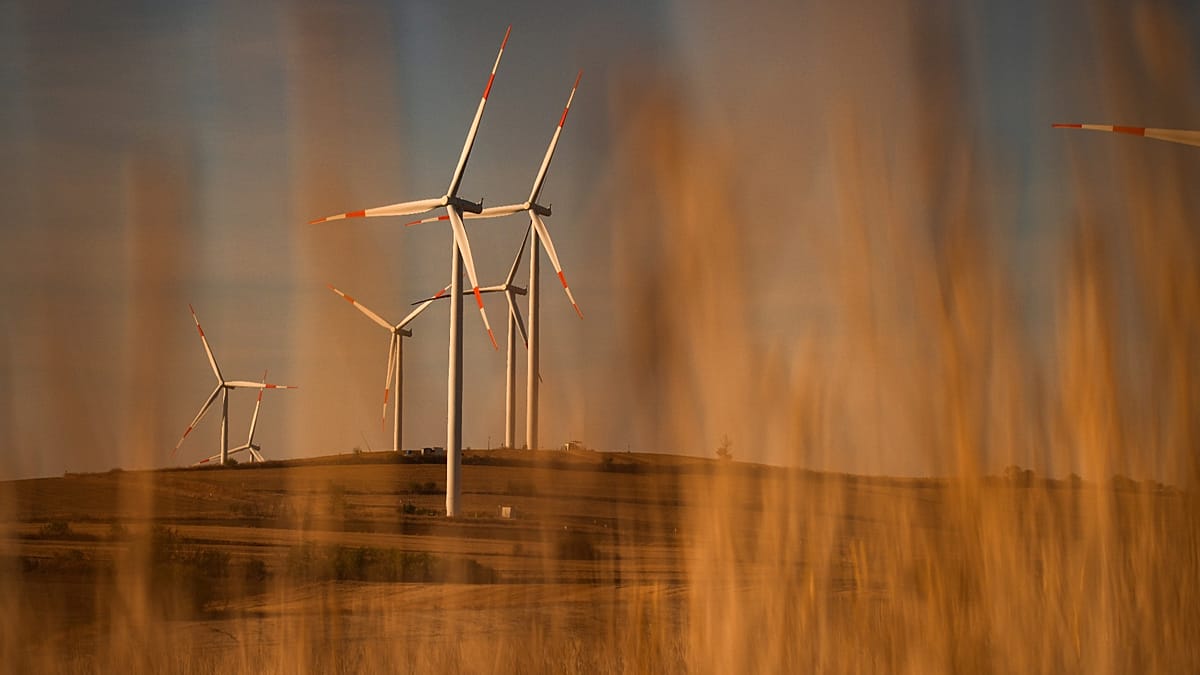
Wind power is often hailed as one of the most cost-effective and scalable tools in the fight against climate change. Across Europe, turbines spin from the North Sea to the Mediterranean, their blades engineered to endure relentless UV radiation, gale-force winds, and even lightning strikes. But that very durability creates a mounting problem: when turbines reach the end of their roughly 20-year service life, their blades are notoriously difficult to recycle.
While 85 to 90 percent of a turbine's mass can be reprocessed, the blades—typically made from fiberglass reinforced with silica and carbon-rich polymer resins—resist conventional recycling methods. As a result, many end up in landfills or incinerators, a practice that is becoming increasingly untenable as Europe's wind fleet ages.
A growing waste stream
According to industry projections, annual decommissioned blade waste in Europe will climb from 20,000 tonnes in 2025 to 55,000 tonnes by 2030. That looming surge has prompted WindEurope, the continent's wind energy association, to introduce a voluntary landfill ban, which took effect last year. The group is now pressing EU policymakers to codify the ban into law, arguing that formal legislation would spur investment in sustainable recycling technologies.
Without such measures, Europe risks becoming a dumping ground for its own green energy infrastructure—an irony not lost on environmental advocates. But a new study published in the journal Chem Circularity offers a promising alternative.
Flash joule heating: a hot solution
Researchers have discovered that subjecting turbine blades to a “brief burst of intense heat”—a process known as flash joule heating—can break them down into silicon carbide and graphene, two materials with significant industrial value. The technique involves heating the blades to around 2,000°C in a matter of seconds, causing the carbon and silica to react and form these compounds.
Silicon carbide is prized for its hardness and heat resistance, while graphene is renowned for its strength and electrical conductivity. The research team, led by chemical and environmental engineer Bing Deng of Tsinghua University in China, found that adding the recovered materials to new resin formulations can actually improve their performance. Just 0.3 percent by weight of the recycled material increased resin stiffness and resistance to deformation by 27 percent under tension and 9 percent under bending.
“The mixture of silicon carbide and graphene can be incorporated back into resins for new wind turbine blades, improving their mechanical and thermal properties,” Deng said. “That is more than recycling—it's upcycling. We're turning something that has little value into something that's worth much more.”
The implications for Europe are significant. As the continent pushes to expand its wind capacity—both onshore and offshore—the ability to recycle blades into new ones could reduce both waste and the need for virgin materials. It also aligns with the EU's broader circular economy goals, which aim to decouple economic growth from resource consumption.
However, scaling up flash joule heating from the lab to industrial reality will require investment and infrastructure. The process is energy-intensive, though the researchers note that the high value of the recovered materials could offset costs. WindEurope's proposed landfill ban could provide the regulatory push needed to make such technologies commercially viable.
For now, the research offers a glimpse of a future where wind turbines are not just a source of clean energy but also a source of valuable raw materials. As Europe grapples with the challenge of decommissioning thousands of turbines in the coming years, this 'hot' solution may prove to be a key part of the answer.