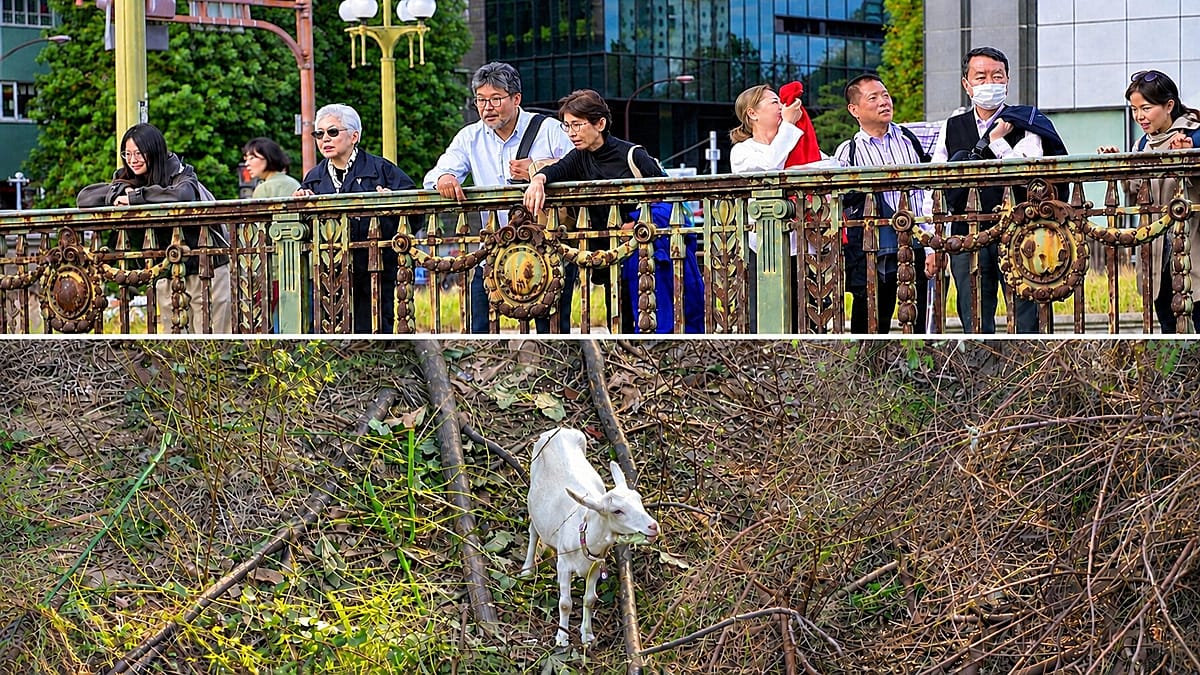
In central Tokyo, two white goats have become unlikely celebrities after being enlisted to tackle overgrown vegetation near Yotsuya railway station. The animals, whose grazing duties are part of a local eco-friendly initiative, have drawn crowds of curious commuters and residents eager to catch a glimpse of the four-legged gardeners.
A novel approach to urban maintenance
The goats, whose names have not been officially disclosed, were introduced as a sustainable alternative to mechanical mowers and chemical herbicides. Their presence at the station, a busy hub on the Chūō-Sōbu Line, has turned an ordinary commute into a pastoral interlude. Passengers have been spotted pausing to photograph the animals, and some have even made special trips to see them.
Local officials say the initiative is part of a broader effort to incorporate green solutions into urban infrastructure. "We wanted to find a way to manage the vegetation that was both environmentally friendly and engaging for the community," a spokesperson for the ward office told local media. "The goats have exceeded our expectations in both regards."
The animals are housed in a temporary enclosure near the station's exit, where they graze on the overgrown grass and weeds that had become a maintenance challenge. Their presence has also sparked conversations about the role of animals in urban environments, with some residents suggesting similar projects could be adopted elsewhere in the city.
While the goats are a novelty in Tokyo, the practice of using livestock for land management is well established in rural Japan, where sheep and goats are often employed to clear hillsides and roadside verges. The Yotsuya project, however, marks a rare instance of such methods being applied in a densely populated metropolitan area.
The initiative has also drawn attention beyond Japan's borders, with international media outlets covering the story. For European readers, the sight of goats at a railway station may evoke similar experiments in cities like Amsterdam or Zurich, where urban grazing has been used to maintain green spaces. The trend reflects a growing interest in nature-based solutions across the globe.
Commuters have responded warmly to the animals, with many expressing delight at the unexpected encounter. "It's a lovely surprise on the way to work," said one office worker, who stops by the enclosure each morning. "It makes you feel a bit closer to nature, even in the middle of the city."
The goats are expected to remain at the station until the vegetation is cleared, after which they will be relocated to a nearby farm. Officials have not ruled out bringing them back for future maintenance work, depending on the success of the current project.
For now, the two goats have become a symbol of creative urban planning, proving that even the most mundane tasks can be transformed into a community attraction. As one local resident put it, "They're doing a great job, and they're making everyone smile. What more could you ask for?"