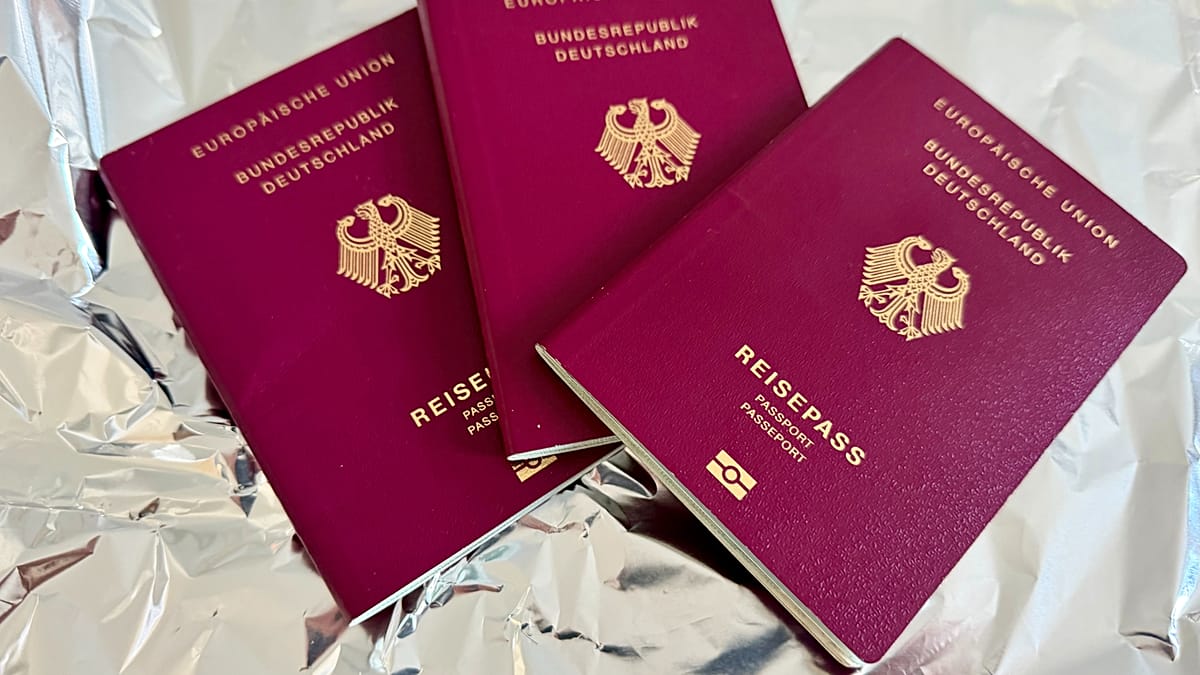
A curious habit has taken hold on TikTok, Reddit and assorted travel forums: holidaymakers are encasing their passports in kitchen aluminium foil before setting off, convinced that the makeshift shield will stop criminals from electronically skimming their personal data in crowded terminals and train stations.
The anxiety centres on the RFID chip embedded in the polycarbonate data page of modern passports. On German travel documents, that chip allows fast, tamper-resistant identity verification at borders, according to the Federal Office for Information Security (BSI). Alongside the digitised photograph, it holds the holder's name, place of birth, sex, eye colour, height and registered address, plus two fingerprints captured when the document is issued.
A threat that barely exists
The question is whether anyone can actually read that data without consent. The chip's transmission range is measured in centimetres, not metres. As with a contactless bank card, a reader would have to be virtually resting against the passport to establish a connection — a manoeuvre that is hard to pull off unnoticed in a queue at Frankfurt Airport or on a packed RER train into Paris.
Specialists therefore regard the foil wrap as largely superfluous. It may block radio waves in theory, but in practice it delivers nothing beyond a vague sense of reassurance — and a fair amount of confusion among fellow passengers watching someone unwrap a silver parcel at the border desk.
There is a practical cost, too. Repeatedly folding and unfolding foil at passport control adds seconds to every inspection, and those seconds accumulate. Anyone who has queued at Amsterdam Schiphol or Madrid-Barajas during a summer peak knows how quickly small delays cascade. The trend sits awkwardly alongside other recent disruptions, from repeated UK air traffic control failures to the general strain on European travel infrastructure.
How the data is actually protected
European regulators have built safeguards into the system itself. In Germany, chip data is not stored in any central database. The passport registers kept by authorities contain only the information they held before electronic documents were introduced. Fingerprints remain exclusively on the document; once the holder collects their passport, the biometric data used during production is irrevocably deleted, as German law requires.
That architecture reflects a broader European approach to identity documents, shaped by EU regulations and implemented differently in each member state. France, Italy, Spain and the Netherlands all issue biometric passports with similar chip technology and comparable privacy rules. The same logic applies in the wider continent: Norway, Switzerland and the UK have adopted comparable standards, and the Western Balkans states have been aligning their documents with EU norms as part of their accession trajectories.
None of this has stopped the foil meme from spreading. Travel forums are full of testimonials from people who insist the wrap saved them from an invisible threat, and the algorithm rewards the drama. It is a familiar pattern: a plausible-sounding risk, a cheap DIY fix, and a viral loop that outruns the boring correction.
What travellers should actually do
- Keep the passport in a closed pocket or bag rather than an outer, easily accessible one.
- Be sceptical of anyone standing unusually close in a queue or on public transport.
- Report a lost or stolen document immediately to consular authorities.
- Skip the foil — it does not meaningfully improve security and slows down border processing.
The BSI's guidance is unambiguous: unauthorised reading during ordinary travel is extremely unlikely. The chip was designed for convenience and fraud resistance, not as a beacon broadcasting personal details to passers-by. Wrapping it in foil treats a hypothetical risk as though it were routine, and in doing so adds friction to a system that millions of Europeans rely on every summer.
For travellers planning autumn getaways, the more useful precautions lie elsewhere — checking document validity, allowing extra time at busy hubs, and keeping an eye on the kind of operational disruptions that have become a recurring feature of European aviation. The foil, however shiny, will not help with any of that.