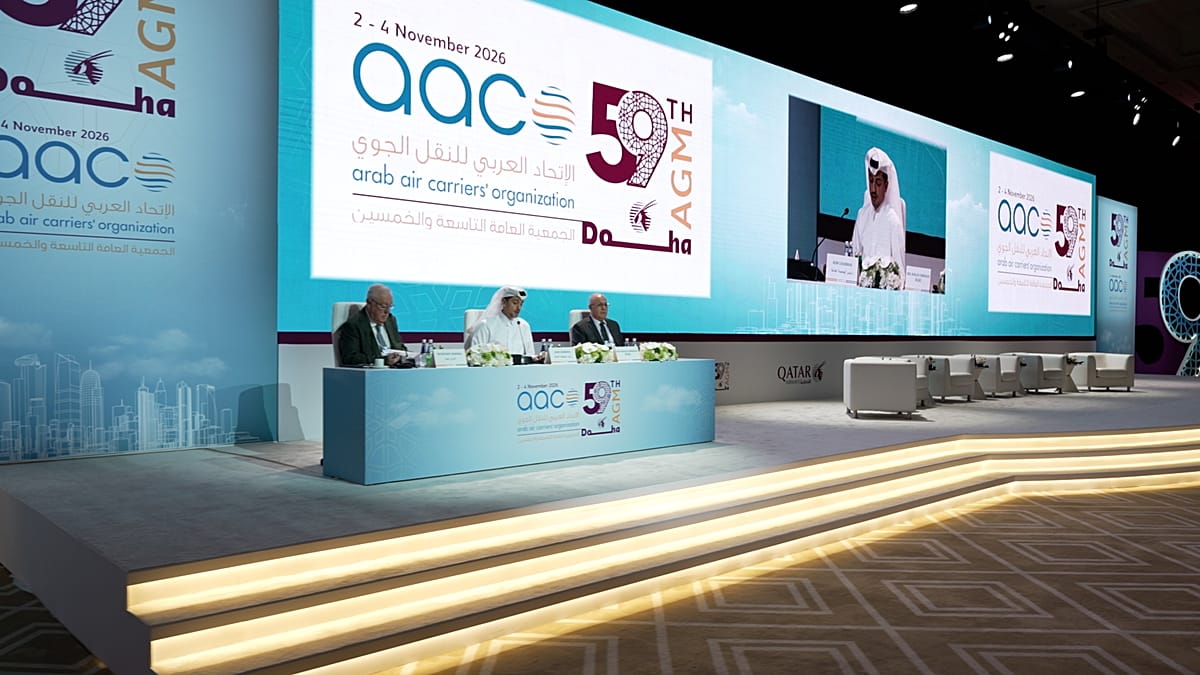
Arab airlines are bracing for a difficult year ahead, with the Arab Air Carriers' Organization (AACO) forecasting a collective net loss of $4.3 billion (€3.82 billion) for 2026. The projection, released during the group's annual general meeting in Doha this week, reflects mounting pressures from geopolitical instability, volatile fuel prices, and what the organization describes as “fluctuating financial conditions.”
AACO, which represents 39 carriers from the Middle East and North Africa—including Qatar Airways, Emirates, Etihad Airways, and Gulf Air—also expects a 5.2% decline in air cargo traffic for its members. Globally, the industry's net profit is set to fall to around $23 billion (€20.5 billion), its lowest level in 12 years, excluding the pandemic period and its immediate aftermath.
The report notes that performance among member airlines will likely vary considerably, depending on their hub locations and exposure to conflict-affected markets. Despite the bleak outlook, AACO insists the industry will remain profitable overall, albeit at a slower pace as higher energy costs and operational disruptions squeeze margins.
Fuel costs and EU carbon rules weigh on carriers
Fuel is expected to account for 31.4% of global industry operating costs in 2026, but for AACO members that figure rises to 37.3%, up from 27.9% in 2025. This sharp increase underscores the vulnerability of Arab carriers to energy price swings, which are exacerbated by regional tensions.
Beyond fuel, the Doha meeting focused heavily on the European Union's proposed Emissions Trading System (ETS). AACO Secretary General Abdul Wahab Teffaha told Euronews Travel that the EU's plan to extend the ETS to flights departing from the European Economic Area and landing in third countries within a 5,000-kilometre radius of Frankfurt Airport by 2029 raises serious questions of “sovereignty.”
“The EU has decided that 'we want to have targets which are beyond the targets which were agreed upon by the ICAO' – and we have no problem with that, because they are exercising their sovereign rights,” Teffaha said. “But this is extra-territoriality, trespassing on the sovereignty of others.” He argued that the move would undermine the Chicago Convention, which grants each state “complete and exclusive sovereignty over the airspace above its territory.”
The proposed extension would affect countries from Turkey and Iraq down to Dubai, and across to Sudan, Egypt, and Morocco. Teffaha also warned that Arab carriers could face double costs for emissions reductions, as they already participate in the Carbon Offsetting and Reduction Scheme for International Aviation (CORSIA). If the two frameworks do not recognise each other's charges, airlines may end up paying twice for the same emissions.
Regional cooperation in focus
The three-day event, hosted by Qatar Airways and chaired by its Group Chief Executive Hamad Al-Khater, brought together more than 200 executives and stakeholders, including representatives from Amadeus and SITA. Al-Khater emphasised the importance of regional solidarity during a period of global disruption.
“This AACO gathering brings together the airlines of the Arab world, which collectively play a vital role in connecting people, businesses and economies across six continents,” he said. “As our industry faces a very difficult period, with geopolitical developments continuing to disrupt global connectivity, regional cooperation has become our greatest strength.”
The aviation sector supports around four million jobs across the Middle East and injects $290 billion (€258 billion) into the regional economy, a figure expected to rise to $730 billion (€649.9 billion) by 2043. During the meeting, AACO and SITA signed a memorandum of understanding to make SITA's WorldTracer Bag Mate, a baggage tracking tool, available to member airlines.
Despite the challenges, Europe remains a key market for Arab carriers. Airlines continue to expand routes and partnerships, with the Doha AGM seen as a vital platform for strengthening ties. The record growth in global travel expected in 2026, led by Europe, offers a glimmer of hope for the region's carriers, even as they navigate regulatory headwinds.
The dispute over the ETS is part of a broader trans-Mediterranean friction over climate policy. While the EU insists on its right to set ambitious targets, Arab carriers argue that unilateral measures could distort competition and harm connectivity. The outcome of this standoff will be closely watched by airlines on both sides of the Mediterranean, as they seek to balance environmental goals with economic viability.