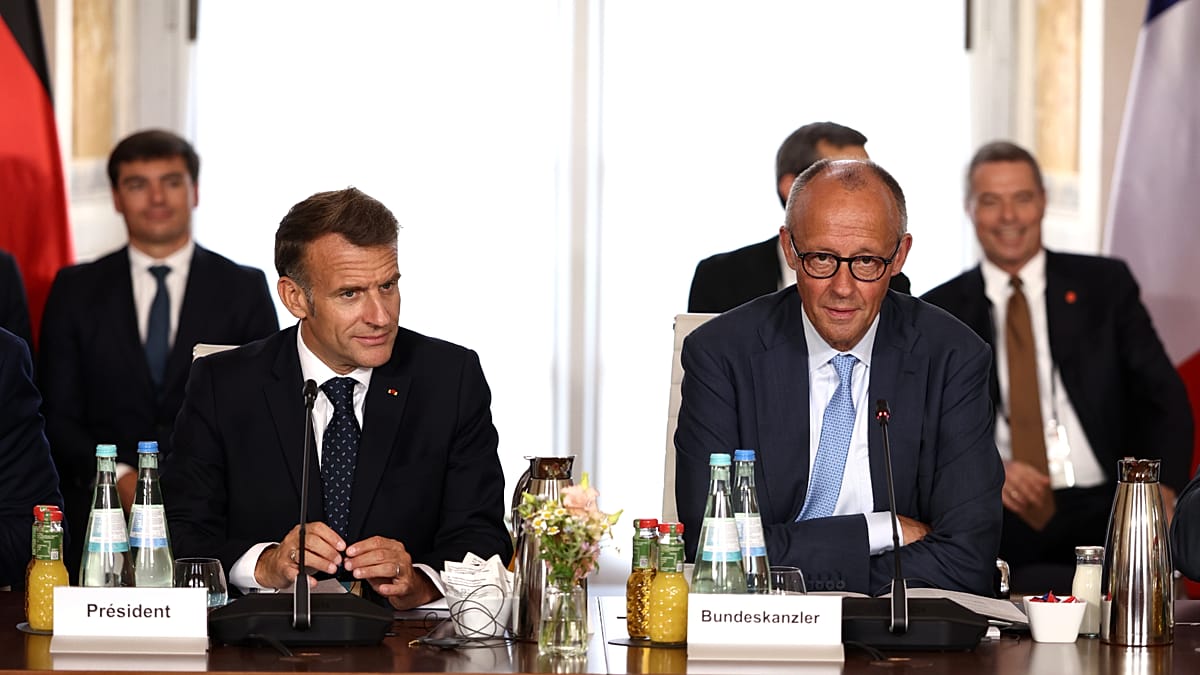
German Chancellor Friedrich Merz and French President Emmanuel Macron met on Friday at the Nörvenich air base near Cologne for the 26th Franco-German ministerial council, signalling a renewed push for closer defence cooperation and a tougher line on China’s trade policies.
Merz confirmed that German conventional forces will participate in a French nuclear exercise later this year, a move that underscores the deepening of bilateral defence ties. “Alongside this work on a shared doctrine, German conventional forces will this year take part in a nuclear exercise of the French military,” Merz said at a joint press conference. He added that a new “strategic steering group” would explore ways to strengthen deterrence, while emphasising that this remains complementary to Germany’s commitments within NATO.
The announcement comes amid broader European efforts to bolster security cooperation, particularly in light of the war in Ukraine. Merz also stated that Germany would join a French-led military manoeuvre scheduled for autumn under the so-called Coalition of the Willing, a group of Ukraine’s allies. The coalition held its latest meeting in Paris earlier this week, attended by both leaders. Macron noted that a Multinational Force for Ukraine, intended for deployment after hostilities cease, would conduct exercises in neighbouring countries in the coming months to validate deployment plans.
This Franco-German push for deeper defence integration follows a period of strained relations between Berlin and Paris. Our earlier report on Merz and Macron meeting in Cologne to salvage Franco-German defence cooperation highlighted the challenges both governments faced in aligning their strategic priorities.
Joint Roadmap on China Trade
On trade, Macron announced that France and Germany aim to produce a joint “roadmap” by September to address what they describe as China’s unfair trade practices. “Right now we are being shaken” by Beijing’s policies, Macron said, referring to the impact on European industries. The plan will be developed by the two countries’ economy, finance, and foreign ministers.
Macron stressed the need to push the European Commission to accelerate market investigations and deploy protective instruments more swiftly. “We want to protect our companies and our industries. We’ve seen it in chemicals, we see it in machine tools, in the automotive sector and in many others,” he said. Merz echoed this, noting that the EU’s trade deficit with China has risen sharply in recent years. “I think it goes without saying that we have to address this imbalance, because it comes at the expense of our industry,” he added.
The European Union is grappling with how to respond to China’s growing flood of exports, which critics argue are supported by generous state subsidies and an undervalued currency. The Franco-German initiative aligns with broader EU concerns, as EU ministers have labelled China a critical long-term strategic challenge. Meanwhile, some MEPs have warned that overly restrictive market measures could destabilise China’s economy, as noted in a recent analysis by a top MEP warning about EU market restrictions.
The joint council also touched on other areas of cooperation, including energy transition and digital policy, but defence and trade dominated the agenda. The meeting comes at a time when Europe is seeking to assert greater strategic autonomy while maintaining its transatlantic alliances.