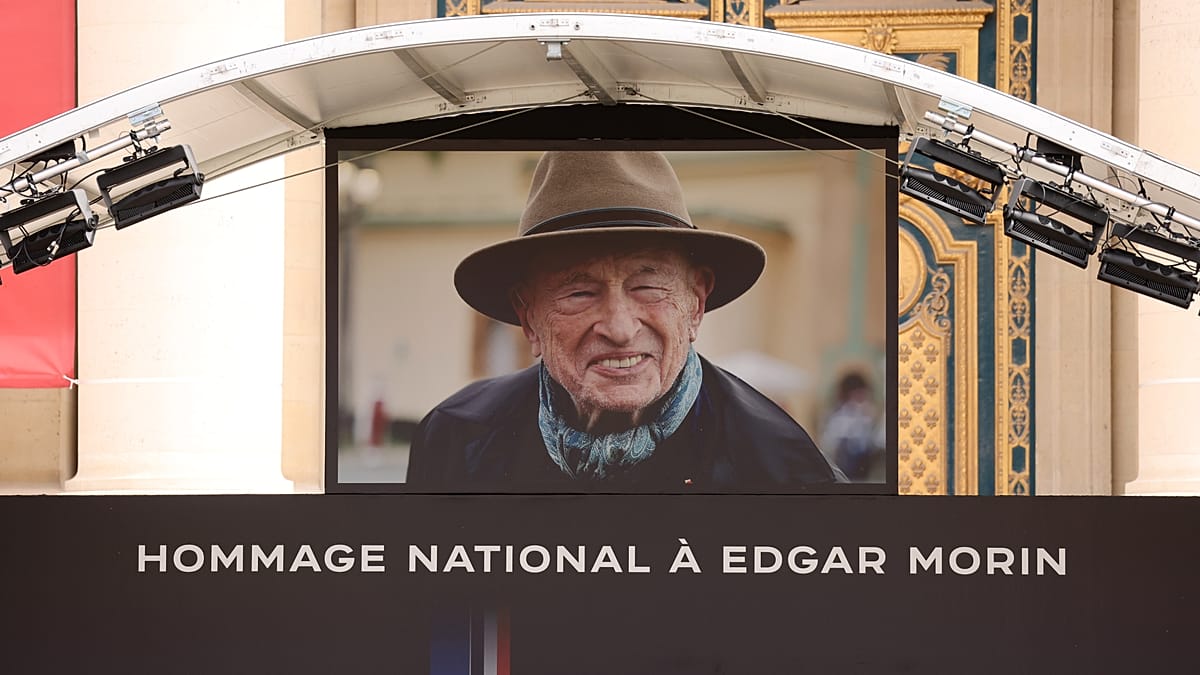
On Wednesday, France bid a solemn farewell to Edgar Morin, the philosopher and sociologist whose life spanned a century of upheaval and whose work defied easy categorization. President Emmanuel Macron, speaking at the Hôtel des Invalides in Paris, hailed Morin as a figure of “exceptional destiny” who never yielded to “the truth of a single camp, a single dogma.”
The ceremony, held in the south courtyard of the Dome, drew a crowd of political and intellectual figures, including former president François Hollande, sociologist Jean Viard, historian Pascal Ory, and Morocco’s head of government, Aziz Akhannouch. Morin’s wife, philosopher Sabah Abouessalam, stood beside his coffin as Macron delivered a fifteen-minute eulogy before a large smiling portrait of the deceased.
“For him, truth never came from a single side, a single dogma. Commitment could not mean falling into line, and the future was destined for chaos if we gave in to despair or to inaction,” Macron said, capturing the essence of Morin’s lifelong intellectual stance.
A Life of Resistance and Revision
Born Edgar Nahoum on 8 July 1921 in Paris to a Jewish family originally from Salonika, Morin joined the French Communist Party in 1941 and entered the Resistance under the pseudonym that would become his public identity. His disillusionment with Stalinism led to his expulsion from the party, a rupture he chronicled in his 1959 book Autocritique. He later co-founded the committee of intellectuals against the war in Algeria, cementing his reputation as a thinker unafraid to challenge orthodoxy.
As a researcher at the CNRS, Morin produced a vast and varied body of work. His 1969 book La rumeur d'Orléans dissected a wave of antisemitic rumors in the French city, while his six-volume magnum opus La méthode (1977–2004) sought to weave together scientific knowledge, philosophy, and social critique into a unified reflection on humanity. He also wrote extensively on ecology, a subject that became central to his later thinking.
After the fall of the Berlin Wall in 1989, Morin turned his attention to the crises of the Western model: the exhaustion of political and economic systems, the ecological emergency, the rise of religious fundamentalism, and the return of war to Europe. His voice remained a constant in intellectual debate well into his old age.
Macron’s tribute framed Morin as a quintessentially French figure with a global reach. “A humanist with a global outlook, certainly, but irreducibly French in his battles for freedom, equality, emancipation and also fraternity with all peoples deprived of their rights,” the president said. “That French energy, generous, ambitious, universal, will continue to be reborn.”
The ceremony at Les Invalides, a site steeped in military and national history, underscored the state’s recognition of Morin’s contributions. For a thinker who spent a lifetime questioning power and dogma, the honor was both fitting and paradoxical. As Europe grapples with resurgent nationalism, climate crisis, and geopolitical instability, Morin’s insistence on complexity and resistance to easy answers remains a potent legacy.



