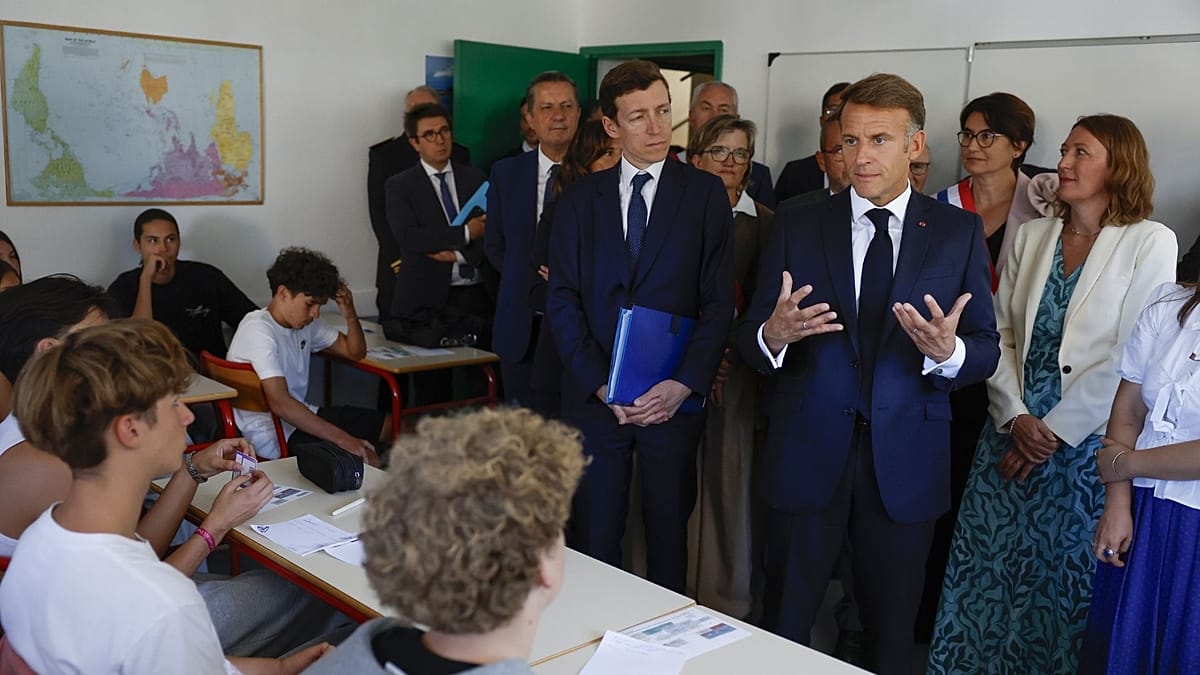
As French classrooms reopened on Tuesday, the government introduced a fresh wave of measures, including a ban on mobile phones in primary and secondary schools and new steps to address sexual violence. Among the most notable is an expansion of the annual school questionnaire on bullying, which has been distributed since 2023, to include questions about sexual violence. The survey, set to reach around 10 million pupils from primary through secondary school, will be handed out in November.
Speaking to BFMTV on 25 August, Education Minister Édouard Geffray described the questionnaire as a tool designed with school staff, parents' associations, and a committee of experts, including child psychiatrists. He suggested the results could be "seismic." Teachers will collect the forms first, and if any responses raise concerns, school leaders are expected to intervene—either by alerting the regional education authority or, in more serious cases, referring the matter to the justice system.
Why now? A wave of scandals and alarming statistics
The initiative comes amid a series of child sexual violence scandals in France, particularly in supervised childcare settings. In Paris alone, 203 criminal investigations are underway into alleged violence, including sexual violence, in schools and after-school programs, according to official figures from 26 August. Despite these numbers, schools remain the primary place where child sexual abuse is reported, with an average of 80,000 reports per year, according to the education ministry.
Estimates from 2023 by the CIIVISE (the Independent Commission on Incest and Sexual Violence against Children) suggest that around 160,000 children are victims of sexual violence each year in France, with 77% of abuse occurring within the family. That translates to one child being raped or sexually assaulted every three minutes.
Parents divided over the survey's approach
The education minister has said the questions will be tailored to pupils' ages, but parents remain split. Samuel Bougnat, father of a three-year-old, welcomed the measure: "I think school has a role to play in providing support and in reporting possible violence, because school should be a sanctuary, a place where children can feel confident enough to talk about things that may be happening at home."
Another father of two, who preferred to remain anonymous, also backed the initiative, calling it "pragmatic given that all children are supposed to go through school at some point; so if there is one place where we can spot things that are problematic and dangerous for children, it is there." He added that he would be watching closely how the forms are rolled out, especially for younger children.
Caroline Varas, mother of a four-and-a-half-year-old, expressed doubts: "I am not entirely sure that school should be responsible for this. I think it should be collaborative work: with independent parents' associations, the local council and the school." She cited a past incident of violence—not sexual—at her child's school, which she only learned about later, and argued that "there is a missing intermediary between the school and parents."
Child protection groups urge caution
Laura Morin-Baudet, head of the Paris-based nonprofit L'Enfant Bleu, which fights child abuse, said she "welcomes" the education ministry's focus on the issue but voiced concerns about the practical implementation. "It all depends on the conditions children answer these questions in. If the child feels comfortable, has the feeling that their friend sitting next to them cannot necessarily see their answers, then perhaps, indeed, they will end up saying something. But on the other hand, if they have the slightest doubt, if they are afraid, if they are unsure where these documents will go, we unfortunately know that they will not necessarily confide."
Morin-Baudet stressed that questionnaires alone are insufficient and that prevention and awareness-raising in schools remain essential. "We know just how poorly trained teachers and childcare professionals are in this area. Our organisation regularly receives calls from professionals who tell us: 'I have observed this and that, what can I do, how should I act?' So we know there is that need." She also highlighted that signs of abuse can manifest through words or behaviour—a child who becomes suddenly agitated, or conversely, withdraws completely. "That is where an adult's gaze can interpret things and build up a relationship of trust."
Teachers' unions back the idea but question the format
Jean-Rémi Girard, president of the National Union of Lycées and Collèges (SNALC), said "the vast majority" of teachers support the initiative. "For us, the most important thing is that school should be a safe place for our pupils and, in fact, for everyone. That does not mean we are the ones who will do the work of the justice system, quite clearly. But we are nonetheless able to talk to pupils, to go and see a little what is happening, to take an interest in children's living conditions and to gather information so that we can then pass the baton to the police and the justice system."
He also noted that "sometimes very young children are not aware of how serious what has happened to them is. With the form, very simple questions will all..." The full details of the questionnaire are still being finalised, but the government hopes that by making the survey anonymous—pupils can choose whether to identify themselves—it will encourage more disclosures.
As France embarks on this unprecedented survey, the debate reflects broader questions about the role of schools in safeguarding children. While the initiative has broad support in principle, its success will depend on careful implementation, adequate training for staff, and the creation of a trusted environment where children feel safe to speak up. The results, due to be analysed after November, could indeed be seismic—but only if the system is ready to respond.