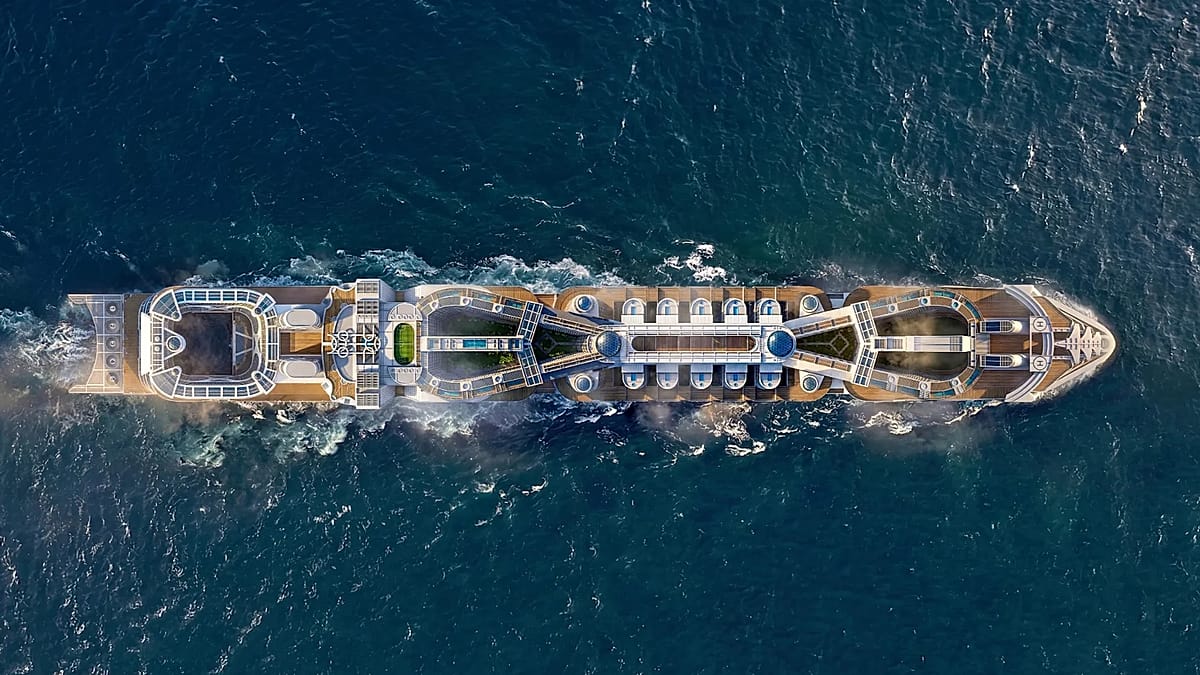
For decades, cruise ships have grown ever larger, but a proposed vessel named the Freedom Ship would render even today's ocean giants minuscule. Envisioned as a permanent floating city, the mile-long craft is designed to host up to 80,000 people—residents, visitors, and crew—as it perpetually circumnavigates the globe. Its backers describe it less as a cruise ship and more as an inhabited ocean-going metropolis, complete with schools, parks, shops, hotels, a hospital, and a 15,000-seat sports stadium.
The concept, first floated in the late 1990s, is the brainchild of Freedom Cruise Line International, based in Florida. If realized, the vessel would measure some 800 feet (244 meters) in width, weigh 2.3 million tonnes, and rise 30 decks high. The estimated cost stands at around £12 billion (€13.87 billion). While no launch date has been set, the ship is expected to be powered by nuclear fuel and serve as a permanent home for 50,000 residents, with an additional 10,000 temporary visitors supported by 20,000 crew members.
What Would Life Aboard the Freedom Ship Look Like?
With its vast capacity, the Freedom Ship would carry more than eight times the number of people aboard the current largest passenger vessels, Royal Caribbean's Star of the Seas and Icon of the Seas. To keep such a population occupied, the ship would offer a staggering array of amenities: two museums, a convention centre, a symphony hall, a water park, a two-storey food hall, shops, banks, a nightclub, and an onboard aquarium for diving enthusiasts. Visitors could stay in two high-rise hotels, and the ship would feature eight helipads. Children living aboard would attend schools offering education from primary through college levels.
Given the vessel's colossal size, an internal tram system would ferry passengers, complemented by 15 miles (24 kilometers) of walkways and approximately three acres (1.2 hectares) of parks. The ship would likely circumnavigate the globe every two years at a leisurely seven knots (about 13 km/h). However, due to its dimensions, it would be unable to dock at any port and would remain in international waters. Visitors would reach the ship via ferries from nearby ports.
Roger Gooch, chief executive of Freedom Cruise Line International, told The Telegraph that appetite for the project is strong: “We could almost justify building three ships.” His team is currently raising start-up funds, and Gooch expressed confidence: “We feel very confident that we can put this together.”
The ship would be constructed in Indonesia, a process that could take up to four years. Gooch hopes residents might move into their homes while construction continues. Once operational, all maintenance would be performed at sea, as the vessel has no home port.
While the Freedom Ship remains a speculative venture, it joins a growing trend of unconventional maritime living. Existing “never-ending cruises” include The World, a private residential ship for millionaires, and the more affordable Villa Vie Odyssey, but both carry only a few hundred passengers. For European travelers, the concept evokes comparisons to the rise of luxury cruise and rail combos gaining traction as slow tourism across the continent, though on an entirely different scale.
The Freedom Ship would be the largest maritime vessel ever constructed, but its feasibility hinges on securing substantial investment and overcoming engineering challenges. For now, it remains a bold vision of a floating city that could one day circle the Earth, offering a permanent home to tens of thousands.