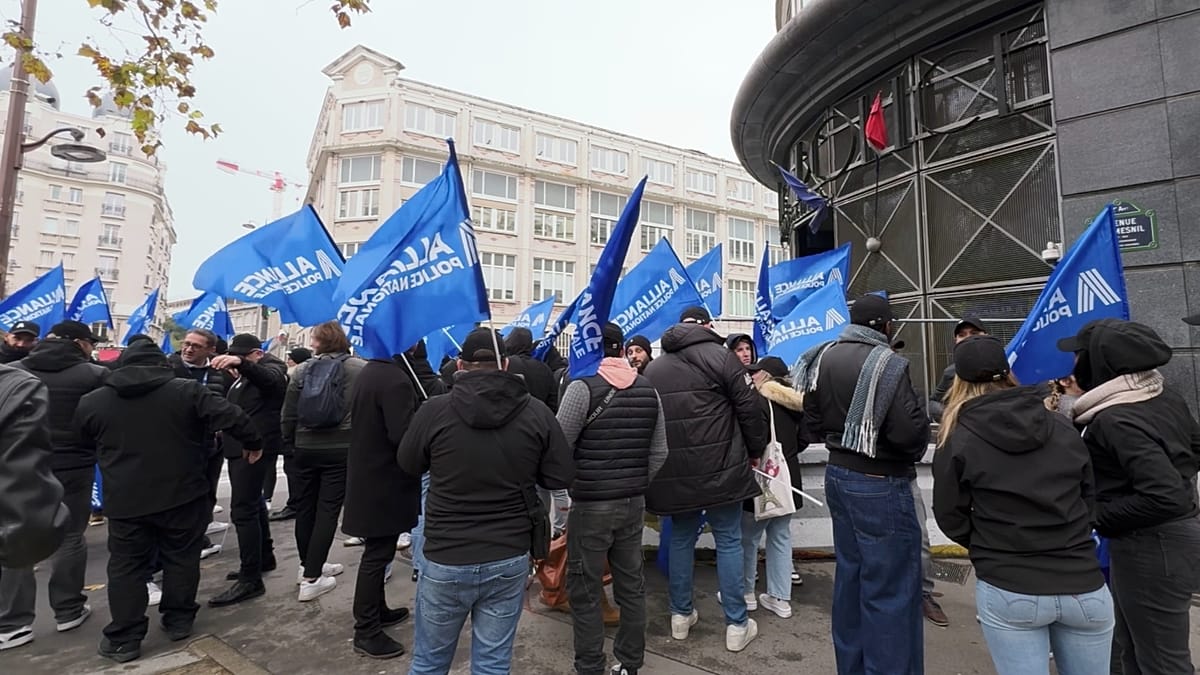
On a cold November afternoon, dozens of police officers gathered outside a station in Paris's 12th arrondissement, stamping their feet against the chill. Union flags from Alliance, Un1té and UNSA-Police were hoisted for the cameras as officers used their breaks to protest—legally barred from striking, they made their grievances heard in the only way available.
The message was blunt: after weeks of successive demonstrations, France's police are exhausted, underpaid and under-equipped. Yannick Landreau, Paris regional representative for the Alliance union, told European Pulse that the risk allowance must rise to 35% of basic salary, up from the current 28.5% that has been frozen since 2019. Interior Minister Laurent Nuñez has proposed a gradual increase to 33.5% by 2029—but unions say that is too slow and too modest.
“More and more of our colleagues are being injured,” Landreau said. “In the first seven days of protests in Paris alone, we recorded 50 injured officers per day. The reality now is that mortar rounds are being fired directly at law enforcement.” He added that intervention units still lack fire-resistant uniforms, and that officers drafted in from local stations for crowd control do not always have adequate protective gear.
The toll is stark: more than 2,600 officers have been injured, leave has been cancelled, and shifts stretch to 15 hours. Last week, some 1,200 members of the CRS riot police reportedly called in sick on a single day, according to an internal count—a sign of how deep the discontent runs.
A decade of crises, no respite
The current unrest is layered on years of strain. From the 2015 terrorist attacks to the Yellow Vest protests of 2018–2019 and successive waves of social upheaval, French police have been mobilised almost without pause. “Never any respite. But we've never given up,” Landreau said.
France relies on roughly 150,000 national police officers and 100,000 gendarmes, whose duties range from everyday policing to counterterrorism. Newly qualified officers earn around €2,160 net a month, rising to about €2,340 in the Paris region, according to official pay scales. The discontent extends beyond frontline roles. Georges Knecht, secretary general of SNIPAT, which represents administrative, technical and scientific staff at the Interior Ministry, said a 2022 agreement has not been fully implemented. “Some staff are now earning below the minimum wage and need a compensatory allowance just to reach it. This cannot go on.”
Knecht noted that such personnel make up only about 15% of police staff in France, compared with 25–30% in most European forces. Forensic police are particularly stretched—just 3,300 nationwide, despite their growing role in investigations. “We've moved from a culture of confession to a culture of evidence,” he said. “From minor burglaries to terrorist attacks, they're the ones on the front line.” He warned that the lack of professional status is pushing staff to transfer to other departments. “We feel we're being put off, that they're playing for time until the next elections.”
Protest policing under scrutiny
While officers demand more protection, the methods used to police demonstrations have come under renewed criticism. The use of rubber-ball launchers and explosive crowd-control grenades has long drawn condemnation from human rights groups, particularly since the Yellow Vest protests, when several demonstrators suffered life-changing injuries. The latest protests have reignited the debate over proportionality and the right to demonstrate.
Parliament's approval last Friday of legislation that presumes the lawful use of firearms by police and gendarmes unless proven otherwise has added fuel. Critics, including opposition MPs, have denounced it as a “licence to kill,” and the law has been challenged before France's Constitutional Council. In an opinion issued on 5 November, the OSCE's human rights office urged France to reconsider, warning that the measure could undermine judicial investigations and victims' access to justice.
Students and trade unions, meanwhile, are determined to keep up the pressure. Barely an hour after the police rally ended on Thursday, demonstrators marched from Bastille towards Nation in eastern Paris, chanting against police violence. Mathis Aversenq, a member of the student coordination Interfac Île-de-France and the far-left NPA-Révolutionnaires, accused the government of trying to wear down the movement. “It's closing high schools and universities,” he said, citing the deployment of gendarmes to monitor students in Nancy and the use of tear gas at a high school.
The standoff leaves the government squeezed from both sides. Police unions want immediate action on pay and equipment, while protesters see the state's response as increasingly repressive. With no sign of compromise, the pressure on Paris shows no sign of easing. The situation also resonates beyond France's borders, as the 2027 presidential election is already seen as pivotal for Europe's future. Meanwhile, Greece's borrowing costs have fallen below France's, a reminder that political instability has economic consequences. And as the EU faces its own budget crunch, the ability of member states to manage domestic crises will be closely watched.



