It began in a Munich student flat in 2019, with five founders and an idea that sounded almost too clever: a water bottle that could make plain water taste like something else—without sugar, sweeteners, or even a drop of flavour. Five years on, Air Up has sold more than 15 million bottles and over 200 million interchangeable pods, and its videos have racked up billions of views on TikTok and Instagram. But the question that now preoccupies the company's leadership is less about virality and more about endurance: can a product that conquered social media become a lasting global brand?
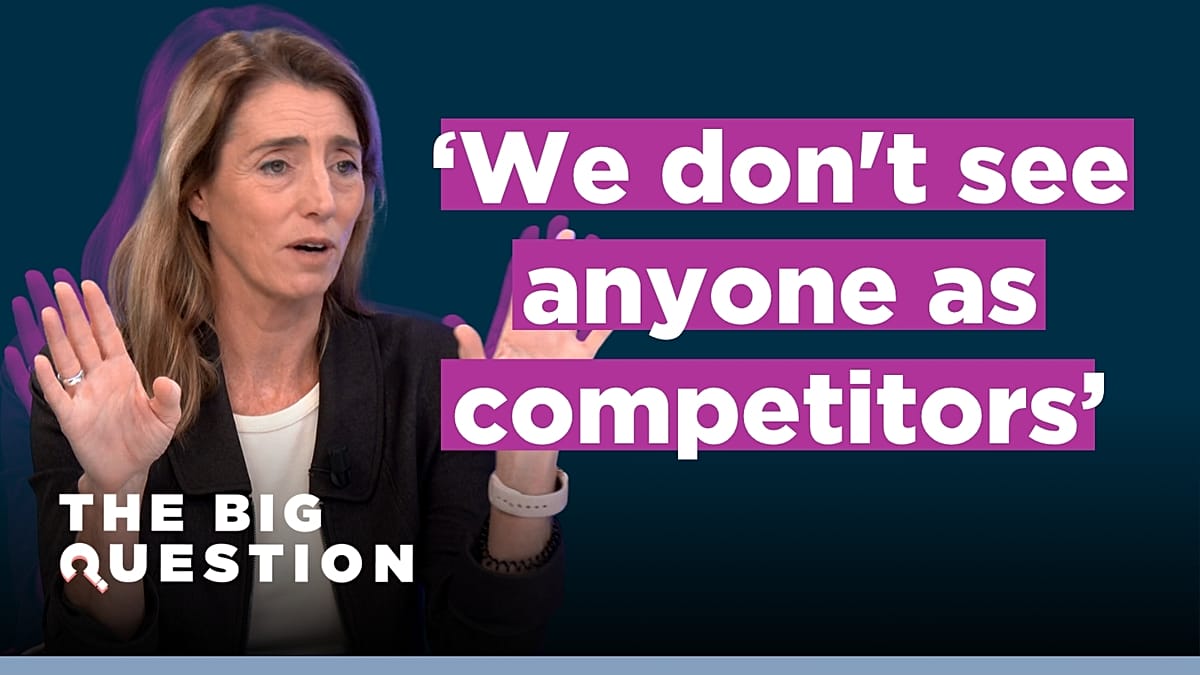
Cristina Kenz, Air Up's chief executive, sat down with Angela Barnes for the latest episode of The Big Question to explain how the company is trying to convert online buzz into repeat purchases. Kenz is no stranger to consumer goods; she previously held senior roles at PepsiCo, Danone, Kraft Heinz, and the company behind Burger King. Her career has been built on fast-moving consumer goods, where the real test is not whether people try a product once, but whether they reach for it again and again.
More than a water bottle?
At first glance, Air Up could be mistaken for just another plastic bottle destined to end up at the back of a kitchen cupboard. But the company's pitch is more specific. Its pods, which click onto the top of the bottle, are designed to create the perception of flavour through smell alone—a process Air Up calls 'scentaste'. The result, Kenz says, is pure water with a hint of flavour and none of the additives found in many commercial drinks.
“We exist to help humans drink more water,” she explained. “And we do it in a way that is no sugar, no artificials, just pure water with a hint of flavour and that gives you the enjoyment.”
That positioning has attracted a notable roster of backers, including actors Ashton Kutcher and Mila Kunis, as well as PepsiCo itself. The involvement of a beverage giant is telling: it signals that the industry sees potential in a product that challenges conventional flavoured drinks.
From hype to habit
Kenz describes the company's journey in three phases: hype, virality, and habit building. The first two came quickly, thanks to social media. The third is harder. “The habit building is a little bit slower in the sense that we need to get people adopting the system day after day for the hydration promise to be true,” she said. “You need to continue coming back, and that is the part that we are invested in now.”
To encourage that repeat use, Air Up is focusing on making the product widely accessible. The company now has 15,000 points of sale across Europe. Kenz draws an analogy with fitness: “It's a little bit like when you think about a gym. We all know that being healthy is going to a gym, but if you have to take a bus and you have to walk a kilometre to get to your gym, you won't make it.”
That logic explains why Air Up is not rushing into new markets. Instead, it is concentrating on building customer habits in its four core markets: Germany, France, Italy, and the United Kingdom. The company is also considering a potential stock-market listing, and Kenz said that if Air Up were to go public, she would favour Europe over the United States—though she stressed that an IPO is not currently a priority.
International expansion is on the horizon, but only after the model is proven repeatable. Kenz said she regularly receives approaches from potential partners in markets such as Korea, Mexico, Vietnam, and Japan. “But where we are in the journey, I think what we need to do now is to really make sure that we find our model, find the repeatability of the model, find the way that we go from the hype, the viral, the habit,” she said. “The moment we get into a habit and we understand how that model works, it's much easier to launch in different countries and find the repeatability of the model.”
The challenge for Air Up is not unique. Many European startups have ridden a wave of social media attention, only to fade when the novelty wears off. The company's bet is that by embedding itself in daily routines—and by making the product as easy to buy as a bottle of water—it can avoid that fate. Whether it succeeds will depend on whether consumers, from Berlin to Birmingham, keep coming back for more than just the initial thrill.