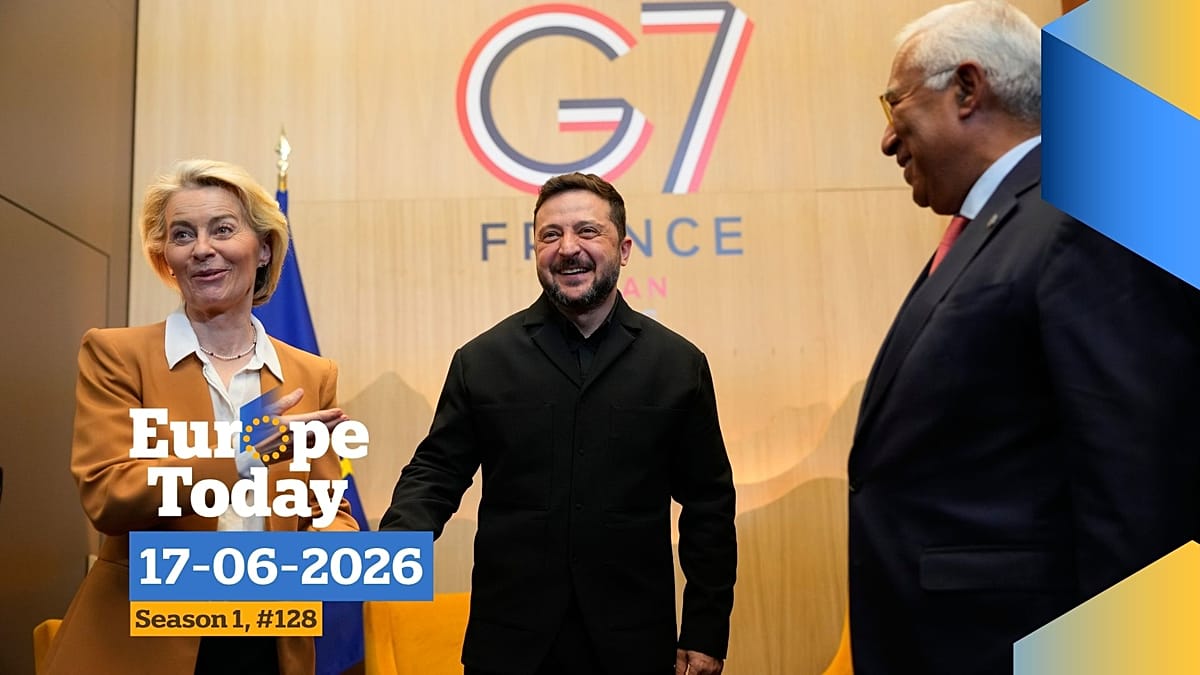
As the G7 summit in Évian-les-Bains entered its third and final day, European leaders intensified their efforts to press US President Donald Trump on the stalled Ukraine peace process. The lakeside French resort became the stage for a series of bilateral meetings and informal exchanges, with EU officials seeking to translate the summit's broad consensus on supporting Kyiv into concrete action.
Euronews correspondent Maria Tadeo reported from the summit venue that the urgency was palpable. "European leaders are using every available moment with President Trump to urge him to break the deadlock on Ukraine," she noted. The discussions come amid growing frustration in European capitals over Washington's wavering commitment to Ukraine's defense, especially as Trump has recently floated a framework deal with Iran that could shift US priorities away from Europe.
The summit also saw a notable moment when German Chancellor-in-waiting Friedrich Merz presented Trump with a personalized football jersey, a gesture that underscored the personal diplomacy at play. Meanwhile, Italian Prime Minister Giorgia Meloni and Trump appeared to patch up a rift that had simmered for weeks, signaling a potential realignment within the G7.
AI and Child Safety: New Commitments on the Table
Beyond Ukraine, the G7 leaders tackled the rapidly evolving field of artificial intelligence. Euronews' Angela Skujins reported that governments and leading tech companies are working on new commitments to improve child safety online. The initiative aims to establish guardrails for AI-driven platforms, which have been criticized for exposing minors to harmful content. European officials, particularly from France and Germany, have pushed for binding standards, though the final communiqué is expected to include voluntary pledges.
The AI discussions reflect a broader European effort to regulate technology without stifling innovation. The European Union's Digital Services Act and AI Act have set a precedent, and the G7 talks in Évian are seen as a step toward aligning global norms with European values.
Ukraine's Path to EU Membership
Former Ukrainian Prime Minister Arseniy Yatsenyuk joined Euronews to discuss Kyiv's dual-track strategy: securing US support for peace while advancing toward European Union membership. "The United States remains a crucial partner, but Europe must take the lead in Ukraine's reconstruction and integration," Yatsenyuk said. He emphasized that Ukraine's EU accession process, which began in earnest after Russia's full-scale invasion, requires sustained political will from all 27 member states.
Yatsenyuk's comments come as the EU prepares for a July summit where a three-way reset deal with the UK is also on the agenda. UK Minister David Lammy expressed confidence that a deal could be secured, potentially reshaping post-Brexit relations.
World Cup Buzz and Austrian Return
In lighter news, the World Cup in Qatar continued to generate headlines, with FIFA President Gianni Infantino becoming one of the most talked-about figures at the tournament. Jakub Janas reported on Infantino's controversial statements, while Euronews' Vincenzo Genovese rounded up the latest action. Austrian MEP Lukas Mandl reacted to Austria's long-awaited return to the World Cup, a moment of national pride that briefly diverted attention from the summit's geopolitical weight.
As the G7 leaders departed Évian, the key takeaways from the summit are expected to shape European policy for months. A full analysis of the six key outcomes is available in our dedicated piece. Meanwhile, the broader context of Russia's diplomatic maneuvers—including President Putin hosting ASEAN leaders in Kazan—serves as a reminder that the G7's unity on Ukraine faces constant tests.
The Évian summit may not have produced a dramatic breakthrough, but it reaffirmed that Europe's network of 27 member states, plus partners like the UK, Switzerland, and Norway, remains the primary driver of continental security and prosperity.