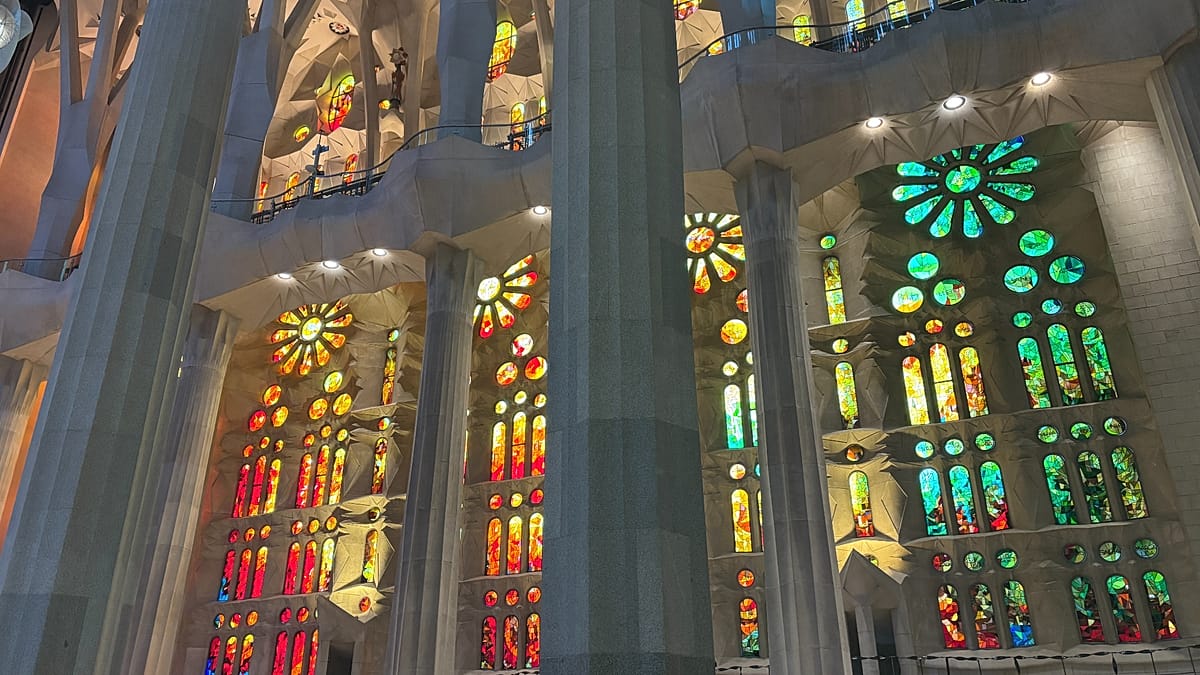
More than a century after Antoni Gaudí's death, newly released documents have shed light on the architect's final wishes. The inventory of his estate, now open to public consultation, reveals that he intended to devote all his assets—from his savings to his home in Parc Güell—to financing the construction of the Sagrada Família in Barcelona.
The inventory, preserved in the Arxiu Històric de Protocols de Barcelona, is a 1926 copy of the will Gaudí signed in 1911 in Puigcerdà. The original was lost in 1936 when the notary's office holding it burned down during the early months of the Spanish Civil War. Among the papers is also the certificate of last wills signed by Manuel Azaña, then a justice official and later president of the Second Republic.
As José Alberto Marín, dean of the Col·legi Notarial de Catalunya, explained, notarial documents are normally subject to protocol secrecy, but once a century has passed they are considered historical records and become accessible to the public.
An inheritance in service of the basilica
The inventory identifies three trusted heirs appointed by Gaudí, a figure specific to Catalan succession law. They were the priest Gil Parés i Vilasau, chaplain custodian of the Sagrada Família; the doctor Pere Santaló i Castellví, a close friend; and Domènec Sugrañes i Gras, an architect and disciple who later took over direction of the works.
The three appeared before notary Luis Rufasta and recorded that Gaudí's express wish was to sell all his assets and hand the proceeds to the construction of the basilica. Sugrañes acted in place of Francesc Berenguer i Mestres, a close collaborator who had died in 1914.
A modest fortune and a single property
The inventory underscores the austerity of Gaudí's final years. His savings were split between two accounts: 1,870 pesetas at the Banco de España in Barcelona and 1,121 pesetas in a savings book at Caixa de Pensions per a la Vellesa i d'Estalvis.
His only property was the house in Parc Güell, in the former municipality of Gràcia, valued by the executors at 45,000 pesetas for a potential sale. According to estimates by the Col·legi Notarial de Catalunya, that sum would be equivalent to around €150,000 today, representing an ordinary level of wealth for the time.
The documents confirm Gaudí's limited attachment to material possessions and his determination to channel all his resources into the project that consumed much of his life. His devotion to the Sagrada Família is well known, but this inventory offers a concrete, legal testament to that commitment.
A document of particular historical value
The significance of the inventory goes beyond its financial content. The destruction of the original will in 1936 makes this copy a key piece for reconstructing the architect's last wishes. In addition, the presence of Manuel Azaña's signature adds a layer of historical interest, linking the document to a pivotal figure in Spanish politics.
After the legal period of 100 years has elapsed, the inventory is now available for consultation at the premises of the Col·legi Notarial de Catalunya, which has kept it in the Arxiu Històric de Protocols de Barcelona. The archive also holds other documents related to Gaudí and the Sagrada Família, including the record of the laying of the basilica's first stone, signed before Gaudí took over the direction of the works.
For those interested in the broader context of Gaudí's legacy, the recent marine reserves expedition off Madeira offers a different kind of European heritage story, while the Hera probe's findings highlight Europe's role in space exploration. Closer to home, the investigation into a deadly Spanish train crash shows how historical documents can also shape modern accountability.
Gaudí's final gift to the Sagrada Família is not just a financial bequest; it is a symbol of his unwavering vision. As the basilica continues to rise, these documents remind us that its construction was, and remains, a collective effort driven by individual devotion.