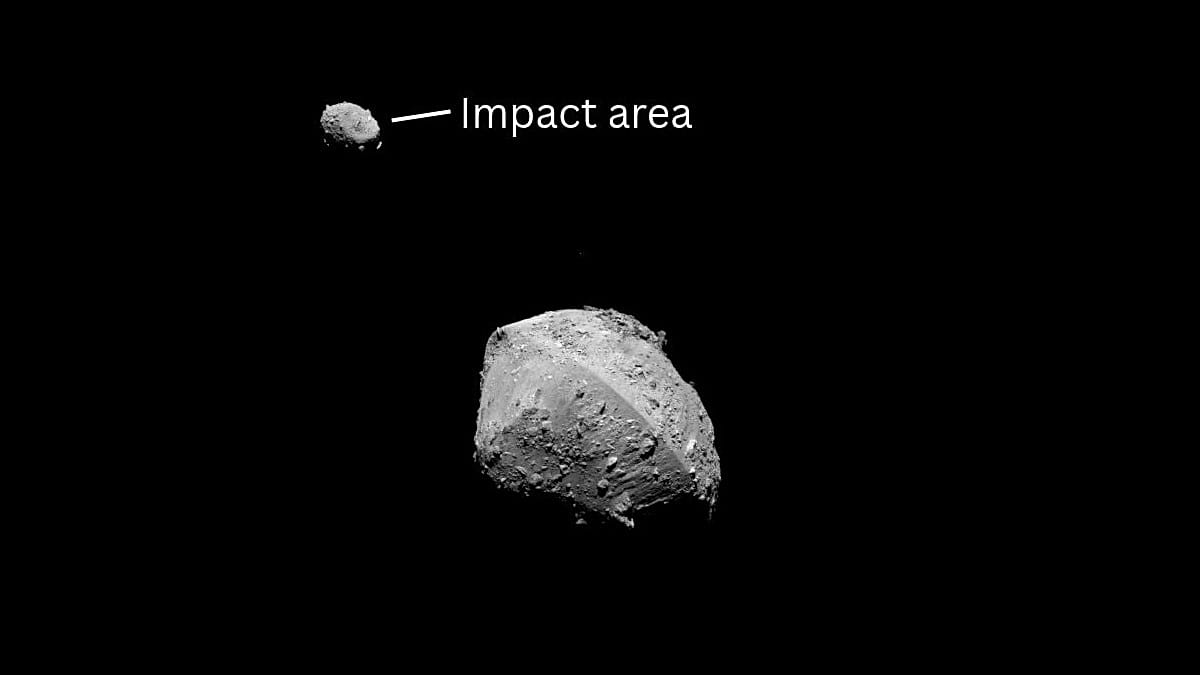
The European Space Agency's Hera mission has beamed back its first close-up views of the asteroid Dimorphos, the 151-metre-wide body that NASA's DART probe deliberately slammed into in 2022. The images, taken from a distance of about 30 kilometres, show a surface transformed by the collision — a vast impact zone surrounded by hundreds of boulders that now drift in the vicinity.
Dimorphos orbits a larger asteroid called Didymos, which appears prominently in the foreground of the new pictures. The pair were chosen for this unprecedented test because they pose no threat to Earth, making them a safe laboratory for studying how to deflect a dangerous asteroid.
The images, with a resolution of 2.7 metres per pixel, reveal an impact scar unlike anything scientists have observed up close. Patrick Michel, principal investigator for the Hera mission, told Euronews: "It's a huge crater, yet it didn't destroy the object, and there are things in the middle of it that we still don't understand."
Perhaps most striking is the swarm of debris — rocks up to a metre across — that now floats around the asteroid. "It's complete chaos," said Ian Carnelli, Hera's project manager. "It's completely different from what our brain would tell us rationally that these rocks should look like and behave."
An unstable spin and a battered surface
Dimorphos appears to be reeling from the impact, its rotation now erratic. "Its rotation around its own axis is very chaotic and very unstable," Michel explained. "It doesn't rotate around a single axis; sometimes the crater on the side facing the direction of rotation is visible, and sometimes it shifts to the other side. So there has also been a significant destabilisation of its rotation."
The Hera spacecraft, which arrived at the binary system in late 2024, will soon deploy two small CubeSats — Juventas and Milani — to fly even closer and study the asteroid's surface, density, and internal structure. The mission team is eager to understand why Dimorphos did not break apart, and they caution against drawing hasty conclusions given how alien these objects are.
"We have six months of investigation ahead of us, with risky operations almost every month. So, it's a bit like an Indiana Jones adventure, full of suspense," Michel said.
Margherita Cardi, who manages the Milani CubeSat, echoed that mix of excitement and anxiety: "It's a nightmare, there's a mix of excitement and panic," she laughed. Milani will have to navigate through the boulder field to map the surface and characterise the dust around the asteroid.
The Hera mission is part of ESA's Space Safety Programme, a broader effort to develop the ability to deflect a threatening asteroid. The success of NASA's DART impact, which shortened Dimorphos's orbit around Didymos by about 33 minutes, has already demonstrated that kinetic deflection works. Now Hera is providing the detailed follow-up needed to understand the full consequences of such a strike.
Carnelli, who spent more than a decade securing funding for the mission, expressed pride in the international cooperation. "I'm really proud to say that for once, space agencies, but also politicians and taxpayers, are taking a natural hazard very seriously. And we're doing something about it, for the good of humanity," he said.
Looking ahead, ESA is preparing the Ramses mission, which will rendezvous with the asteroid Apophis when it passes close to Earth in 2029. Carnelli is also seeking an extension for Hera, which still has ample propellant. "The idea being that we leave in September and we go on a two year journey around the solar system. We visit two more asteroids — flybys — and then we come back to Didymos," he explained.
Returning to the battered rock would allow scientists to observe how its orbit and rotation have evolved over time, and whether the surface structures have shifted or eroded since the impact. Such long-term monitoring is crucial for refining planetary defense strategies.
The Hera mission's findings come as space agencies worldwide step up efforts to protect Earth from potential asteroid impacts. The data gathered here will inform future deflection missions and help ensure that humanity is prepared should a real threat emerge.