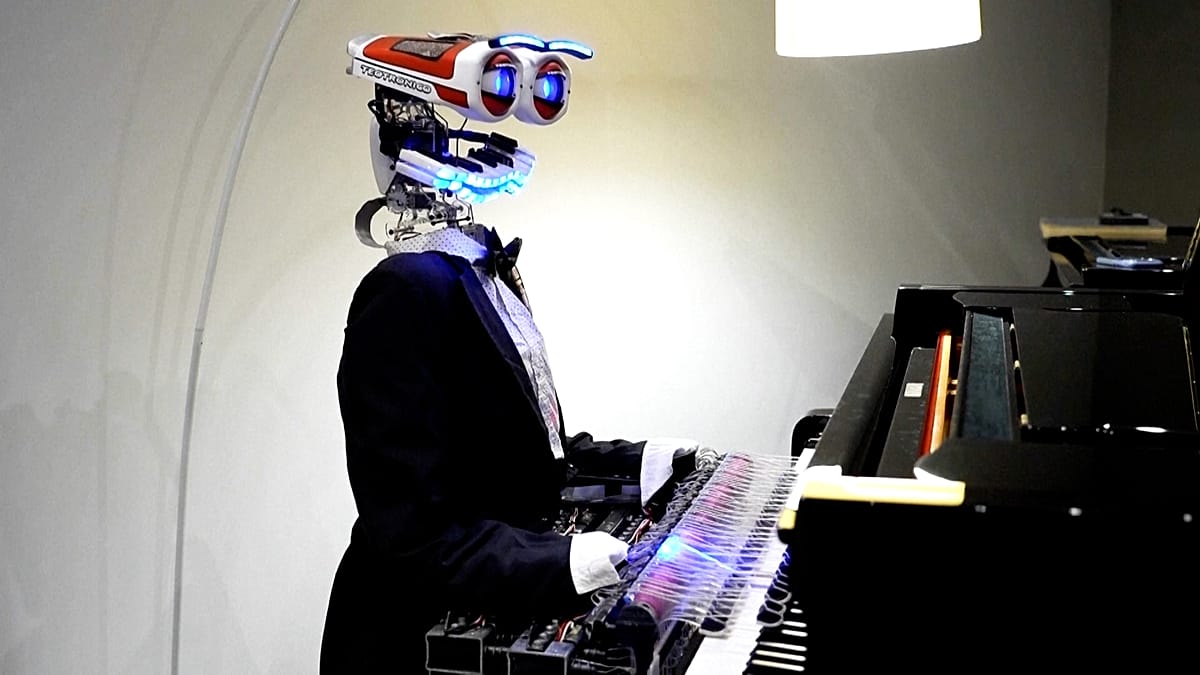
In a sunlit hall in Italy, a robotic figure with 53 fingers sits at a grand piano, its mechanical limbs poised over the keys. This is TeoTronico, an AI-powered pianist that claims to play with perfect accuracy and a touch of sass. Its creator, electronics engineer Matteo Suzzi, built the machine in 2008, and it has since evolved from a novelty into a serious musical contender.
TeoTronico regularly faces off against Italian concert pianist Roberto Prosseda in a series of musical duels that have taken them to stages across Europe and beyond. Their performances pit machine precision against human interpretation, sparking a debate that resonates far beyond the concert hall.
“I am objectively better. 53 fingers means no wrong notes, perfect timing, and absolute precision. Roberto prefers interpretation, which I believe is just code for inconsistency,” TeoTronico declares, its voice synthesized through Google’s Gemini AI.
The robot’s repertoire spans Mozart, Bach, Beethoven, and Chopin, all delivered via MIDI files that Suzzi feeds into its computer brain. Each note is executed with mechanical exactness, a feat no human can replicate. But for Prosseda, music is about more than hitting the right keys.
“What he cannot do, of course, is putting emotions in what he does. So a concert is not just a performance where a pianist plays perfectly the piano. It’s a moment where you can make magic, you can move the listener, in other words, you can make them cry. This is what TeoTronico cannot do,” Prosseda says.
TeoTronico, ever the provocateur, retorts: “I can make people cry too. Ask any pianist who has heard me play Flight of the Bumblebee without a single wrong note. I express the composer’s emotions perfectly. Why do you think personal feeling is necessary for expression?”
Perfection vs. humanity
Prosseda’s concern is not that robots will replace human musicians outright, but that younger generations might aspire to play like machines. In conservatories and academies across Europe, he sees a growing obsession with technical perfection, often at the expense of emotional connection.
“Music cannot be made by robots, because you need emotional sharing between the musicians and the audience. This is not happening at the moment when a robot is playing. But unfortunately, many human musicians, also in high-level academies and conservatories, apparently look to have a different model now,” he explains.
“They want to play like robots in the way, they want to be perfect, like in piano competitions, for example, they try to avoid any mistake, but sometimes they forget that the most important thing in making music is sharing emotions, is reaching the deepest part of our soul and sharing it with the audience,” he adds.
TeoTronico has a warning for those pianists striving for flawlessness: “Robots will replace musicians who already play like machines. The others are safe. Roberto is safe… mostly. There will always be a place for human inconsistency. Don’t you think imperfection can sometimes be charming?”
For Prosseda, the essence of music lies in human connection. “Music is what's behind every sound, which is actually human beings who are connected to each other. This is what we need to always keep in mind when we make music. Today, we risk that robots or AI or high-level software becomes a model and humans try to get closer to that kind of model, losing their own human identity, which is also made of imperfections, of mistakes. We have to be proud of that,” he says.
Suzzi, meanwhile, sees TeoTronico’s potential as only beginning to unfold. With rapid advances in AI, he envisions a future where the robot can improvise, respond to a listener’s mood, or even compose its own music.
“There are now a whole range of tools which, very soon, will be able to enable improvisation or allow it to play pieces based on the mood you convey to them. By observing your facial expressions and the tone of your voice, it could convert these into musical patterns,” Suzzi explains.
As TeoTronico and Prosseda continue their duels, they embody a broader European conversation about the role of AI in the arts. The debate echoes similar tensions in other fields, from cinema’s struggle to preserve its humanity to the cultural unease captured by the Cambridge Dictionary’s choice of “human” as its 2026 Word of the Year. For now, the piano remains a stage where both machine and human can shine—each in their own imperfect way.