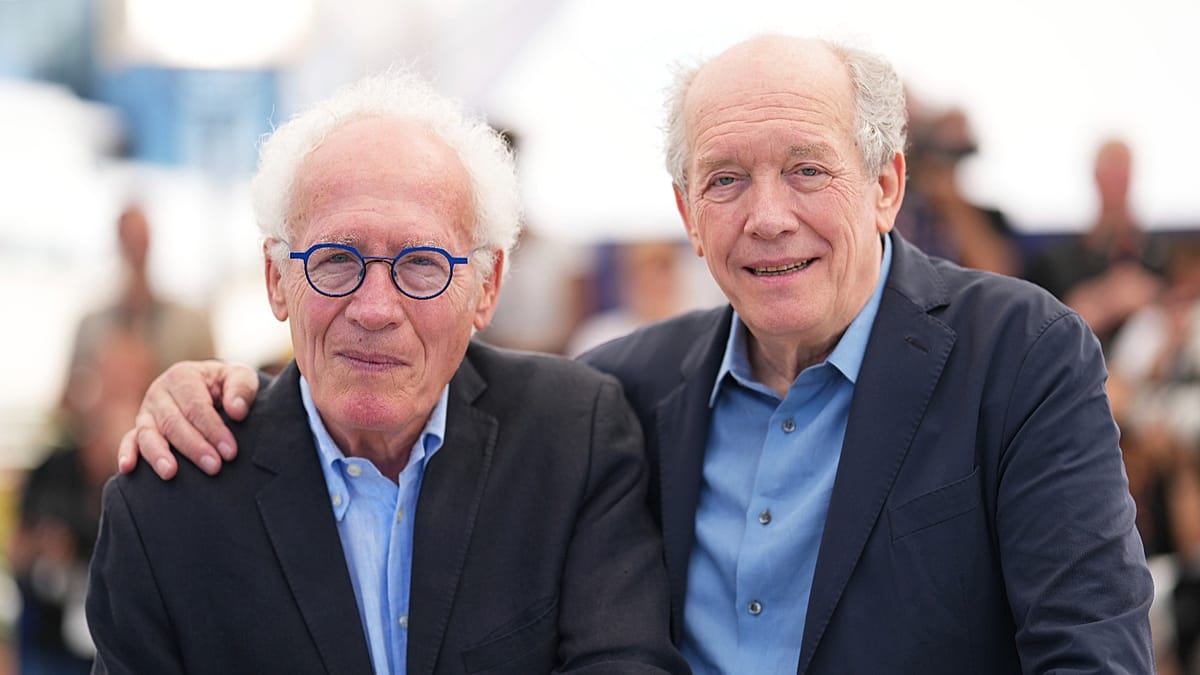
Jean-Pierre and Luc Dardenne, the celebrated Belgian filmmakers behind such humanist dramas as Rosetta and L'Enfant, will receive the European Film Academy's Lifetime Achievement Award in January. The brothers, who have been a defining presence in European independent cinema for nearly four decades, spoke with us about the honour, the enduring power of empathy on screen, and the challenges posed by artificial intelligence.
A career built on continuity and compassion
Luc Dardenne described the award as recognition of a sustained artistic exploration. "It reflects the fact that we've made films that have had a certain continuity," he said. "After a certain time, you can indeed say: 'Well, there's something rather unique about these two brothers who've been making films for about forty years.' Plus, we're European, so the Academy probably thought: 'Right, we should honour them!'"
The brothers have won six prizes at Cannes, including two Palme d'Or for Rosetta (1999) and L'Enfant (2005). Their most recent honour came last year when Jeunes Mères won Best Screenplay on the Croisette. Their European Film Awards history includes the 1997 documentary prize for Gigi, Monica… Et Bianca and the 2011 screenwriting award for Le gamin au vélo.
Cinema as a machine for empathy
When asked about Juliette Binoche's ambition to "rehumanise society through cinema," Jean-Pierre Dardenne was cautious. "One must always be careful with statements, even if they are important," he said. "There are many examples throughout history that show us that cinema hasn't humanised anything at all… But it can contribute to us being human. It can help us become more human."
He pointed to Charlie Chaplin as a benchmark. "There is such generosity in his films, a constant spirit of civil disobedience in the character of the Tramp, and an enormous faith in life," he said. "Chaplin's films are full of life—they're not like funeral dirges."
Luc Dardenne recalled Kenji Mizoguchi's Sancho the Bailiff as a film that sparked "a profound human sense of compassion, friendship and closeness to the victims, the oppressed." He also cited François Truffaut's The Woman Next Door as a work that captures human complexity. "We feel close to these two lovers, close to their story, their inability to love one another and yet love each other," he said. "Beyond this impossibility, we experience something very profound and very human."
European cinema in flux
Asked about the evolution of European cinema, Luc Dardenne described a period of upheaval. "The current situation is complex for European cinema, world cinema, but also for African cinema—because we always tend to forget about it," he said. "For them, however, the situation is more financial and practical in nature."
The brothers' concerns echo broader anxieties across the continent. French cinema, for instance, has warned that proposed budget cuts could kill 400 films by 2027. Meanwhile, the rise of AI poses new threats to the craft. "We need to ensure that there remains a sense of humanity in cinema," Jean-Pierre insisted, stressing the importance of protecting the human element in storytelling.
Their own work, rooted in the industrial landscapes of Liège and the lives of ordinary people, has consistently championed that humanity. As they prepare to be honoured by the European Film Academy, the Dardennes remain a vital reminder of what cinema can achieve when it stays close to the ground.